
Simanaitis Says
On cars, old, new and future; science & technology; vintage airplanes, computer flight simulation of them; Sherlockiana; our English language; travel; and other stuff
MARS—AS TIMELY AS TODAY’S HEADLINES, OR THOSE OF THE LATE 19TH CENTURY, OR THOSE OF MAR’S ORIGIN PART 2
YESTERDAY WE STARTED ANALYZING a cornucopia of things Martian appearing in AAAS Science. We continue today in Part 2 with assessment of Mars’ elemental structure—and, though lacking canals, any signs of biogenic records.
A Radical New Picture. Paul Voosen recounts, “It’s been nearly 3 years since NASA’s InSight mission ended on the surface of Mars, its solar panels smothered in dust. But data from the lander, which captured signals from faint marsquakes to probe the planet’s interior, are still yielding fresh results. Two new studies use InSight data to paint a radical new portrait of Mars.”
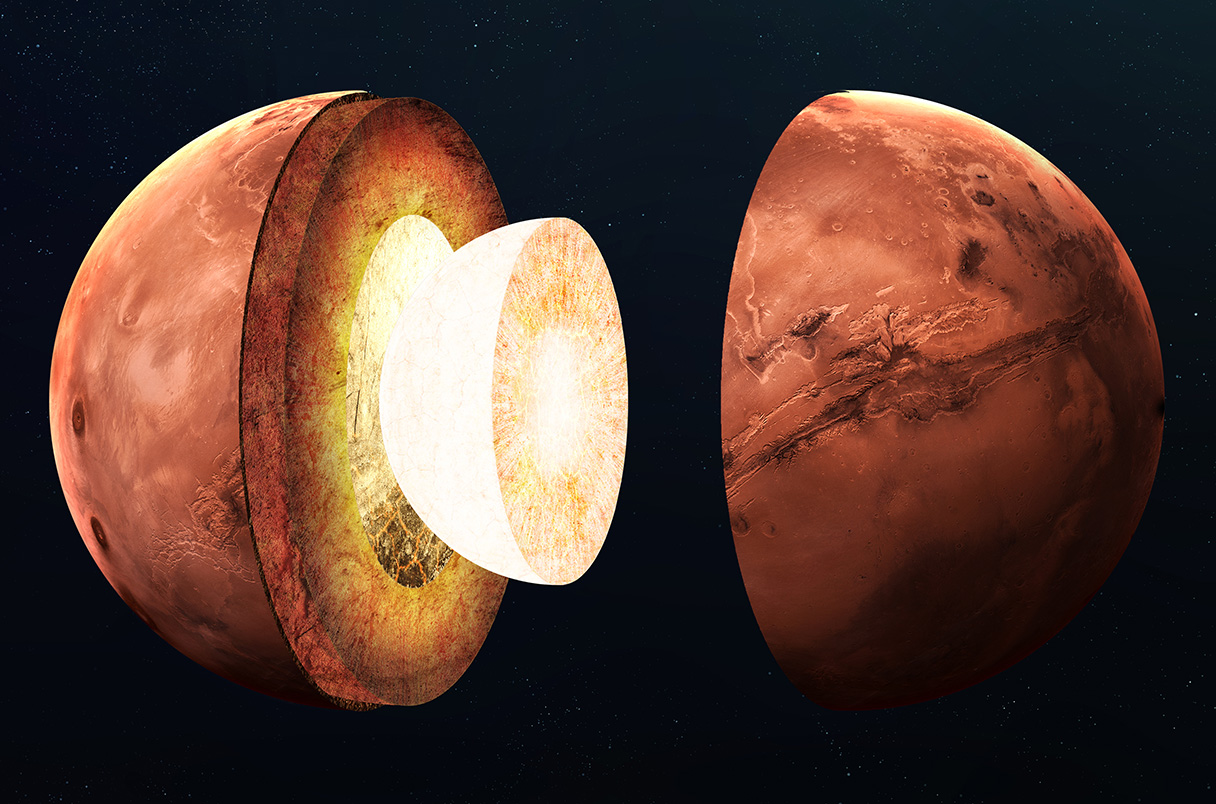
Image by Vadim Sadovski/Shutterstock via Science.
“Taken together,” Voosen recounts, “the findings suggest a planet that is both more, and less, like Earth than researchers expected. The first result, published last week in Science, suggests the martian mantle—the layer of rock that makes up most of its volume—does not ooze and mix like on Earth, but rather preserves the remnants of smaller planetary bodies that collided to form the planet. The second result, published today in Nature, goes deeper, finding that rather than possessing a purely molten metal core, as earlier InSight analyses suggested, Mars—like Earth—has a solid core at its center.”
Life on Mars? Maybe. Maybe Not. Lowe observes, “There are some astrobiology headlines today around this paper from a large team working with the Perseverance rover on Mars. It’s all about a particular sampling region, a valley that has been carved into the wall of Jezero Crater.”

The first full-color image transmitted by Perseverance from Jezero. “A key objective for Perseverance’s mission is astrobiology, including the search for signs of ancient microbial life.” Image and caption from NASA JPL-Caltech via Science.
A Unique Mudstone. Lowe recounts, “Close examination of this showed it to be some variety of mudstone, a sedimentary rock made up of deposits of very fine silt and sand.… The mudstone in this area has plenty of silica, alumina, and iron oxide, but it’s quite low in manganese and magnesium oxides, and that makes it quite different from the Western Fan material (which doesn’t show those latter two elements depleted). The interpretation is that those latter deposits were formed under oxygen-poor conditions.”
Hmm… Silica? Alumina? Iron Oxide? That is, a presence of oxygen.
Lowe continues, “… there are a lot of dark grains in the lighter rock, informally called ‘poppy seeds’ by the team, that are colored dark blue to dark green depending on the light. These seem to be enriched in iron, zinc, and phosphorus, and their spectral properties indicate that they are some sort of iron phosphate mixture in various hydration states.”
Meanwhile, Back on Earth. Lowe observes, “Now here on Earth we have seen this sort of thing happening all the time. Such reduced iron phosphates (such as vivianite and others) and iron sulfides are formed by microbial reduction of iron and sulfates, and this Fe-S metabolism is considered one of the signs of early life in the fossil record.”
Biogenic Or Abiogenic? A Quandary in More Ways Than One. “We definitely need to study these formations more and try to model them here on Earth, but what we need to do for sure is make good on the sample-return part of the Perseverance mission. Bright Angel samples and others are stored on the rover and at cache points on the Martian surface in labeled tubes for eventual retrieval, but the proposals for how to go get them are in a state of expensive disarray. Until we’re able to do that, no one will be sure. Results like these make that an even more important goal.” ds
© Dennis Simanaitis, SimanaitisSays.com, 2025
 Simanaitis Says