
Simanaitis Says
On cars, old, new and future; science & technology; vintage airplanes, computer flight simulation of them; Sherlockiana; our English language; travel; and other stuff
ADMIRING THE ART OF MITCHELL JOHNSON
ART CRITIC DONALD KUSPIT IDENTIFIES THE APPEAL of Mitchell Johnson by noting this artist’s fusion of abstraction and realism. My introduction to Johnson’s oil paintings came from their occasional appearances in The New York Times Magazine.

Mitchell Johnson, South Carolina-born 1964, American artist. Johnson studied at Washington Studio 1987–1988, Parsons School of Design/ The New School, 1990. Image from inmenlo.com.
Google Books recounts that his “color- and shape-driven paintings exist at the intersection of color theory, art history, nostalgia, and observed experience. His work is in the permanent collections of over 35 museums.”

Striped Chair (North Truro), 2025, 24 x 29 inches, oil on canvas, by Mitchell Johnson via an ad appearing in The New York Times Magazine.
Donald Kuspit’s article “Mitchell Johnson: Abstract Realism, Realistic Abstraction,” WHITEHOT MAGAZINE, August 2025, gave me an illuminating lesson in art appreciation. I glean tidbits of it here in appreciation of both artist Johnson and art critic Kuspit.

Kandinsky’s “Two Poles.” Kuspit begins (along with my Bookshop.org link): “More than a century ago, in The Spiritual In Art And Painting in Particular, 1912, Wassily Kandinsky famously argued that the problem of contemporary art was to reconcile the ‘two poles’ of art, ‘the Great Abstraction’ and ‘the Great Realism,’ more particularly the ‘purely artistic’ and ‘objective.’ ”
Kuspit recounts, “Kandinsky realized this goal in his Murnau paintings of 1909, some of interiors, some of landscapes, but abandoned it in 1910, when he made his first abstract improvisations: art has suffered ever since from this split—paid the expressive and aesthetic price ever since.”

Above, Murnau: Houses in the Obermarkt, 1908, one of Kandinsky’s Murnau paintings. Image from Thyssen-Bornemisza Museo Nacional. Below, Improvisation 28 (Second Version), 1912, one of Kandinsky’s abstract improvisations. Image from The Guggenheim New York.

The Complementation of Both. Kuspit notes, “There is no other painter working today who has attained this ideal: Mitchell Johnson’s paintings make it exquisitely clear that the ‘complementation of the abstract by means of the objective and vice versa’ remains the goal of painting….”
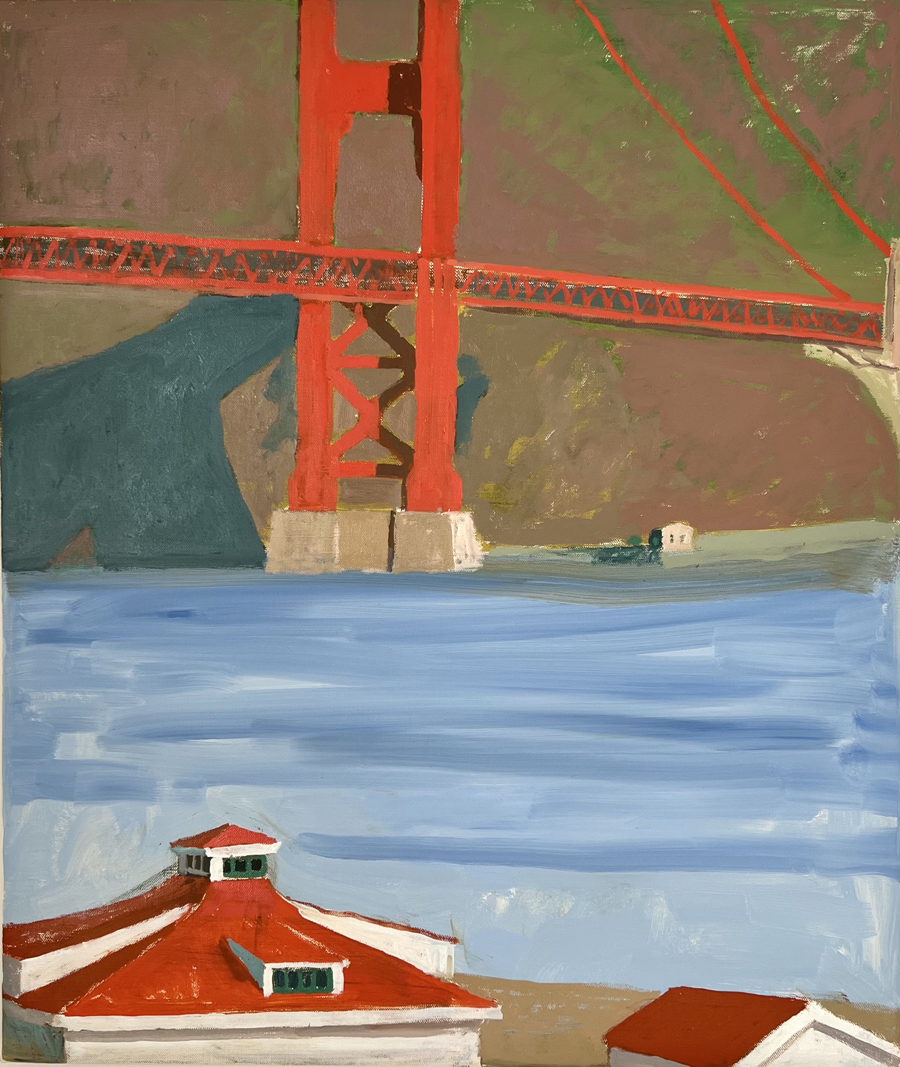
Presidio, by Mitchell Johnson, 2023, 26 x 22 inches, oil on canvas. This and the following images from WHITEHOT MAGAZINE.
Kuspit notes, “Kandinsky argued that it was hard to convincingly integrate red and blue—especially Johnson’s subtle gestural blue and blatantly solid red, but Johnson deftly does so by implying that the spontaneous flow of the blue water, more or less straight linear gestures, has an affinity with the compact curves of the red rooftops.”

Luxembourg Dogs, by Mitchell Johnson, 2022-2023, 16 x 26 inches, oil on canvas.
“It is an ingenious juggling act,” Kuspit recounts, “all the more daring in Luxembourg Dogs. The spatial collapsing of that work—foreground dog’s brown head, its body out of the picture, making it more emphatically present, and background with a tiny, barely decipherable dog on a thin leash held by a man in a blue coat, is a tour de force of mannerist painting, as its distorted perspective and space make clear.”

Orange Boat, by Mitchell Johnson, 2020-2023, 58 x 75 inches, oil on canvas.
Kuspit says, “Orange Boat, abruptly contrasting with a bright blue sea, and a child in pale dress and rower in blue pants, the yellow in the child’s blonde hair and in the rower’s hat suggesting their closeness, is a particularly tender-minded work in Johnson’s oeuvre.”
In fact, it’s one of my favorites.
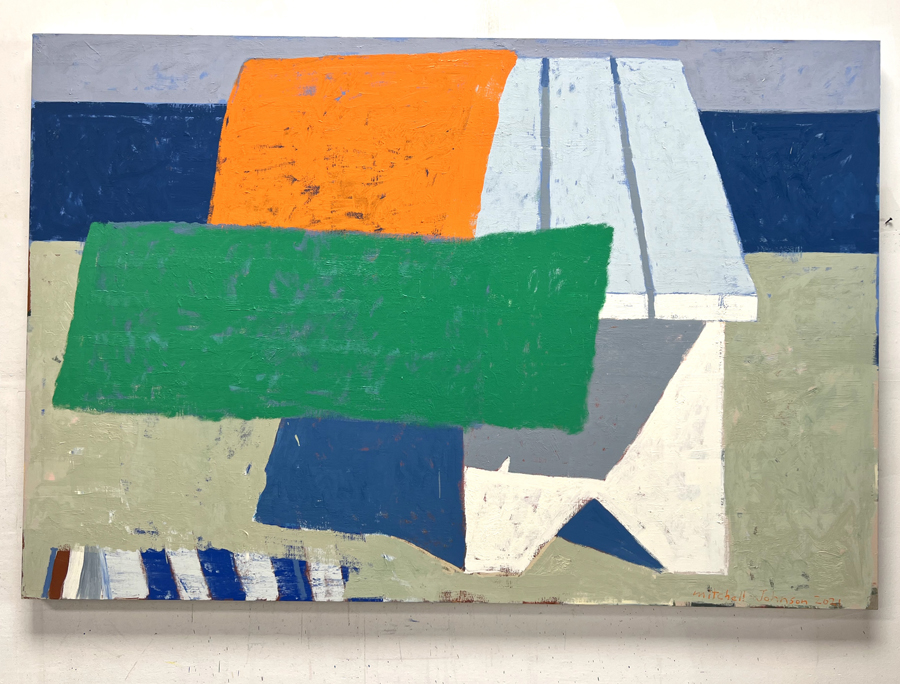
Monaco, by Mitchell Johnson, 2019-2023, 58 x 84 inches, oil on canvas.
Discussing one of Johnson’s more abstract paintings, Kuspit says, “Monaco is not just a luxurious place with a beautiful beach on the Mediterranean, but fraught with tension, as the contradiction between the orange, green, and blue planes, along with the plane of white table they flank and overlap, makes clear. Johnson is a master of abstraction, as his oddly constructivist paintings show, but of unconscious feeling, for his geometry serves to contain and with that control the strong feelings implicit in his strong colors.”
Historically Important. “Apart from that,” Kuspit concludes, “his paintings are art historically important, because they seamlessly fuse abstraction and realism, which Kandinsky tore apart to the detriment of both even as he recognized that they were implicitly inseparable, tied together in a Gordian knot, as they masterfully are in Johnson’s paintings.”
This leaves me with a new appreciation of art, prompted as I mentioned from Mitchell Johnson’s works appearing in The New York Times. Thanks, NYT; thanks, artist Johnson, and thanks, art critic Kuspit. ds
© Dennis Simanaitis, SimanaitisSays.com, 2025
 Simanaitis Says