
Simanaitis Says
On cars, old, new and future; science & technology; vintage airplanes, computer flight simulation of them; Sherlockiana; our English language; travel; and other stuff
THE 1927 TARGA FLORIO—AT THE CHECKER BUGATTIS ARE 5 FOR 8, ANOTHER BUG IN A GARDEN PART 2
PART 1 YESTERDAY BEGAN our review of the Targa Florio with details of two women competing in the event, the Baronessa Maria Avanzo in 1920 and Elizabeth Junek in 1927. Here in Part 2 we focus on the 1927 event as described in Pur Sang, a publication of the American Bugatti Club.
Back to the 1927 Targa. Pur Sang’s Vol. 40 Summer 2000 No. 3 contains an article about the 1927 Targa Florio written by Tom Clifford. He recounted, “The first appearance of the Type 37A Bugatti was at the Targa Florio on 24 April 1927. Count Conelli and Louis Charvel ‘Sabipa’ entered T37A’s under their own names.”
“As both were team drivers,” Clifford said, “it is likely that these were team cars on loan. It is possible that they were two of the six T37As delivered to Italy in May (37269 through 37274).”
Hugh Conway’s Bugatti Magnum identifies these six of the nine Type 37s delivered to Albert Musy of Turin.
“Caberto Conelli’s T37A had race number 6,” Clifford continued, “and he drove an excellent race, finishing in second place overall and first place in the 1500cc category. The car had small brakes and the second spare wheel carrier on the driver’s side. The front valence had three rows of four louvers.”
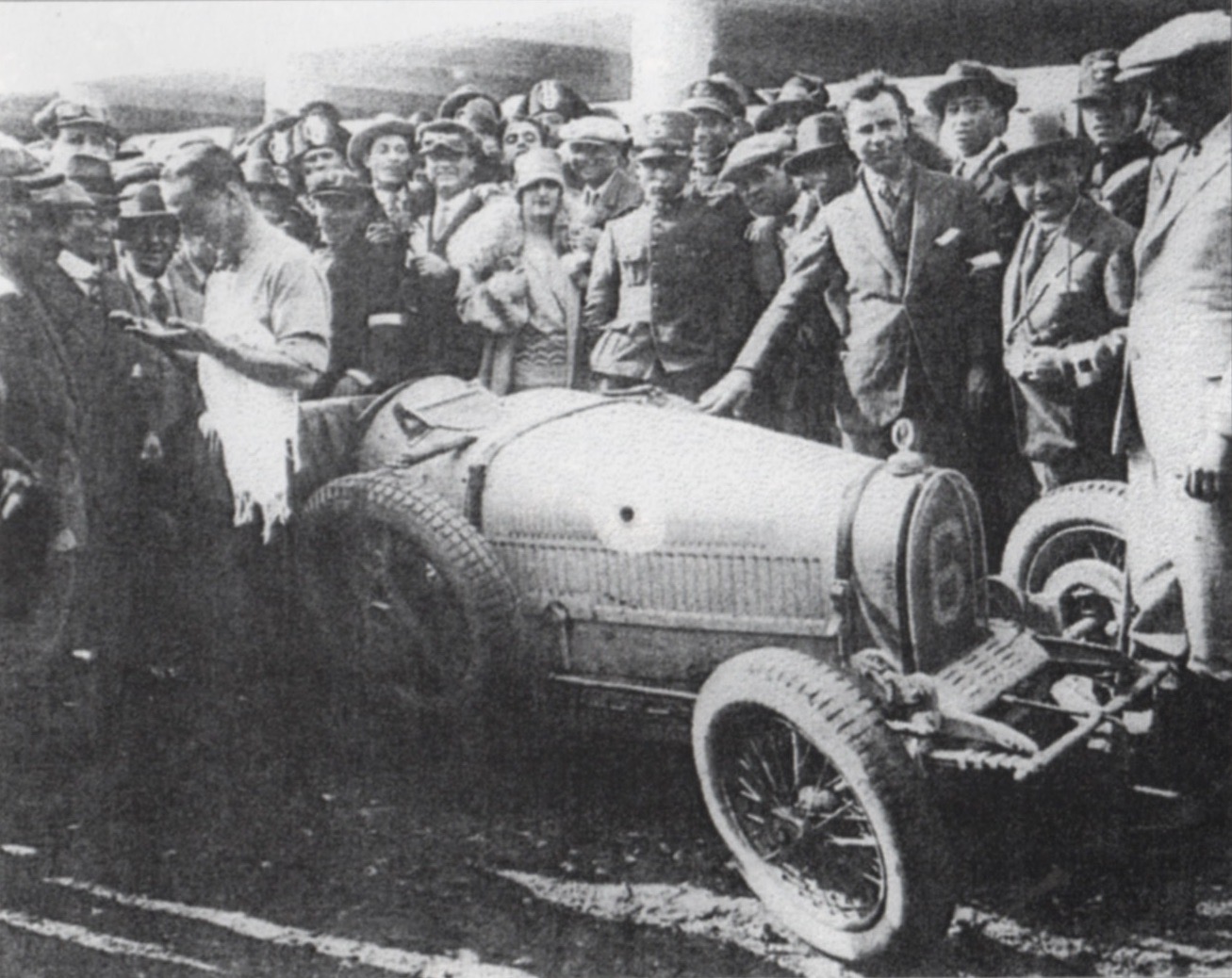
Conelli’s Type 37A. This and the following images from Pur Sang.
A Wide Radiator and More Louver Counting. Clifford described, “Sabipa raced T37A number 4. The car had small brakes, a second spare wheel on the driver’s side, and no mirror. A very unusual feature was that the car had a wide ‘Targa’ radiator. The front valence also had two rows of three louvers with a center row of two louvers and two flanking rows of two louvers.”
These louver details were apparently clues for identifying one hand-built Bugatti from another.

Sabipa’s T37A. (There’s a tale concerning the surrounding cultivation.)
Sabipa’s Adventure. “Unfortunately,” Clifford related, “Sabipa crashed on the first lap. From W. F. Bradley’s book Targa Florio we have the following account:”
“… on a right-hand bend, near the bottom of a hill, Sabipa said, ‘I went over there.’ We looked around in vain for any signs of a car or for traces of a car having skidded off the road,’ ” Bradley wrote.
Bradley continued, “We had reached a fertile valley with olive groves and cultivated patches, the road, unlike most of the circuit, being hemmed in with bushes. Sabipa found a gap in the bushes and pointed ahead to his car standing 50 feet below in the rich brown soil of a garden with fruit trees in full blossom as a framework.”

Bradley’s commentary continued: “He had forgotten where to go slowly, for on this bend he hit a boulder, burst a front tire, leaped a 3-foot ditch, then executed a beautiful vol plane [French: “gliding flight”] on the soft ground of the garden where the car came to a standstill on its four wheels with little perceptible injury and no injury to the driver.”
Whew. Quite a debut for a Type 37A. Thanks, Tom Clifford and Pur Sang, for preserving the tale. ds
© Dennis Simanaitis, SimanaitisSays.com, 2025
 Simanaitis Says