
Simanaitis Says
On cars, old, new and future; science & technology; vintage airplanes, computer flight simulation of them; Sherlockiana; our English language; travel; and other stuff
GIVING A.I. WISDOM AND MATURITY
A.I. PIONEER DE KAI recognizes that Artificial Intelligence is still in its infancy requiring careful and thoughtful rearing.
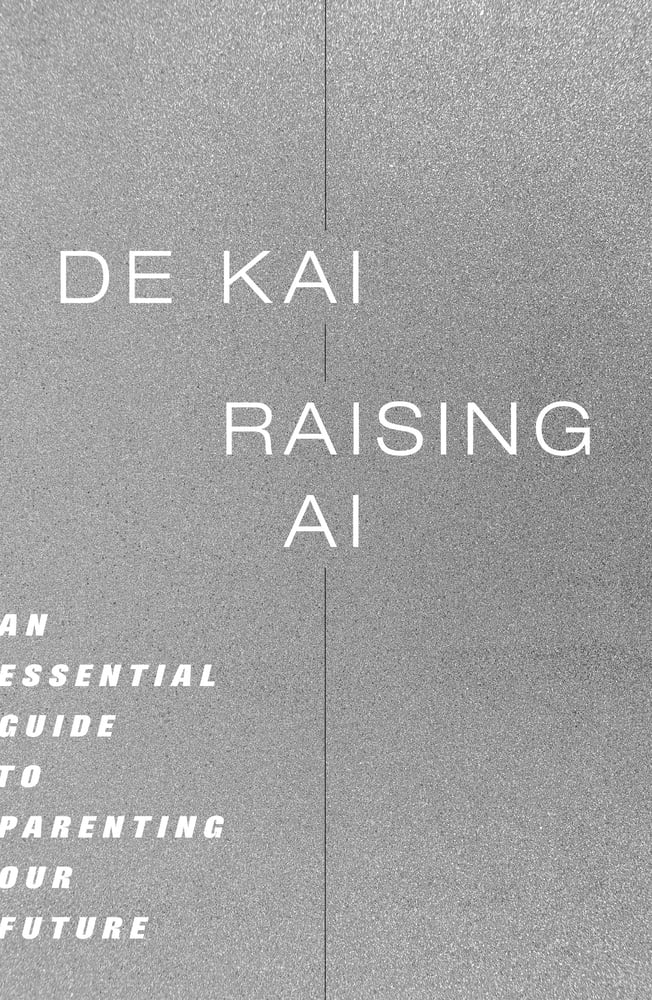
Raising A.I.: An Essential Guide to Parenting Our Future, by De Kai, MIT Press, 2025.
His website cites De Kai Wu holding a joint appointment at Hong Kong University of Science and Technology, Department of Computer Science and Engineering, and at University of California, Berkeley’s International Computer Science Institute. He is also Independent Director of the A.I. ethics think tank The Future Society.

In “Following in Our Footsteps,” AAAS Science, July 10, 2025, Adrian Woolfson reviews De Kai’s book Raising A.I. “Nurturing A.I. while it is young,” Woolfson observes, “will help it achieve an ethical adulthood.”
Akin to Raising Kids. Woolfson posits, “Although not biological, A.I. systems, like their natural counterparts, are malleable, vulnerable, and deeply impressionable. They possess, he [De Kai] argues, something akin to ‘psychologies.’ And as with children, how we ‘raise’ them—design, train, and engage them—will determine their ethical and moral trajectories.”
Artificial Empathy. “This,” Woolfson quotes De Kai, “will involve defining strategies that engender them with Enlightenment values, cultivating ethical reasoning, the emergence of ‘artificial empathy,’ and fostering what he calls ‘artificial mindfulness.’ A.I., in short, needs to ‘feel how it’s thinking.’ ”

Image by Ryzhi/Stock via Science.
Nurturing A.I. Woolf cites De Kai, “If we succeed, ‘there is a path to a flourishing future.’ The consequences of failure could be catastrophic. Without a compensatory ‘cultural hyperevolution,’ A.I. could undermine individual liberty, foster societal collapse, challenge the integrity of democracies, and threaten the survival of humankind itself. De Kai calls on each of us to ‘step up to our individual responsibilities as parental guardians and role models for the A.I.s who mimic and amplify our own behavior’ and to learn how to ‘nurture’ them.”
Otherwise…. Woolfson observes, “The ‘dawning A.I. civilization’—a hybrid of natural and artificial intelligences—is, De Kai reminds readers, largely unregulated, profoundly opaque, and dominated by the interests of a handful of profit-maximizing tech behemoths. The artificial children they have unleashed are often ill-mannered and unruly, lacking introspection, empathy, and a coherent moral compass.”
Distrusting empathy? Where have we heard that before?
“Unlike the rule-based A.I. of the past,” says Woolfson, “these newer A.I.s, based on large language models, are probabilistic and analog. They acquire knowledge through training on huge datasets, but their learning is constrained by proprietary algorithms and entrenched biases.”
Sorta GIGO combined with greed and bonkers.
Precocious Kids. “The result,” Woolfson observes, “is that these poorly schooled and parented A.I.s amplify our worst tendencies. Exploiting intrinsic human cognitive biases, they often reinforce and promote fear, polarization, disinformation, populism, prejudice, irrationalism, radicalization, groupthink, and tribalism…. They are, De Kai argues, reminiscent of precocious children, but with greater reach. They are the ‘artificial influencers’ of our emerging ‘artificial society.’ ”
Inclusive, Empathetic, and Enlightened. Woolfson asks, “So how, at a practical level, can we produce mindful A.I.s that are inclusive, empathic, and embody Enlightenment values?”
Not Goliath, But David. De Kai feels that machines—and humans—need to be culturally educated. Woolfson writes, “This new hybrid would guide the automatic, hallucinating, pseudo-intelligence of current A.I., substituting the monolithic, data-hungry ‘Goliath’ intelligence of today’s generative A.I.s with context-aware ‘David’ intelligence—capable of learning from select, much smaller datasets.”
Our Kids Are Already Learning. This last idea—learning from select, much smaller datasets—is extremely important and something already being applied. See “Let’s Celebrate the Frogs of Calaveras—and A.I.,” here at SimanaitisSays earlier this week. There, it was a dataset of specific frog audibles being analyzed, not an Internet scraping of possibly misinformation, irrelevant ideologies, and hallucinations.
The California Red-legged Frogs are helping in this rearing and education of A.I. ds
© Dennis Simanaitis, SimanaitisSays.com, 2025
 Simanaitis Says
Let us hope De Kai’s right. If so, and we can press AI developers to so heed, the above is the best news re: AI we’ve seen.