
Simanaitis Says
On cars, old, new and future; science & technology; vintage airplanes, computer flight simulation of them; Sherlockiana; our English language; travel; and other stuff
CABLING ELECTRICITY UNDERSEA
“ELECTRIC POWER IS NO LONGER THE HUMDRUM INDUSTRY IT USED TO BE,” writes Stanley Reed in “How The Deep Sea Cables That Power The World Are Made,” The New York Times, July 14, 2025. Here are tidbits gleaned from this interesting article, together with my usual Internet sleuthing.

An Old Business. In 1879 the Italian firm Pirelli Cavi e Sistemi was formed, only seven years after Giovanni Battista Pirelli established a business specializing in products of elastic rubber. In 1881 Cavi e Sistemi (Cables and Systems) began producing submarine telegraph cables. It wasn’t until 1885 that Pirelli made carriage springs of elastomeric material; its first tires for velocipedes (we’d call them bicycles) appeared in 1894.

And A Growing One. Cable production continued—and continues to be—a major part of Pirelli. Today Wikipedia notes of its Goldman Sachs spinoff, “Prysmian S.p.A. is a multinational company with headquarters in Milan, Italy, specialising in the production of electrical cable for use in the energy and telecom sectors and for optical fibres.”
Prysmian has operations in Europe with 48 plants, 23 in North America, 13 in Latin America, 13 in the Asia-Pacific region, and 7 in the Middle East, Africa, and Turkey. It’s the world leader in the production of cables for wind farms.
Demand Far Outrunning Supply. Stanley Reed recounts, “This complex in Pikkala, on the outskirts of Helsinki, the Finnish capital, is one of the few places in the world that can produce conduits with the capacity to link countries and the durability to withstand the rigors of the ocean depths.… Undersea routes are often the preferred option for sharing power between countries or simply keeping cables out of sight.”
Conducting Electricity. Reed observes, “The market is so tight, experts say, because making these high-capacity cables is difficult and time-consuming. To form the cores that conduct electricity, as many as 161 strands of copper or aluminum need to be wrapped together. At the factory, these wires—often three to a cable—are encased in polyethylene insulation, jacketed in plastic and lead, and armored with a metal sheath.”

Production in Medieval Towers. “It is more efficient,” Reed learned, “to make the cables if they are hanging vertically so manufacturing lines run up medieval-looking towers. The Finnish plant, which has about 510 employees, recently added one more than 600 feet high to increase production to around 1,150 miles a year.”

The tower at the cable plant is the tallest building in Finland.
Loaded Aboard Ship. “Over a week’s time,” Reed describes, “about 80 miles of high-voltage cable snaked out from a factory to the boat, where it was coiled into tall stacks on big turntables. After loading the cable, the Monna Lisa headed across the Atlantic Ocean to help hook up a wind farm being built off the coast of Virginia.”

Above, spools of cable awaiting shipboard. Below, loaded in readiness for cable installation.

A Multi-Functional Plow. Reed describes, “When laying cable, the powerful boat pulls a plow that, with the aid of water jets, digs a trench as deep as 16 feet and simultaneously buries it, giving some protection against accidents like dragged anchors or deliberate sabotage. Last year, a power cable and communications links connecting Finland to other countries around the Baltic Sea were severed by a ship dragging anchor.”

Above, the Monna Lisa’s plow; below, its water jets that dig the cable trench.
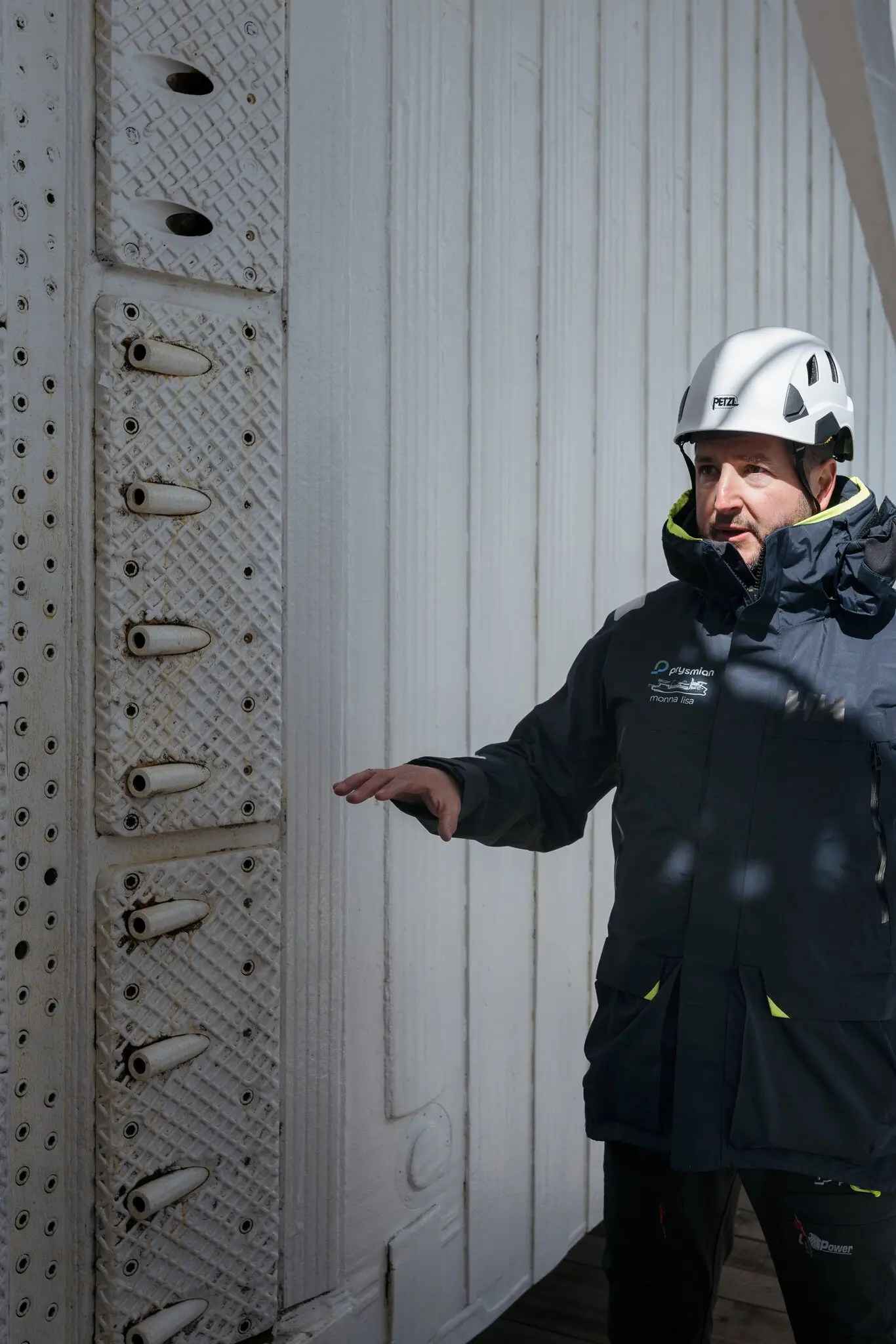
“Smart” Cables. Reed notes, “The growing importance of these cables creates ‘vulnerabilities’ that the company is trying to reduce through means like embedding sensors in the cables for early warning and having a repair ship on standby.”
He adds, “A remote-controlled vehicle makes sure the cables are following the planned route. Powerful motors and a sophisticated guidance system help the boat hold its position when the weather becomes too rough, preserving the cable and saving time and money.”
An Expanding Market. Electrification of the world’s mobility and intensive electric demands of A.I. are forming an expanding market for Prysmian. The firm is “basically sold out through 2028,” Reed learns. And “orders on the books for these conduits, which can carry up to two gigawatts of power, have jumped to around €17 billion from €2 billion five years ago.”
That should surely keep those medieval towers humming. Thanks, Stanley Reed, for the tour. ds
© Dennis Simanaitis, SimanaitisSays.com, 2025
 Simanaitis Says
Fascinating, thank you. We know copper’s expensive and oft purloined, but we’d think anything so vital as this intercontinental power distribution would demand nothing but: “To form the cores that conduct electricity, as many as 161 strands of copper or aluminum need to be wrapped together.” From 1965-72, many US homes new or renovated were given cheaper, softer aluminum wire which expands and contracts more than copper, connections can become loose, and it’s also prone to aluminum oxide, while copper merely forms a patina. Aluminum wire in homes is 55 times more likely to host a fire hazard.