
Simanaitis Says
On cars, old, new and future; science & technology; vintage airplanes, computer flight simulation of them; Sherlockiana; our English language; travel; and other stuff
OPERA—PARK AND BARK, VERISMO, BUT ALWAYS RIDING THE RAZOR EDGE OF ABSURDITY
IN HER A MAD LOVE: AN INTRODUCTION TO OPERA, Vivien Schweitzer describes “park and bark” singers as those “who mostly stand immobile, or limit themselves to stock gestures, as was common in the past.” There’s also verismo, which she calls “a soap-opera snapshot of human nature at its most elemental.” Nor does she overlook unconventional settings for traditional operatic fare. All mad love—and good fun.
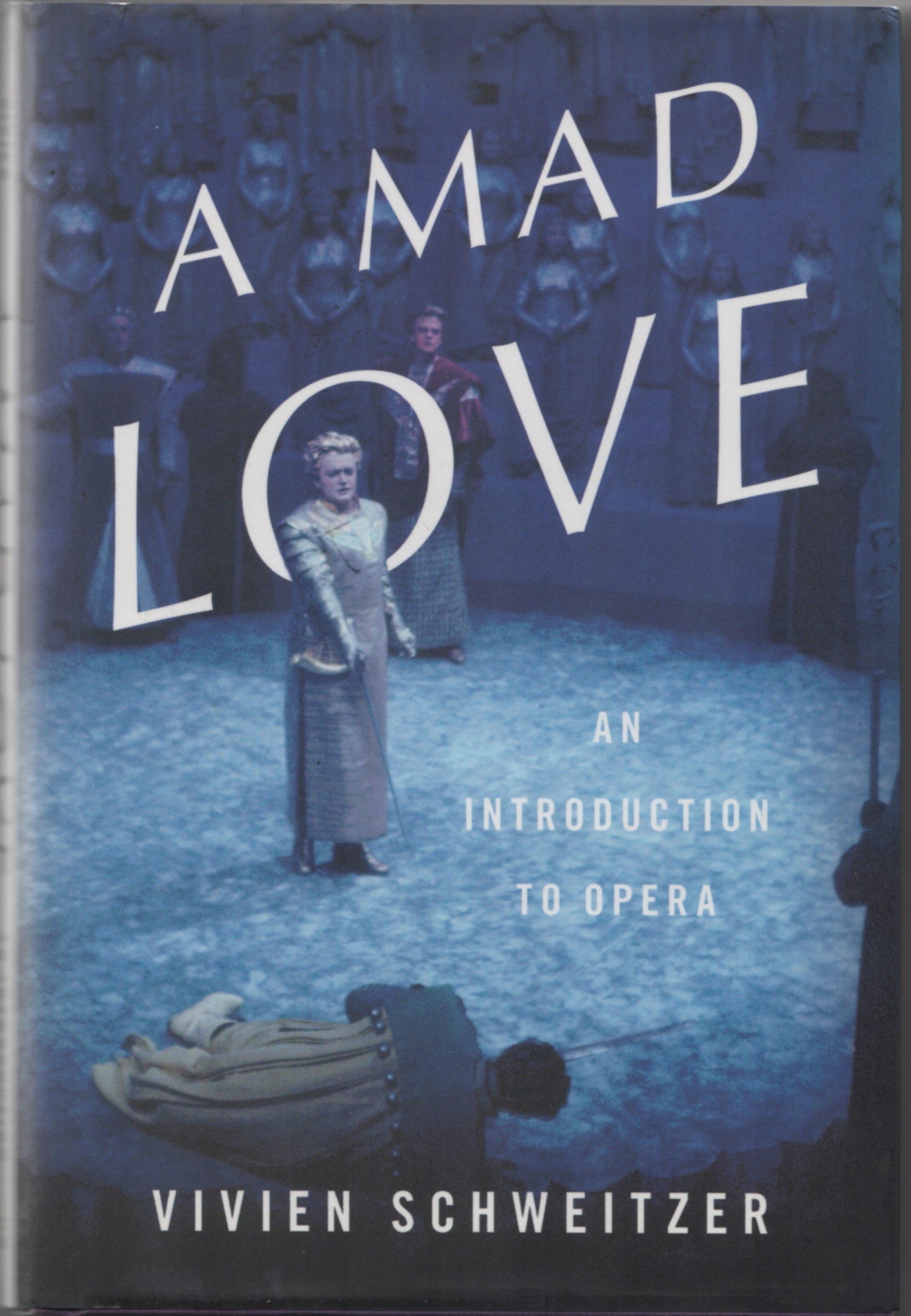
A Mad Love: An Introduction to Opera, by Vivien Schweitzer, Basic Books, 2018.
Varied Genre. I’ve enjoyed opera of varied genre: For example, Pacific Opera Project’s Magic Flute is set in the video-game world of “Super Mario Brothers,” “Donkey Kong,” and “The Legend of Zelda.”

Papageno and Pamina in POP’s Magic Flute.
By contrast, other productions are done so traditionally as to fit “park and bark” (aka “stand and shout”). Schweitzer quotes Joan Sutherland (often criticized for her lack of acting ability) who said, “If you want to see a wonderful actress, you go to see a straight play.”
Opera’s Razor Edge. I’ve always savored Peter Ustinov’s view that “opera rides the razor edge of absurdity.” Schweitzer offers, “In 1888, Tchaikovsky wrote in his diary that he had “never encountered anything more false and foolish than the effort to get truth into opera. In opera everything is based upon the not-true.”
Schweitzer continues, “Which means that a fifty-year-old might be convincing as a teenage consumptive, or a portly middle-aged man as an ardent young lover. If the ‘truth’ lies in the emotions the singer conveys with his or her voice, then it really doesn’t matter what the singer looks like.”

Image from “The Art of Kabuki.”
A Kabuki Lohengrin. Schweitzer describes, “For his production of Wagner’s Lohengrin, the director Robert Wilson asked the singers to move while enacting stylized poses that resembled kabuki, a type of Japanese dance-drama. Wilson was loudly booed at the premiere in 1998, but the production—an abstract staging featuring a haze of blue lighting—was more positively received at its revival in 2006. Some of the singers (including [Karita] Mattila) who sang in Wilson’s Lohengrin lamented the physical demands of the staging on the performers, who had to sing difficult roles while carrying out Wilson’s extremely slow stylized hand and arm movements.”
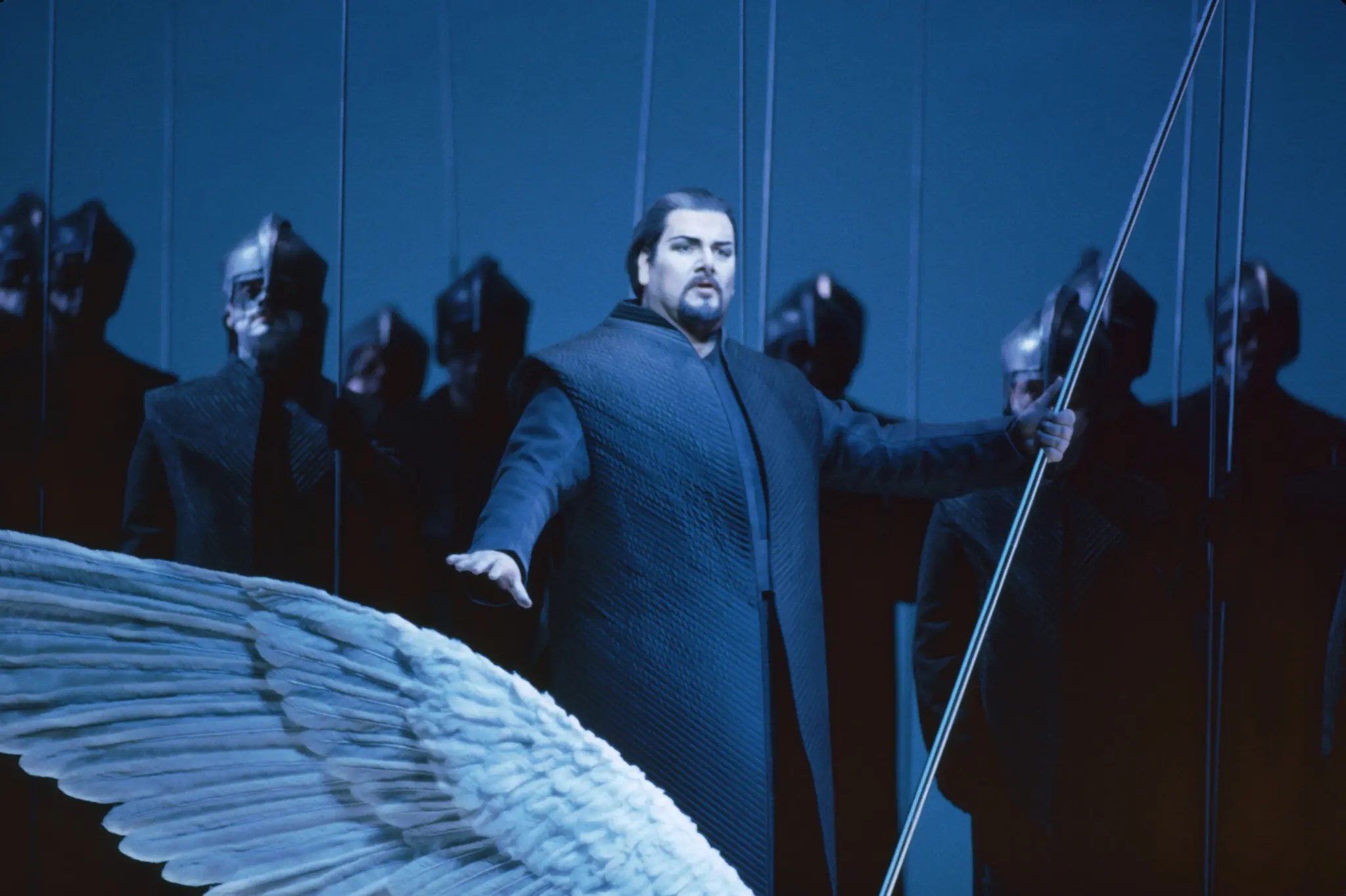
Tenor Ben Heppner sang Lohengrin in the Wilson production. Image from The Metropolitan Opera via The New York Times.
A Bunraku Madama Butterfly. Daughter Suz and I recall this one from our Met HD theater attendance: Schweitzer recounts, “The first time I saw Anthony Minghella’s production of Madama Butterfly (which originated at the English National Opera in London), I was perplexed by the Bunraku puppet that was used to portray Butterfly’s son—usually the role is enacted by a little boy.”
“I was distracted,” Schweitzer says, “by the three men in black who manipulated the puppet on stage.”

Madama Butterfly, her son Sorrow, and invisible puppeteers. Image from The New York Times.
Daughter Suz and I, Kabuki fans, understood that the trio’s black attire served to render them invisible. And, Schweitzer notes, “When I saw the production a few years later, the puppet seemed a reasonable and believable component of the opera.”
An American Ring Cycle. Schweitzer recounts, “A staging by the American director Francesca Zambello, presented most recently at the Washington National Opera in 2016, proved both visually stunning and psychologically insightful.”

Gordon Hawkins as Alberich. This and the following image by Scott Suchman/operawarhorses.com
“Das Rheingold,” describes Schweitzer, “is set in Gold Rush-era California, where Alberich is panning for gold. As the cycle unfolds, the environmental purity of the nineteenth-century American West degenerates into widespread ecological destruction, and the gods’ fight to maintain power becomes a metaphor for the struggle between the one percent and the economic underclass.”
“The Nibelungs,” Schweitzer describes, “are portrayed as suffering workers instead of manipulative dwarves. Wotan is a greedy businessman who signs shady real estate deals, presiding over his empire from a Manhattan skyscraper. At the end of this Das Rheingold, the gods, dressed in early twentieth-century finery, ascend to Valhalla via a gangplank of a ship that could be the doomed Titanic.”
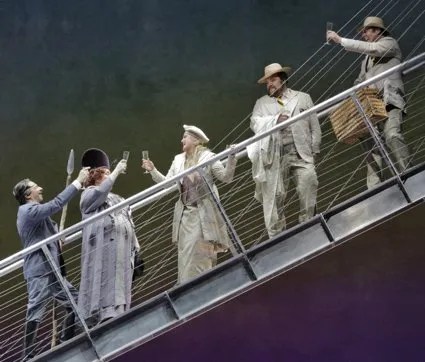
Onward to Valhalla, the Zambello Ring Cycle revival, 2018.
Schweitzer continues, “In Act II of Die Walküre, Siegmund and Sieglinde flee the wrathful Hunding and take shelter under a decaying interstate overpass. Siegfried takes place in a desolate landscape in which a grimy trailer is parked near a trash heap and a decaying power plant; in Götterdämmerung, the Rhinemaidens see their river polluted and destroyed.”
Gee, I suspect this particular Ring Cycle won’t be revived under Trump’s tutelage of National Arts.
© Dennis Simanaitis, SimanaitisSays.com, 2025
 Simanaitis Says
Let me mention Bomarzo, an opera in two acts by the Argentinian composer Alberto Ginastera. Opening at the Washington National Theater in ’67, it was promoted as the first “Rock Opera” but the whispering in the local entertainment media of it being a “sextravaganza” ensured a sold out run before going to Broadway.My girlfriend of the time was one of the dancing, prancing chorus, and while titillating, you see sexier stuff today on PBS … maybe Sesame Street!Still, deemed too risque’ for the Argentinian revolving door Dictator Ongania of the time, a gala run there was killed … relegating the opera to sporadic revivals.IMHO, formulaic story, but expensive and exotic to stage.
Thanks for sharing this, Bob. “Bomarzo” certainly fits Ustinov’s “riding the razor edge of absurdity.” Wikipedia makes it sound almost normal. On the other hand, its YouTube trailer makes the razor edge sure look gloomy. Me, I like my sex with an occasional smile.
Pingback: RENÉE’S COSÌ—AND OTHERS PART 2 | Simanaitis Says