
Simanaitis Says
On cars, old, new and future; science & technology; vintage airplanes, computer flight simulation of them; Sherlockiana; our English language; travel; and other stuff
REPARTEE ON AND OFF STAGE AND SCREEN
ENOUGH WITH POLITICS; THERE HAS BEEN PLENTY of great dissing in other areas. Dr. Mardy Grothe has a fine collection in Viva La Repartee, tidbits from which are offered here occasionally enhanced by my usual Internet sleuthing.

Viva La Repartee: Clever Comebacks & Witty Retorts From History’s Great Wits & Wordsmiths, by Dr. Mardy Grothe, Harper, 2009.
Farnum’s Vanity, Herford’s Repost. Dustin Farnum was America’s first matinee idol, pulling down more than $10,000/week back in 1914 in Cecil B. DeMille’s The Squaw Man. Humorist Oliver Herford asked the notoriously vain Farnum, “How are things going?”
The latter gushed, “I’ve never been better. My new play is a smash hit. Why, only yesterday I had the audience glued to their seats.”
Herford said, “How clever of you to think of it.”
Orson’s Shadow. This reminds me of the play Orson’s Shadow, when Orson Welles objects to drama critic Kenneth Tynan telling him Chimes at Midnight is playing to empty houses. “These are the kind of rumors that destroy my life. Where and when did you hear the rumor that I’ve been playing to empty houses? ,” demands Orson. “I heard it tonight from the other member of the audience,” says Tynan.

Image from L.A. Theatre Works.
Borge’s Droll Response. Pianist Victor Borge charmed audiences with his humor. Once he was playing for an unexpectedly sparse crowd at a theater in Flint, Michigan. Not to have spirits dampened, Grothe reports, Borge “looked out into the audience and said, ‘Flint must be an extremely wealthy town. I see that each of you bought two or three seats.’ ”
Hitch’s Assessment. Actress Mary Anderson portrayed nurse Alice MacKenzie, one of the eight Americans and Brits adrift in Alfred Hitchcock’s Lifeboat, 1944.
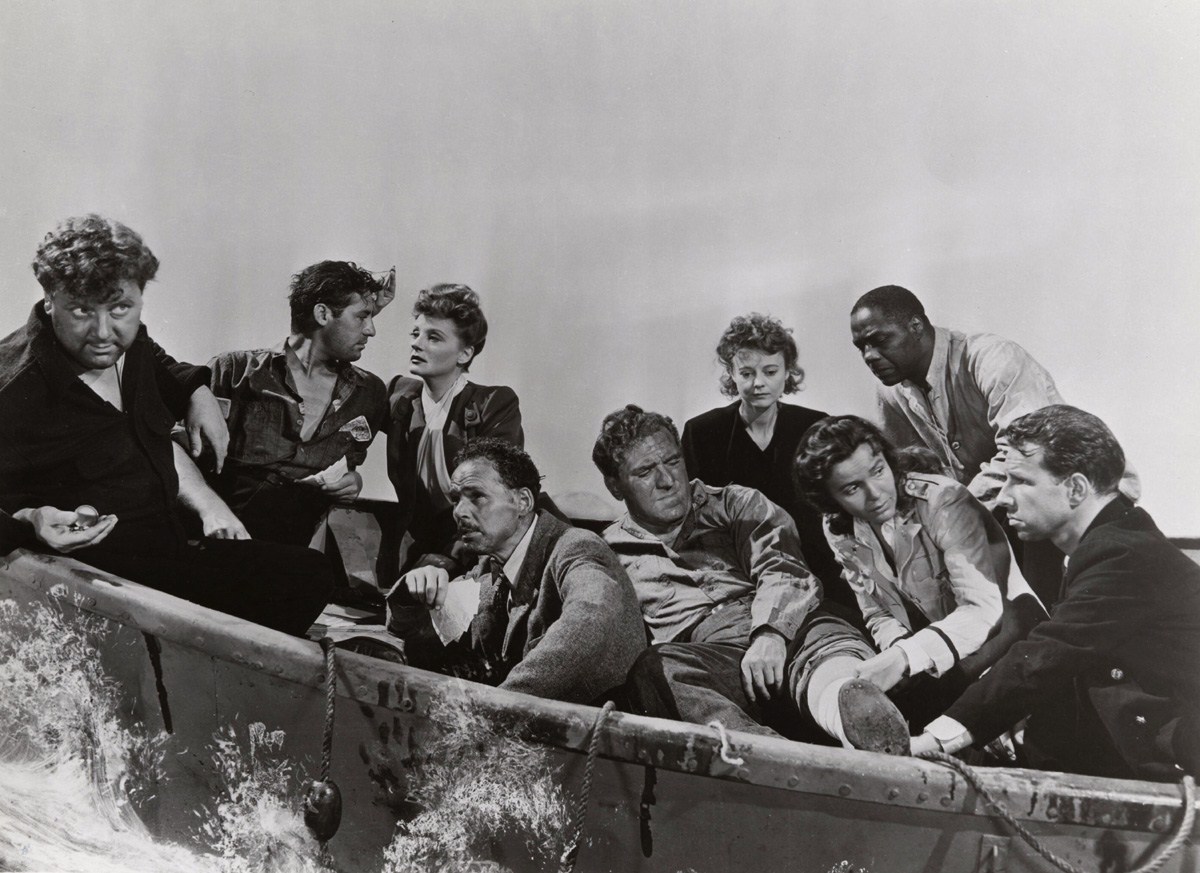
L–R: Walter Slezak, John Hodiak, Tallulah Bankhead, Henry Hull, William Bendix, Heather Angel, Mary Anderson, Canada Lee, and Hume Cronyn. (Odd man out, Slezak is the German Kapitän.) Image by 20th Century Fox via Wikipedia.
Grothe recounts, “While posing for publicity photographs for the film, actress Mary Anderson approached the director and asked, ‘What is my best side, Mr. Hitchcock?’ ”
Hitch replied, “My dear, you’re sitting on it.”
Bernhardt and Wilde. “Sarah Bernhardt,” writes Grothe, “starred in a number of Oscar Wilde’s plays (in 1893, Salomé was written—in French—especially for her). While the pair had great respect for one another and enjoyed a close relationship for more than twenty years, they sometimes clashed over how she was interpreting a role.”
This occurred just before Salomé opened in Paris. “After the flare-up,” Grothe recounts, “a now calm Wilde pulled out a cigarette, and said, ‘Do you mind if I smoke?’ The Divine Sarah, still miffed, replied coldly: ‘I don’t care if you burn.”
A Completely Different Venue. During the 1981 Formula One season, Williams drivers Carlos Reutemann and Alan Jones had a contentious relationship. Hagerty writes, “At the end of 1981, Carlos Reutemann suggested he and Williams teammate Alan Jones might try to ‘bury the hatchet.” ‘Yeah, in your back, mate,’ Jones replied.”
Other sources suggest that perhaps the Jones response might have been decidedly more vulgar.
Horse-Racing Repartee. I recently watched The Big Sleep, 1946, (indeed, yet again; I can savor it and its book repeatedly). Socialite Vivian Sternwood Rutledge (Lauren Bacall) is exchanging horse-racing/personal repartee with sleuth Philip Marlowe (Humphrey Bogart). “Well,” he says, “I can’t tell till I’ve seen you over a distance of ground. You’ve got a touch of class, but I don’t know how far you can go.”

Image from The Big Sleep via Classic for a Reason.
She replies, “A lot depends on who’s in the saddle.”
Diamond Lil. Another classic line noted by Grothe comes in Mae West’s play Diamond Lil, 1928, “in which she more fully displayed the sultry, wisecracking style that would become her trademark. In one scene, a woman gazes at West’s jewelry and says with admiration, ‘Goodness! What beautiful diamonds!’ ”
“West replies, ‘Goodness had nothing to do with it, dearie.’ ”
“I Was Reading a Book the Other Day…” In Dinner at Eight, 1933, there’s a great interaction between Jean Harlow and Marie Dressler, much of which is non-verbal on the latter’s part:

Image from YouTube.
Over-the-hill stage actress Carlotta portrayed by Marie Dressler does a wonderful double-take when gold-digger Kitty played by Jean Harlow says she’s been reading a book. Carlotta “listens skeptically… that machinery will take the place of every profession,” looks Kitty up and down, and murmurs, “Oh my dear, that is something you never need worry about.” ds
© Dennis Simanaitis, SimanaitisSays.com, 2025
 Simanaitis Says