
Simanaitis Says
On cars, old, new and future; science & technology; vintage airplanes, computer flight simulation of them; Sherlockiana; our English language; travel; and other stuff
BAEDEKER’S CANADA 1900 PART 2
YESTERDAY, WE FIGURED IT’S TIME to learn more about Canada. And my Baedeker’s Travellers Guide, 1900, seemed a fine place to start. Here in Part 2, we’ve missed our train outta Halifax by confusing Nova Scotia local time with standard time.
No big thing: As author J.F. Muirhead, M.A., already noted, it’s cheaper to be stuck in Nova Scotia.

This and following images from Baedeker’s Canada.
Indeed, Muirhead recommends, “Numerous Yachting and Rowing Races take place in summer. Small boats may be hired at the North Slip (Pl. E, 2), at the Ferry Slip (Pl. E, 4), and at Luke’s Freshwater (Pl. D, 5). Band Concerts in the Public Gardens (Sat. afternoon).”
Halifax. “Halifax, the capital and largest city of Nova Scotia, is beautifully situated on the S.E. coast of the province…. on the E. slope of a small rocky peninsula, enclosed by its splendid harbour.”
“Its position as the chief winter harbour of Canada, as the nearest American port to Great Britain (2170 M. to Cape Clear [off the southwest coast of County Cork, Ireland]), and as the E. Terminus of the Canadian railway-system makes it of great commercial importance.”

And Across This Vast Country. My first encounter with the Yukon, Canada’s westernmost and smallest territory, came in Beaver Creek on my Toyota FCHV adventure co-driving one of its fuel cell hybrid vehicles 2300 miles from Fairbanks to Vancouver.
Muirhead cites an “impetuous Beaver Creek,” though the locale isn’t cited as “Canada’s westernmost community,” as it is in Wikipedia. Neither Baedeker’s nor Wikipedia mention Buckshot Betty’s.
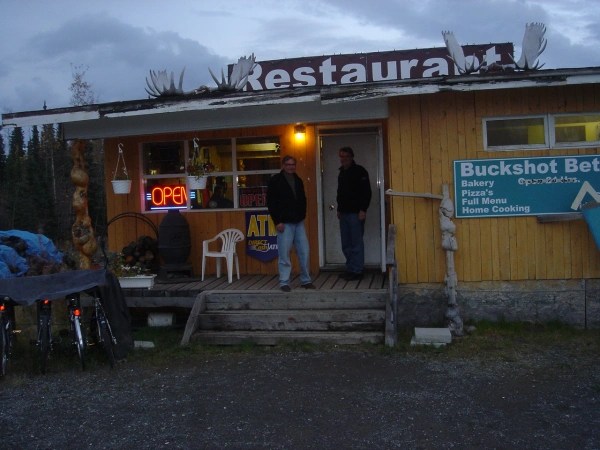
Buckshot Betty’s, Beaver Creek, c. 2007. Image from “Oh! Canada!”
I highly recommend Buckshot Betty’s Yukon Burger. It has all the proper fixings of a bacon-and-egg breakfast.
Enroute in Dawson. The Alaskan Highway was constructed during World War II to connect the contiguous U.S. to Alaska through Canada. Wikipedia notes that today “its component highways are British Columbia Highway 97, Yukon Highway 1, and Alaska Route 2.”

Our adventure started in Fairbanks to Dawson and then continued on to Vancouver.
Muirhead’s Dawson City: “Dawson, founded in 1897 on the right bank of the Yukon, at its confluence with the Klondike, is the capital of Yukon District and the centre of the Klondike Mining Region. It is now a bustling little town of about 15,000 inhabitants…. The total value of the gold produced in the Klondike Region in 1897-99 is estimated at about $25,000,000 (5,000,000 l) [some $883 million today]…. In winter there is a regular dog-train service between Dawson and Bennet Lake.”
The Trump Attraction?? Donald’s paternal grandfather Frederick Trump was born in 1869 in the Palatinate (then part of the Kingdom of Bavaria). Wikipedia describes, “During periods of war and anti-German discrimination in the United States, Trump’s son Fred later denied his German heritage, claiming his father had been a Swede from Karlstad, Sweden. This version was repeated by Fred’s son Donald in his 1987 autobiography.”
Hmm…. Grandpa Fred immigrated to the U.S. in 1885 to avoid conscription in the Imperial German Army. Wikipedia observes, “As a result of Trump fleeing mandatory conscription required of all citizens, a royal decree was later issued banishing him from the country.”

Frederick Trump, 1869–1918, German-American businessman.
Wikipedia continues, “In 1891, he began speculating in real estate in Seattle. During the Klondike Gold Rush, he moved to the Yukon and made his fortune by operating a restaurant and a brothel for miners in Whitehorse.”
If this sounds familiar, check out my “The Most Happy Felon—A Screenplay. ds
© Dennis Simanaitis, SimanaitisSays.com, 2025
 Simanaitis Says