
Simanaitis Says
On cars, old, new and future; science & technology; vintage airplanes, computer flight simulation of them; Sherlockiana; our English language; travel; and other stuff
BAEDEKER’S CANADA 1900 PART 1
WHAT WITH THE ACQUISITIONAL WEAVES of our Queens Felon, I thought it’s time to direct attention toward our friends to the north. And, you’ll not be surprised, I have a definitive source for this research: my Baedeker’s Canada.
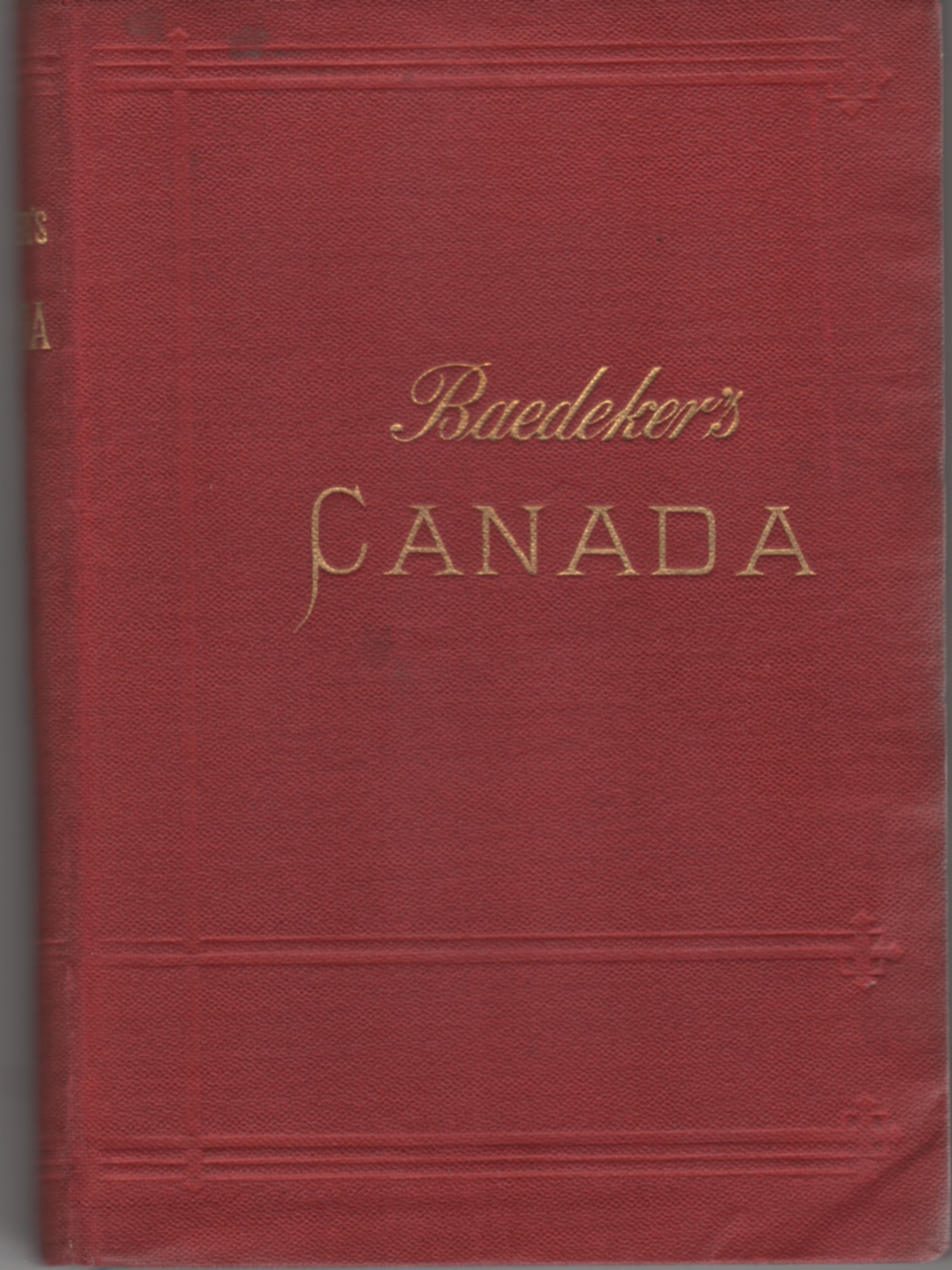
The Dominion of Canada with Newfoundland and an Excursion to Alaska, by Karl Baedeker, Leipsic [Leipzig], 1900.
Despite being more than 125 years old, this one is among the brightest of my Baedeker’s collection. I bought it in North Hollywood in 1986 and traveled with it only once, in 2007 on my 2300-mile adventure from Fairbanks to Vancouver in a Toyota Fuel Cell Hybrid Vehicle.
Here, in Parts 1 and 2 today and tomorrow, are tidbits gleaned from my Baedeker’s, including locales actually visited, and other sources. As usual, quoted passages are the Baedeker’s author’s; otherwise, they’re my scribbling.
Preface: Its author J.F. Muirhead, M.A., was also author of the companion volume on the United States. He observes, “No one is better aware than the Editor himself of the inevitable imperfections in the early editions of a guidebook… where a journey still necessarily assumes something of the nature of an exploration.”
Expenses: “The expenses of a visit to Canada depend, of course, on the habits and tastes of the traveller, but may be said, roughly speaking, to be much the same as those of European travel (except in respect of the greater distances to be traversed) and considerably less than those of the United States.”
“The hotels which charge as much as $5 a day can be numbered on one’s fingers, and the average hotel expenses will not exceed $3 a day, while in some parts of the Dominion (e.g., Nova Scotia) they will be less than that.… It would be safer to reckon on a daily expenditure of $7-8.”

By the way, the Bank of Canada identifies that between 1880 and 1914 its dollar and that of the U.S. were on par. On July 11, 1864, the Canadian dollar reached an all-time high, $2.78. (Gee, I wonder why?) On January 21, 2002, it reached an all-time low, $0.6179 (blame budget deficits and weak commodities); it’s $0.73 today (likely trade uncertainties and differing Canadian/U.S. interest rates).
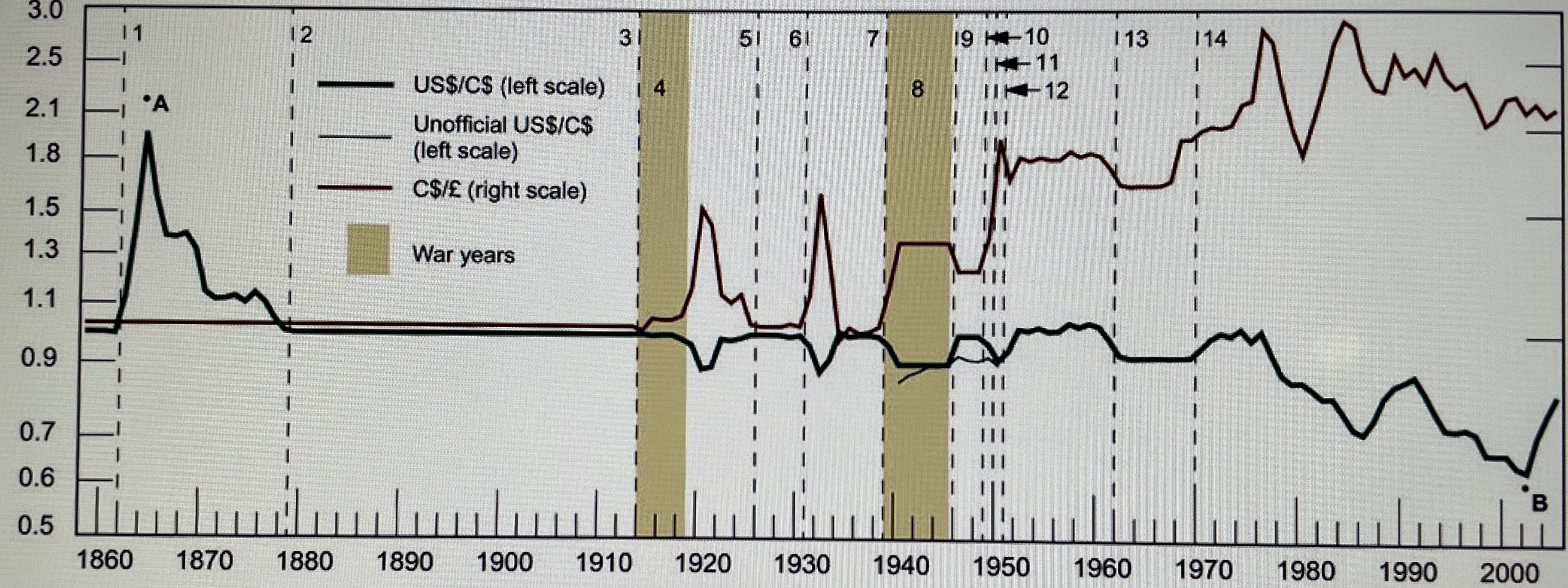
Image from Bank of Canada.
Here, of courses, we’re looking at 1900 when a dollar was a dollar. But Muirhead’s $7-$8 would equate to $268-$306 in today’s U.S. dollar ($366-$418 Canadian).
Time: Back in 1900 one’s pocket watch would agree on either side of the “54 40 or Fight” border. (My little joke, see “Friendly Borders.”) Most of the U.S./Canada border is the 49th parallel and has been so since 1818.
Time zones were shared too: Eastern (75th Meridian), Central (90th), Mountain (105th), and Pacific (120th).

However, Muirhead observes, “True local or mean solar time may be anywhere from 1 min. to 30 min. ahead or behind the standard time; and in some cases, where the ordinary clocks keep local time (as in Halifax) and the railway clocks keep standard time, the results are confusing.”
Tomorrow in Part 2, we learn an upside of missing the train outta Halifax. We also discover a possible source of the Queens Felon’s northern envy. ds
© Dennis Simanaitis, SimanaitisSays.com, 2025
 Simanaitis Says
Pingback: BAEDEKER’S CANADA 1900 PART 2 | Simanaitis Says