
Simanaitis Says
On cars, old, new and future; science & technology; vintage airplanes, computer flight simulation of them; Sherlockiana; our English language; travel; and other stuff
NATURE’S DYNAMIC COLORATION, TRANPARENCY, AND THERMAL MANAGEMENT
MATTHEW D. SHAWKEY OFFERS A PROVOCATIVE TITLE “Now You See Me, Now You Don’t,” in AAAS Science magazine, June 26, 2025: “Some squids,” Shawkey recounts, “are masters of disguise. They can change not only colors but also skin textures and patterns to mimic their surroundings with stunning accuracy in a few seconds. This includes shifting between colored, transparent, and mixed colored transparent states.”

Shawkey cites a research paper in this same issue of Science, “Gradient Refractive Indices Enable Squid Structural Color and Inspire Multispectral Materials,” by Gorgii Bogdanov et al. Here are tidbits gleaned from this research paper and Shawkey’s summary article, together with my usual Internet sleuthing.
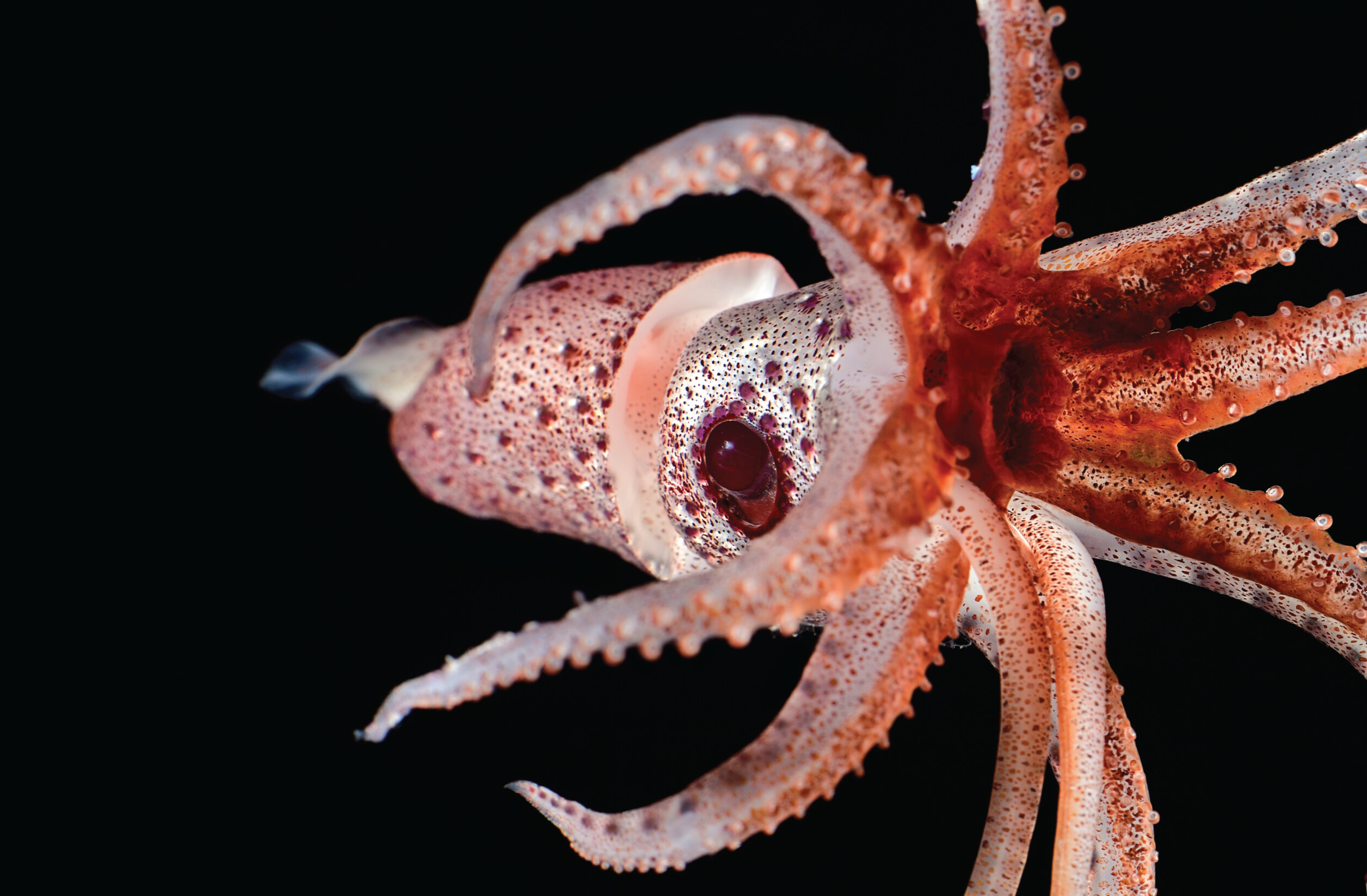
Iridophore cells in squid tissues allow squids to change their skin color rapidly by controlling light reflection. Image by Solvin Zanklmmiden Pictures via Science.
Structural Coloration. Shawkey describes, “In contrast to pigments which produce color by selectively absorbing certain wavelengths of light and reflecting others, structural coloration is based on light scattering by specific arrangements of materials at the nanometer scale. For example, a soap bubble has a higher refractive index than air (it bends light more than air), which causes light to scatter into its component wavelengths (colors) at the interface where a few-nanometers-thin layer of soap meets air.”
Shawkey continues, “Interference between the scattered light waves can enhance or cancel certain wavelengths. This creates individual colors that vary with the thickness of a soap bubble at a given point and the angle of incident light, producing a rainbowlike iridescent structural color.”
“Similarly,” Shawkey recounts, “some animals, such as chameleons, can actively vary their structural colors based on external stimuli. A change in the distance between materials in the chameleon’s skin, which are arranged in a crystalline structure, shifts colors across the visible light spectrum to match that of the surroundings such as leaves and rocks. However, becoming transparent is one trick chameleons have not yet mastered.”
A Cephalopod Speciality. Shawkey observes, “Many cephalopods, including some squids and octopuses, can appear nearly transparent. They contain a specific protein called reflectin that enables dynamic changes of color and reflectance for disguise. However, how squids achieve the shift from colored to noncolored (transparent) states has been puzzling.”
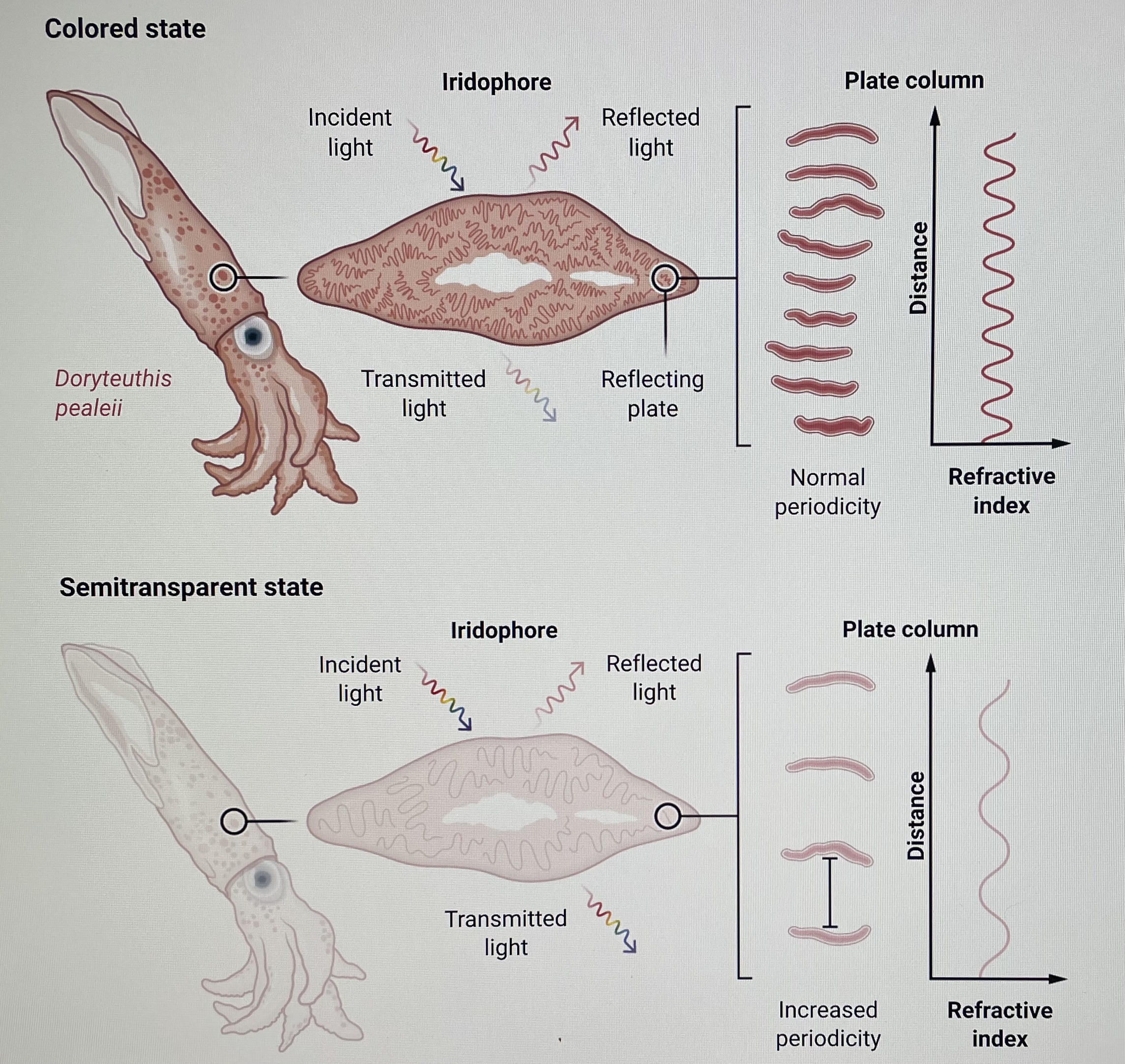
Periodically Reflective Plates of Iridescent Cells. “Bogdanov et al.,” Shawkey cites, “imaged live color-changing squid tissues to determine the mechanism behind this transition. The authors identified specific arrangements of reflecting plates in an iridophore, an iridescent cell in squid tissue. The periodic structure of plates caused sinusoidal variation of the refractive index within the iridophore (see the figure). Although other optical materials with refractive index gradients occur in living tissue, such as the moth eye, this previously unseen sine-wave distribution of refractive index allows squid tissues to become transparent.”
Graphic by A Fisher/Science.
Master of Disguise. As described in the Graphic, “Reflecting plates inside an iridophore cell of a squid are arranged in a distinct nanostructure. The specific arrangement varies the refractive index, which dictates how light interacts and determines the perception of color. Changes in the plates’ arrangement by external stimuli cause a rapid switching between colored and transparent state.”
The Researchers’ Composite Materials. Shawkey notes, “Although Bogdanov et al.’s composite materials displayed dynamic color change, these synthetic analogs still fall short of the remarkable abilities of squid skin, which are a product of millions of years of evolution. However, the designed materials are promising for engineering applications. The authors extended the iridescence phenomenon into near-infrared light waves that are not optically visible but can be detected as heat.”
Thermal Properties As Well. “This,” Shawkey describes, “allowed the composite films to switch both optical and thermal properties, moving beyond what squids are known to do. What function could the next iterations of the bioinspired films of Bogdanov et al. achieve? The most obvious one is camouflage, but shifts between visible and near-infrared light waves could also bring dynamic coloration and thermal management to building materials and textiles. These examples show the practical aspects of the flashy color changes seen in nature.”
See, for example, “Talking About Paint That’s Cool” and “Nanoporous Fabrics May Keep Us Cool.”
It took squids millions of years to evolve such dynamic coloration and thermal management, but research such as this—if not impeded by ignorance of science—could yield societal benefits incredibly sooner. ds
© Dennis Simanaitis, SimanaitisSays.com, 2025
 Simanaitis Says