
Simanaitis Says
On cars, old, new and future; science & technology; vintage airplanes, computer flight simulation of them; Sherlockiana; our English language; travel; and other stuff
WHAT IS CLASSICAL MUSIC?
COMPOSER/CONDUCTOR MATTHEW AUCOIN ASKS “Do You Actually Know What Classical Music Is? Does Anyone?,” The Atlantic, April 15, 2025. This captures my eye because I include classical among my musical interests, everything from Bach to Copland, Mozart to Wagner, Adams and Glass to Adès and Saariaho.

Indeed, these last four are modern composers of operas I’ve seen as part of the Metropolitan HD series: Nixon in China, 1987; Akhnaten, 1983; The Exterminating Angel, 2016; and L’Amour de loin, 2000; respectively. Indeed, Daughter Suz reminds me that Matthew Aucoin’s Eurydice, 2020, is yet another modern opera we’ve enjoyed in Met HD.

Eurydice arrives in the Underworld in Aucoin’s opera. Image from Metropolitan Opera.
What Is Classical?; Whom Is It For? Matthew Aucoin recounts, “The unruly and elusive entity known as classical music does not sound like any one thing, and the sheer abundance of the tradition might invite the conclusion that trying to define it at all is a hopeless exercise. But that would be a mistake, especially at this moment. Like every other sector of cultural life, classical music has been roiled over the past decade by intense debates about the field’s ongoing lack of diversity, among performing artists, composers, and leaders of musical organizations. The stakes of these discussions—which have involved charges of Eurocentrism, head-in-the-sand elitism, even white supremacy—have at times felt existential, given many institutions’ financial straits…. What is classical music, whom is it for, and what about it is worth defending?”
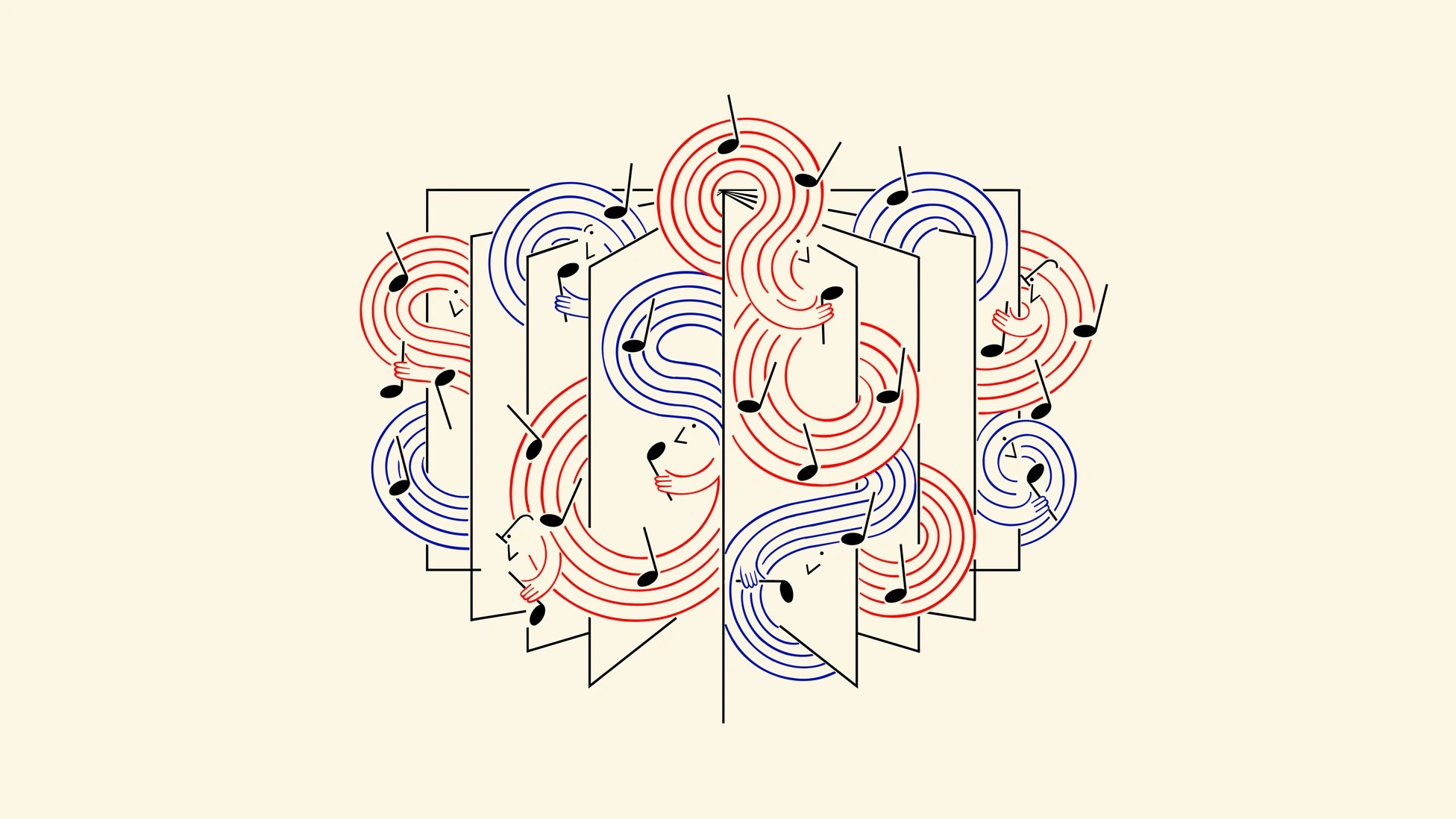
Image by Pierre Buttin from The Atlantic.
A Shared Technology of Transmission. Aucoin posits, “What links Hildegard von Bingen and Kaija Saariaho, Johann Sebastian Bach and George Benjamin, is not a specific sound or aesthetic but a shared technology of transmission. At its core, classical music isn’t ‘classical.’ It is written music.”
In Contrast to Studio Recording or Live Performance. Aucoin expands on the idea: “The reference point for a given piece of [classical] music is the score, rather than a studio recording or a live performance. Beethoven’s symphonies have been recorded hundreds—if not thousands—of times, and they’ve been performed many more times than that, but every one of those performances and recordings refers to the same score.”

Beethoven’s Fifth Symphony in C Minor. Image from leonardbernstein.com.
The Score: Foundational. Aucoin notes, “…the act of score-making links together artists who could hardly sound more different from one another—say, an Italian composer of the late Renaissance and early Baroque period like Claudio Monteverdi and a 20th-century American avant-gardist like John Cage. Even an extreme case, such as Cage’s famous 4’33”—a work in which performers refrain from playing their instrument for four minutes and 33 seconds—depends on its score, a simple and playful set of written instructions. (In fact, to a greater degree than most notated music, 4’33” is inconceivable as a work of art without those directions.)”
Even in Big-Band Jazz. “Many of the big-band masterpieces of Duke Ellington and Billy Strayhorn, for instance,” Aucoin observes, “strike me as indistinguishable, in their creative genesis, from orchestral works by Igor Stravinsky and Aaron Copland that were being written around the same time: They are notated in exquisite detail, usually for large ensembles, and Strayhorn’s gorgeously balanced wind and brass voicings remind me in particular of Stravinsky’s.”
More Than Purely Oral Tradition. Aucoin claims, “Written music matters for the same reason written language does: To write is to free oneself from the constraints of memory…. When you write, you don’t simply set down your thoughts; in the process of writing, your thoughts are transformed, and allowed to assume a newly complex shape—the miraculous scaffolding that emerges from the accumulation of thoughts on the page.”
Astonishing Communication. “Notation,” Aucoin recounts, “doesn’t just open the way to the creation of unbounded musical universes; it also enables astonishing forms of human communication. An orchestra, a chorus, a jazz big band, a marching band—these are complex macroorganisms whose inner workings require formidable feats of interactive precision, all of which depend on information encoded in a written score. I can’t think of another comparably intricate form of social coordination outside the military.”
Agreed. And why does this remind me of Groucho Marx’s line “Military justice is to justice what military music is to music.” I suspect I know Matthew Aucoin’s view on the matter. ds
© Dennis Simanaitis, SimanaitisSays.com, 2025
 Simanaitis Says