
Simanaitis Says
On cars, old, new and future; science & technology; vintage airplanes, computer flight simulation of them; Sherlockiana; our English language; travel; and other stuff
COUNTERING MICROPLASTICS
STUTI MISHRA REPORTS “NEW PLASTIC THAT DISSOLVES in Seawater Raises Hopes for Tackling Ocean Pollution,” The Independent, June 4, 2025. She recounts, “The material, created by researchers at the University of Tokyo, is being described as the fastest-degrading plastic of its kind. The researchers say it can vanish within hours in saltwater or soil without leaving behind harmful microplastics.”

Microplastic Risk. Mishra explains, “Plastic pollution has emerged as a major health hazard, with microplastics now found in human organs and even brain and bloodstream. The UN has warned that plastic waste entering the oceans could triple by 2040 unless urgent action is taken. While recycling rates remain dismally low, especially for single-use plastics, scientists and innovators are racing to develop alternative materials that break down more easily or bypass the problem altogether.”
A Supramolecular Plastic. Mishra recounts, “In a laboratory demonstration, a small piece of the material disintegrated in a tub of seawater after only an hour of stirring, according to a study published in the journal Science.”

The technical paper “Mechanically Strong Yet Metabolizable Supramolecular Plastics by Desalting Upon Phase Separation,” Science, November 21, 2024, is by Yiren Cheng et al. Its Editor’s Summary by Phil Szuromi notes, “A strong, glassy supramolecular polymer has been shown to prevent the formation of marine microplastics by slowly dissolving in salt water into metabolizable compounds. Cheng et al. show that salt bridging between sodium hexametaphosphate or sulfated polysaccharides and guanidinium sulfates expels sodium sulfate to create a cross-linked network that is stable until the electrolytes are added back. The dried material is a moldable and recyclable thermoplastic that can be water stabilized with hydrophobic coatings.”
Bacteria Digestable. Mishra writes, “Scientists say the material maintains the strength of traditional petroleum-based plastic, but, when exposed to salt, breaks down into its original components, which are then digested by naturally occurring bacteria.”
“What sets this new plastic apart,” notes Mishra, “is its ability to disappear not just in water but also in soil which contains salt. A 5cm piece can degrade completely after about 200 hours in moist earth, according to the researchers. It is also non-toxic and non-flammable and emits no carbon dioxide as it breaks down, the researchers say.”
“The breakthrough,” she continues, “comes at a time when plastic waste continues to flood the world’s oceans. Global plastic pollution is estimated to triple by 2040, with the UN Environment Programme warning that up to 37 million tonnes of waste could enter marine ecosystems each year.”
Applications To Come. “While the dissoluble plastic is not yet commercially available,” Mishra notes, “the researchers are working on developing coatings that will allow the material to be used like conventional plastic in packaging and other everyday applications without compromising its rapid degradability in nature.”
Locally. Here in California, as of December 2024 single-use plastic bags are no longer used in grocery stores. Shoppers are encouraged to bring their own bags; paper or multi-use plastic bags may be bought at 10¢/15¢ apiece.
In the Vons produce department, gizmos dispense filmy green bags marked “Certified COMPOSTABLE” in lieu of previously offered plastic bags sans this certification.

Above, one of Vons produce bags from Crown Poly. Below, its multi-national certification.

Crown Poly notes that its Compostable Bags “are made from 100% vegetable starches…. These bags are certified for both commercial and HOME composting.”
Biodegradable or Compostable? One of the icons on my filmy green bag is “BPI Compostable.” The Biodegradable Product Institute is described as “a science-driven organization that supports a shift to the circular economy by promoting the production, use, and appropriate end of lives for materials and products that are designed to fully biodegrade in specific biologically active environments.”

Image from Elevate Packaging.
Compostables are a subset of biodegradables. In particular, composting results in purely organic matter or humus within a specific time. A biodegradable product may break down into a few organics eventually, but with non-organics—e.g., microplastics—still present.

Image from Good Start Packaging.
Yearning for the Good Old Days? Curiously enough, eBay has a “Vintage VONS Vegetable Bags Grocery Store Roll of Plastic TV Movie Prop 1973” for $60 or Best Offer.
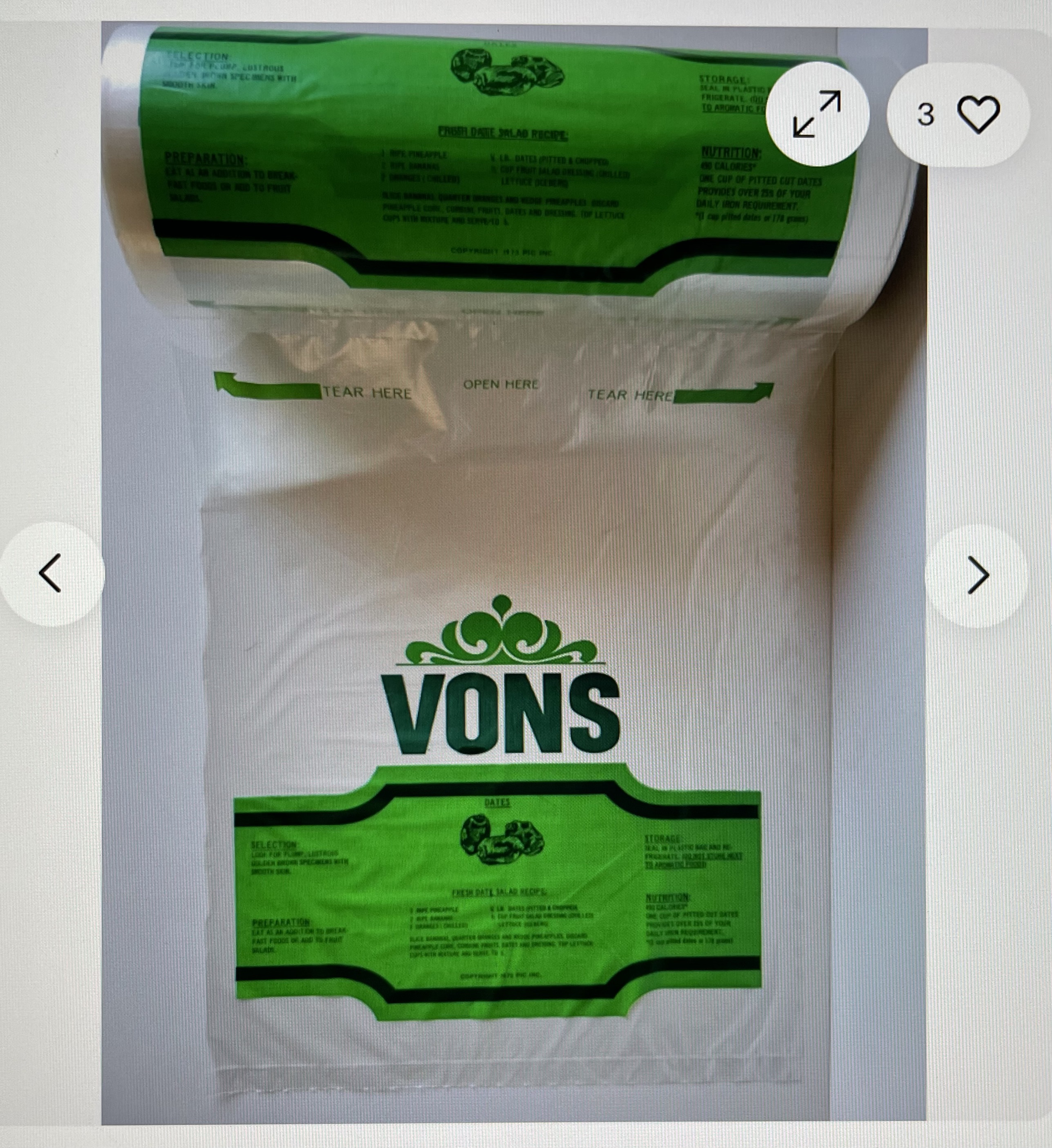
I showed this pic to a young man staffing my local Vons produce department. He smiled and said, “Gee, that’s before I was born!”
Yep. Science has progressed a lot since 1973. And, if unfettered by asinine ideologies, it’ll continue to progress. ds
© Dennis Simanaitis, SimanaitisSays.com, 2025
 Simanaitis Says