
Simanaitis Says
On cars, old, new and future; science & technology; vintage airplanes, computer flight simulation of them; Sherlockiana; our English language; travel; and other stuff
SCIENCE HAPPENS PART 2
YESTERDAY WE DISCUSSED SCIENCE as it navigates itself through the pages of AAAS Science magazine; this, despite a Trump administration seemingly bent on eschewing science at every opportunity. Today in Part 2, let’s talk real science.

Furor Over Majorana Quasiparticles. I’ve saved this one for last because it has nothing to do with retribution, reduced funding targeting D.E.I., or other D.C. matters. It’s an out-and-out squabble between scientists—in the nanorealm of quantum physics.

A Majorana 1 processor, which Microsoft claims contains eight ultrarobust topological qubits (whatever they may be). Image by John Brecher for Microsoft via Science.
Zack Savitsky does an admirable job of explaining why a “Debate Erupts Around Microsoft’s Blockbuster Quantum Computing Claims,” Science, March 20, 2025. By way of background, I add SimanaitisSays encounters with this bizarre world of quantum computing.
Bits Versus Qubits. As described in “Computing with Quanta,” a digital computer counts on two fingers, albeit very quickly. Its basic units are 1 and 0, on or off. By contrast, the basic unit of a quantum computer is the quantum bit, or qubit, a two-state system of physical properties occurring on the atomic level.
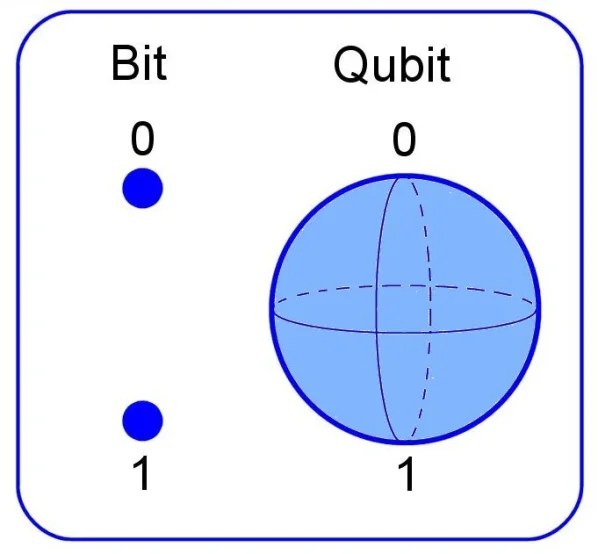
Digital Versus Quantum Computing. Both types of computers accept data as input, employ processing algorithms, and produce output. Whereas digital computing is precise—and relatively slow—a quantum device’s logic gates operate probabilistically, their incredible speed enhanced by the quantum property of “entanglement,” i.e., interaction from afar. However, a tradeoff of probabilistic behavior is its degrading into “decoherence,” sorta garbling data and requiring complex correction techniques.
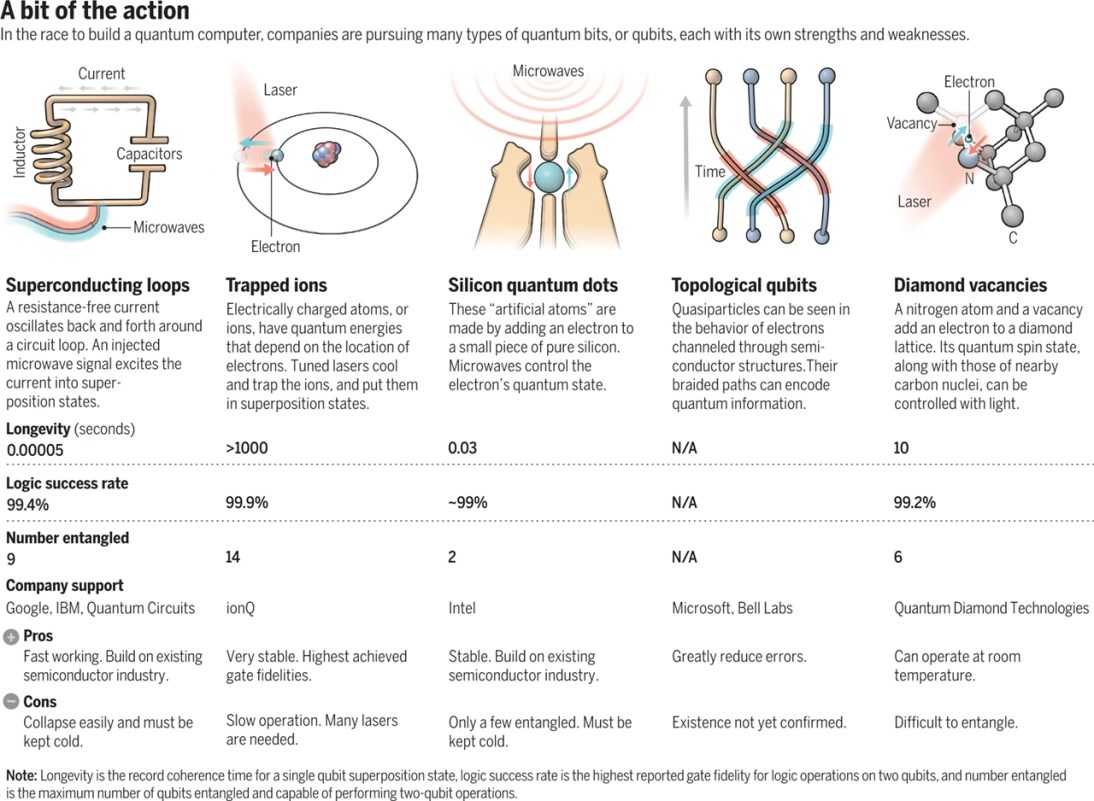
Image from “Quantum Computer Update” via Science.
In particular, note that topological cubits offer greatly reduced decoherence.
Making Qubits Behave: The Majorana Particle. A Majorana particle is its own anti-particle, a concept hypothesized by Ettore Majorana in 1937. Savitsky calls such particles “essentially delocalized electrons.”

Ettore Majorana, 1906–1938, Italian theoretical physicist, member of the National Fascist Party, a specialist in neutrino masses. Image from Wikipedia.
Wikipedia notes that this Italian theoretical physicist was “disappeared” in Fascist Italy in 1938. The Majorana equation, Majorana fermions, and Microsoft‘s device attempting to create topological qubits, Majorana 1, are named after him. In 2006, the Majorana Prize was established in his memory.

Flip to March 18, 2025, Anaheim, California. Zak Savitsky recounts goings-on at the APS Global Physics Summit 2025: “Microsoft physicist Chetan Nayak faced a formidable challenge: convincing an excited but largely skeptical standing-room audience of other scientists that his company had shaken the landscape of quantum computing. Nayak tried to make the case that his team had created the world’s first ‘topological’ qubit, a potential robust quantum analog of the 0-or-1 bit that powers a conventional digital computer.”
“Doing so,” Savitsky notes, “would require not only conjuring the long-sought Majorana quasiparticle—a proposed mode of electron behavior never before confirmed—but also controlling multiple Majoranas on an actual platform to encode quantum information.”
The Furor Erupts. Savitsky observes, “Many audience members, however, remained largely unsold. ‘I don’t think the data are convincing,’ says Jelena Klinovaja, a physicist at the University of Basel.” (You know professor are serious when they know “data” are the plural form.) ‘It is difficult to be convinced from the presented data that one is really dealing with a topological [qubit].’ ”
Savitsky continues, “And just the day before at the same meeting, Henry Legg, a physicist at the University of St. Andrews who had already posted two preprints challenging the company’s work, attacked further. ‘It doesn’t look like Majoranas, at least to me,’ Legg said at a Monday session. ‘Any company claiming to have a topological qubit in 2025 is essentially selling a fairy tale [that] undermines the field of quantum computation … and public confidence in science.’ ”
Professor Legg is very kind in thinking we all understand quantum physics.
Savitsky comments, “For his part, Nayak remained collected and convinced that his team has tamed the elusive Majoranas, even as Legg and other physicists denounce Microsoft’s claims. ‘We’ve only revealed a tiny fraction of what we’ve done,’ Nayak tells Science. ‘It’s going to look more and more convincing that this is going to be the basis of a technology.’ ”
I note that scientists disagree, and yet do so without calling each other NAMES in ALL CAPS. ds
© Dennis Simanaitis, SimanaitisSays.com, 2025
 Simanaitis Says
It seems quantum computing is akin to fusion energy. Beguiling but just out of reach.
A typically good article in the December 19th, 2022 New Yorker about quantum computing, in their Annals of Technology, “The Future of Everything: How the quantum computer will change the world–eventually,” by Stephen Witt.
https://www.newyorker.com/magazine/2022/12/19/the-world-changing-race-to-develop-the-quantum-computer