
Simanaitis Says
On cars, old, new and future; science & technology; vintage airplanes, computer flight simulation of them; Sherlockiana; our English language; travel; and other stuff
KINGS PART 2
WE’RE IN THE MIDST OF TOM JOHNSON’S LRB REVIEW of the Burt/Partington book Arise, England: Six Kings and the Making of the English State. Here in Part 2, we continue the tales of Neds II and III and….

Like Elvis, Is Edward II Still Around? “But he [Edward II] kept reappearing,” Johnson relates, “doomed to haunt the realm in the form of his imposters. Around 1337, a bizarre letter from a papal notary called Manuele di Fieschi reported that Edward was still alive. Apparently he had disguised himself as a servant, killed his sleeping jailer (the dead body then presented as Edward’s own), before escaping, dressed as a hermit, via Ireland, France and the Holy Roman Empire to Cecima in Lombardy, where he was living out his days as a pious recluse.”
Gee, yet another bio series?
And There’s More: “The next year,” Johnson cites, “a man called ‘William le Galeys’ was picked up by Edward III’s court as it progressed through northwestern Germany on its way to the imperial court of the Holy Roman Emperor. William also claimed to be Edward II, but only dined at the king’s expense for a few weeks before disappearing from the records. A small minority of historians think there is some substance to these stories. Perhaps Edward is still out there somewhere, like Elvis.”
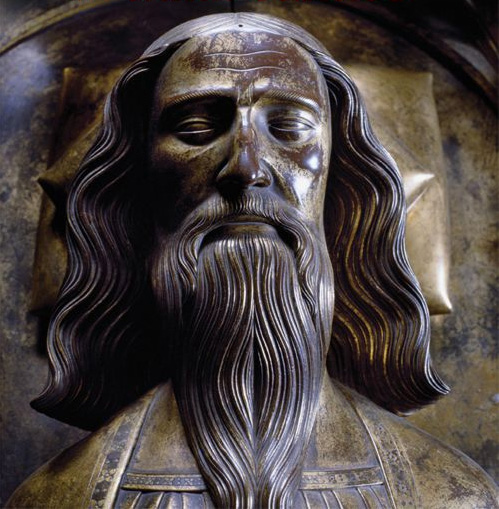
Edward III reigned from 1327 to 1377, one of the longest in English history. Image of his funerary monument in Westminster Abbey via Wikipedia.
Edward III, Or Charlie McCarthy? Johnson recounts, “When Edward III died, a craftsman was commissioned to make a life-sized effigy—‘an image after the likeness of the king’—to rest atop his tomb in Westminster Abbey. The mannequin was made from wood and straw and painted with polychrome gesso. Archaeological analysis has since demonstrated that the head was once covered with a wig and crown, the hairs used to feign the eyebrows plucked from a ‘small dog.’ [Whence Johnson’s article title.] The plaster face was hauntingly real because it was a cast taken from the king’s death mask.… The eyes on the mask were painted open, as if he were still alive, still watching himself being watched.”
Johnson’s Conclusion: Nevertheless, “The spectacle of medieval government was more surreal, more interesting, stranger and bleaker than any peacocked king.”
My Recollection: There’s another tale concerning yet an earlier Edward, this one The Confessor:
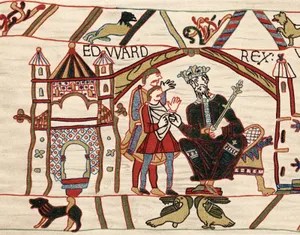
From another LRB reviewer Tom Shippey: “Edward, so the story goes, always suspected Godwin [Edward’s father-in-law] of involvement in the capture, blinding and murder of Alfred [Edward’s brother], but never accused him outright. One day, however, as the two men sat together at dinner, one of the waiters stumbled, caught himself, and said cheerfully and proverbially: ‘One leg helps another, as brother helps brother.’ At this, Edward turned to Godwin and said: ‘But I have no brother.’ Stung by the implied accusation, Godwin took a piece of bread and said: ‘If I had any part in the murder of Alfred, may this piece of bread choke me when I swallow it.’ He swallowed it, choked and died.”
How do you say Si non e vera e bon trovato in Old English? ds
© Dennis Simanaitis, SimanaitisSays, 2025
 Simanaitis Says