
Simanaitis Says
On cars, old, new and future; science & technology; vintage airplanes, computer flight simulation of them; Sherlockiana; our English language; travel; and other stuff
STIMSON AND BEAN—HEROIC DOCTORS PART 2
YESTERDAY, WE FOLLOWED AMERICAN DOCTORS Barbara Stimson and Achsa Bean to England after the U.S. Army denied them officer appointments. Today, we continue Catherine Musemeche’s “Major Barbara’s War,” Smithsonian, March 2025, as the two experience wartime Europe.

Their British Assignments—Not Without Bias. Musemeche writes, “She [Stimson] and Bean had hoped to be stationed in the same city, but on their first day of work, Bean boarded a train to the Bristol Royal Infirmary, in the southwest of England, while Stimson squeezed into a packed cabin bound for London to treat civilian orthopedic injuries at the 327-bed Royal Free Hospital. Their separation, however, proved to be brief. The Bristol hospital was expecting Bean to be a male physician, and when it turned out she was not, Bean was promptly driven to London and dropped at the Royal Free Hospital.”
Stimson’s Expertise; Bean’s Learning Curve. “At the Royal Free,” Musemeche recounts, “Bean served on the medical wards while Stimson familiarized herself with British surgical practices, working alongside the head orthopedic surgeon. Stimson, an orthopedic trauma specialist, shared her expertise with the use of internal fixation rods to stabilize complex leg fractures and other American surgical techniques.”
Stimson wrote, “We felt we could be of some much-needed help, both professionally and, in a way, emotionally. We were living, visible proof that Americans cared.”
News Reaches Back Home. Musemeche writes, “While a limited number of women physicians had been appointed to serve in the RAMC since 1939, no American women ever had. With help from Lady Astor and the American ambassador, John Gilbert Winant, they were commissioned on February 1, 1942. It took all of a week for the news to reach the American public. ‘Army Rank for Dr. B. Stimson: American Woman Surgeon Is Made a Major in British Medical Service,’ the New York Times reported on February 8, 1942.” Other newsworthiness was to follow.

This and other images from Smithsonian.
Anyone For Cricket? Musemeche recounts, “Described by one British officer as ‘a big, businesslike woman with a boyish bob and a keen sense of humor’ in Women Doctors Today, Stimson proved popular at her first RAMC post. She served as the pianist in a classical trio and played bridge and table tennis. She even subbed in to a cricket game one day when the officers’ team came up one person short. A novice, she proved adept at fielding and throwing the ball. ‘To my amazement, it stopped the game,’ she later wrote. ‘They apparently had never seen a woman throw overhand!’ ”
Resistance, Then Reluctant Acceptance At Home. “As secretary of war,” Musemeche notes, “Henry L. Stimson, Barbara Stimson’s cousin and 31 years her senior, worked closely with Army Chief of Staff George C. Marshall to formulate military strategy.”
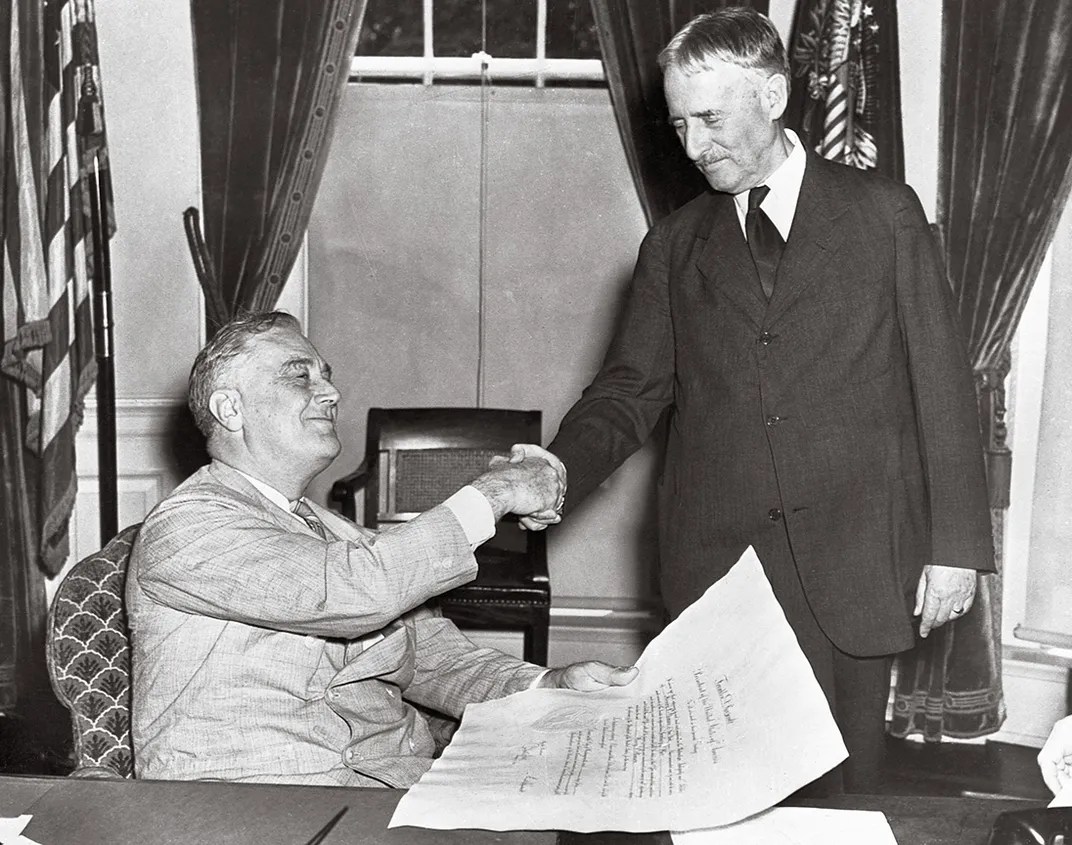
President Roosevelt greets Henry L. Stimson upon the Senate’s confirmation as Secretary of War, July 10, 1940.
“According to Stimson,” Musemeche recounts, “Henry had opposed granting commissions to women doctors. [U.S. Ambassador] Winant hoped that a meeting with Barbara Stimson might persuade Henry to change his mind. She agreed, and in late December she sailed to New York.”
Musemeche continues: “ ‘Babbie, I don’t like to see you in that uniform,’ she recalled him telling her, upon seeing her in her British military attire when they met in Washington, D.C. ‘But you don’t give women doctors commissions in the U.S. Army Medical Corps,’ Stimson answered.”
The Sparkman-Johnson Act. “A few months later,” Musemeche says, “in April 1943, Roosevelt signed into law the Sparkman-Johnson Act, which authorized the U.S. Army and Navy to grant women physicians commissions in the medical corps for the duration of the war plus six months.”
Ha. Don’t let ’em get used to it.
“After the act’s passage,” Musemeche notes, “Stimson was offered various positions in the U.S. Medical Corps, including as a gynecologist, but none allowed her to practice orthopedic surgery. She refused them all.”
Bravery at the Italian Front. “ ‘I had treated mangled limbs from the buzz bombs, from the retreat from France at Dunkirk and from the Sicily campaign when in North Africa, but none like that afternoon,’ Stimson wrote of her first day treating casualties from Monte Cassino, the site of the bloodiest battles of the Italian campaign resulting in more than 54,000 Allied casualties,” Musemeche notes. “More than 2,400 members of the RAMC, including physicians, laid down their lives during World War II. In Italy alone, 121 were killed.”

Major Barbara’s War Ends. “In August 1945,” Musemeche writes, “Stimson was honorably discharged, receiving two distinguished military medals. George VI named her a Member of the Order of the British Empire, for ‘the energy, zeal and breadth of vision’ she brought to the specialized orthopedic center she opened at the No. 70 British General Hospital. Military historians Judith Bellafaire and Mercedes Herrera Graf later recognized Stimson as a medical pioneer in Women Doctors in War, published in 2009.”
Post-War. Musemeche writes, “After the war, Stimson returned to Columbia University to resume operating and teaching. In 1947, she moved to Poughkeepsie, New York, where she maintained a private practice. In 1959, she became the first woman president of the Dutchess County Medical Society and the first female member of the New York Surgical Society. Upon retiring in 1963, she moved to Owls Head, Maine, and lived with Bean and their two Norwegian elkhounds until Bean’s death in 1975. In 1986, Stimson, who was living with her sister Dorothy, died at the age of 88.”
Rest their sweet, brave, talented souls. ds
© Dennis Simanaitis, SimanaitisSays.com. 2025
 Simanaitis Says
I read your wonderful story right after reading that Arlington National Cemetery has begun wiping from its website histories highlighting Black, Hispanic and women veterans, per orders from our ruler in DC.
Every day recently has been a day of great sadness. He is also imprisoning students for protesting the killings of Gaza’s innocents. (Yes, not all Gazans are innocent. I know that.)
Thanks, Tom, and thanks Smithsonian Magazine.
When and how will it all end?
Wonderful story 🌅🌅
Agreed. Thank Smithsonian—ds
Glad Smithsonian printed it, you found it, and you let us know about it. Thanks! If it’s online, I hope the Wayback has grabbed a copy for safekeeping; Smithsonian gets federal funding, and printing (and making available online) stories like this, in the current political environment, is a formula for funding cuts if not outright censorship.