
Simanaitis Says
On cars, old, new and future; science & technology; vintage airplanes, computer flight simulation of them; Sherlockiana; our English language; travel; and other stuff
CELEBRATING THE DETROIT OPERA, HANDEL’S RINALDO, KIDS’ RESILIENCE, AND THERAPY DOG ASPEN
BACK WHEN I VISITED THE MOTOR CITY A LOT, I also enjoyed performances of the Michigan Opera Theatre. It has appeared here at SimanaitisSays in “Many Flutes Are Magical” and “Detroit’s Götterdämmerung Parts 1 and 2.” Since February 28, 2022, this principal opera company in Michigan is known as the Detroit Opera.

These days I travel very little and, alas, I missed its recent production of Handel’s Rinaldo, a classic 1711 opera performed with fascinating Detroit Opera innovations. Here are tidbits gleaned from a variety of sources.
A Globalist Composer. Wikipedia recounts, “Born in Halle, Germany, Handel spent his early life in Hamburg and Italy before settling in London in 1712, where he spent the bulk of his career and became a naturalised British subject in 1727.” He is well-known for his operas, oratorios (including Messiah), ceremonial music (Music for the Royal Fireworks, Water Music), concerti grossi, and organ concerti.

George Frideric Handel, 1685 (Bach’s birth-year as well)–1759), German-British Baroque composer. Portrait, c. 1710, by Christoph Platzer via Wikipedia.
Agrippina and Rinaldo. Handel wrote the two operas Agrippina and Rinaldo in Italian within a year of each other, 1711-1712. Rinaldo, notes Wikipedia, “was the first Italian-language opera written specifically for the London stage…. The story of love, war and redemption, set at the time of the First Crusade, is loosely based on Torquato Tasso’s epic poem Gerusalemme liberata (“Jerusalem Delivered”), and its staging involved many original and vivid effects. It was a great success with the public, despite negative reactions from literary critics hostile to the contemporary trend towards Italian entertainment in English theatres.”
Ha. I’m reminded of H.L. Mencken’s line, “Opera in English is, in the main, just about as sensible as baseball in Italian.”
By the way, Agrippina is my favorite Handel opera, especially as performed by The Metropolitan Opera. Kate Lindsay’s portrayal of Nerone (Nero) is a real hoot!
Kids’ Resilience. As described by Duante Beddingfield in the Detroit Free Press, February 25, 2025, “Sometimes, a lighthearted evening at the opera is just what the doctor ordered. Detroit Opera’s charming ‘Rinaldo’ is a whimsical potion of a production. Director Louisa Proske’s warm and magical staging takes Handel’s tale of kings and warfare during the First Crusade (which premiered this very week in 1711) and transforms it into a musing meditation on hope and dreams and the innocence of childhood that left the Feb. 22 premiere audience roaring with approval.”
“Somewhere in a chilly hospital ward,” Beddington recounts, “Rinaldo, a young boy recovering from brain surgery, shares a room with an unconscious girl who appears to be struggling to survive. Rinaldo’s fate also seems unclear. He keeps himself company by disappearing into fantasies from his beloved storybook that tells of knights, sorcerers, monsters and magic. In these daydreams, he is a mighty warrior; the opera’s actions unfold within the scope of his brilliant imagination.”
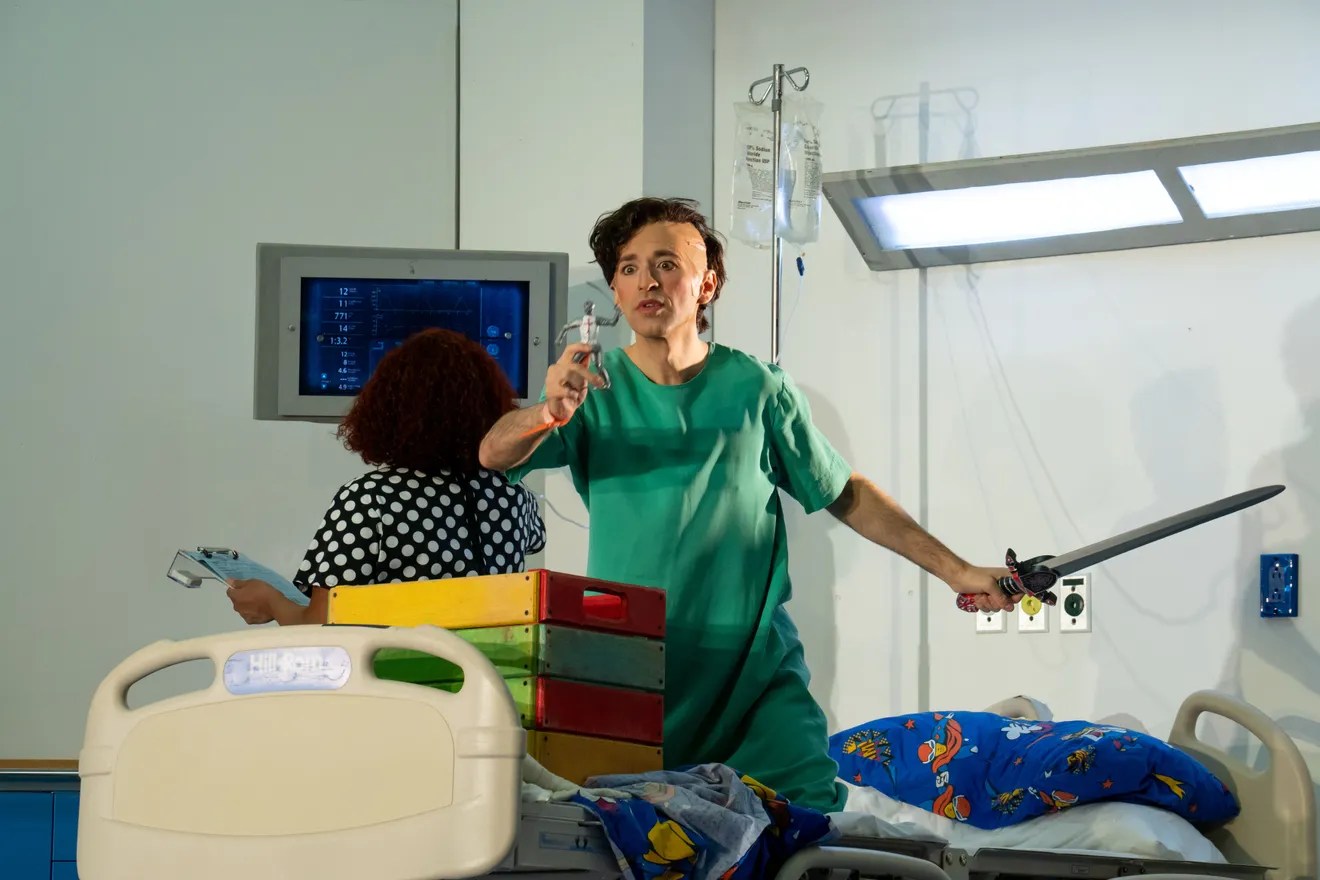
Rinaldo is portrayed by countertenor Anthony Roth Constanzo. This and the following image by Detroit Opera/Austin Richey via the Detroit Free Press.
Beddington continues, “[Soprano] Elena Villalón delivers a sparkling turn as distressed damsel Almirena, and their act one duet is a major highlight.”
The sorceress Armida is sung by soprano Nicole Heaston. Beddington describes, “Nicole Heaston gives one of the performances of the season with her wonderfully hammy Armida, chewing every matchstick of scenery to be found. Her over-the-top entrances, broad comedy, Disney villain energy and soaring, angry soprano bring an unpredictable, irresistible lightning-bolt energy to her scenes.”
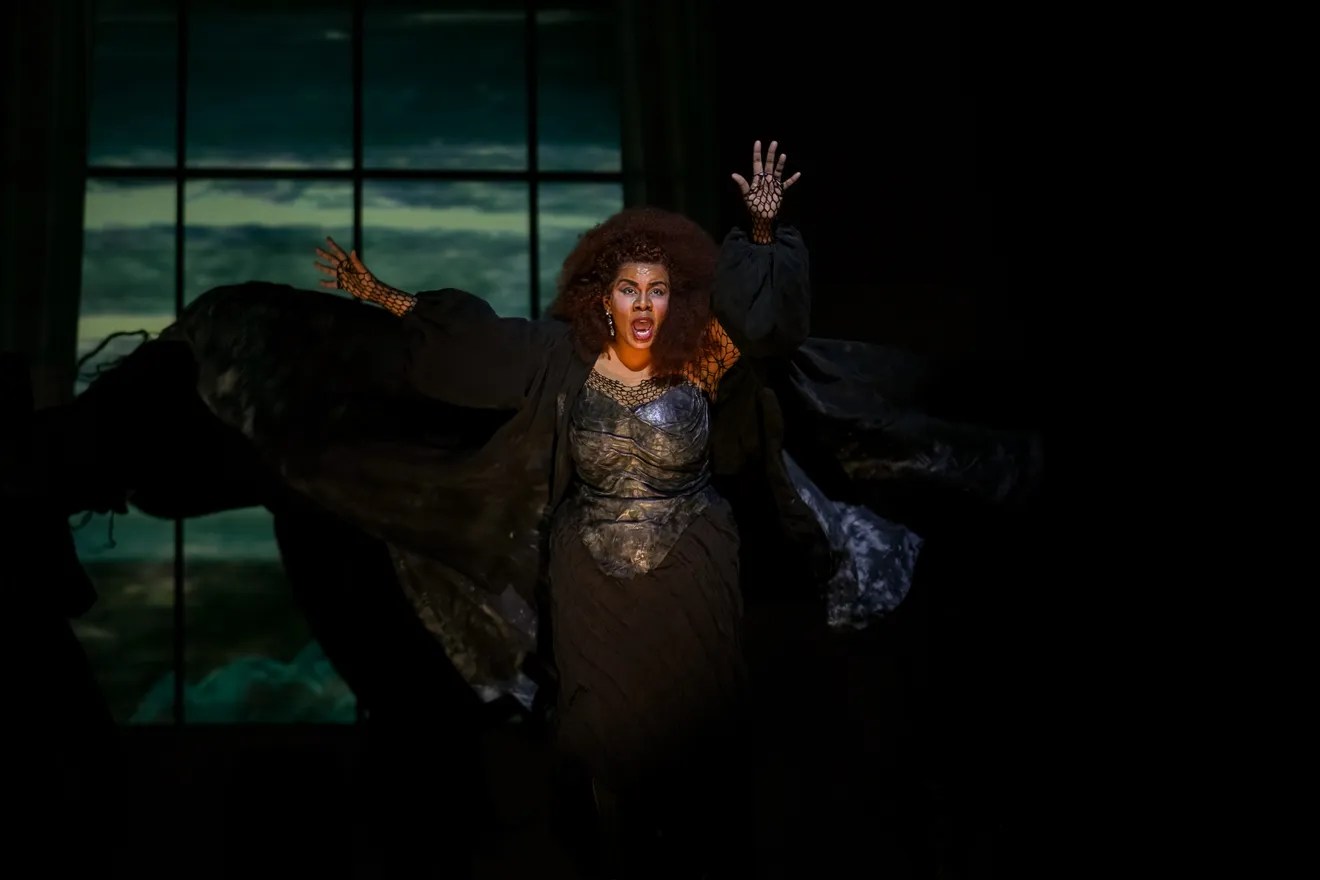
Nicole Heaston’s Armida “bigger-than-life star turn that occasionally leaves you gasping with laughter.”
The Detroit Opera Orchestra. Beddington describes the orchestra’s “stylish performance, playing in top form along with an amazing continuo ensemble with the indispensable Michael Leopold winning the day on theorbo (a large, stringed instrument in the lute family).”
Longtime readers of SimanaitisSays may recall theorboist Michel Angers accompanying soprano Peggy Bélanger at “Ferraris I Have Known.”
And Let’s Not Forget Aspen. Beddington writes, “I hate to ruin maybe the show’s best surprise, but praise must be printed for real-life therapy dog Aspen, a Golden Retriever who took time from his busy career to play a therapy dog in this staging. At curtain call, the audience abruptly leapt to its feet when the very good boy was trotted out by handler Amanda Loveday.”

Clearly, as Beddington suggests, “Just what the doctor ordered.” ds
© Dennis Simanaitis, SimanaitisSays.com, 2025
 Simanaitis Says
That is a great story! Thank you. And of course I had to search (Duck Duck Go, not Google) for “opera dogs.” First result was a cute story about Verdi and his dogs: https://operawire.com/the-wonderful-world-of-opera-dogs-giuseppe-verdis-hunting-companion-pampered-pet/
Operawire also listed a couple of other stories of composers and their dogs, such as Wagner’s many pooches. Then there’s the wierder stuff: I almost want to see this movie: Dogs at the Opera (warning, Youtube trailer; I don’t know if it was ever actually released). But I didn’t see anything on Page One that referred to dogs actually acting; Detroit may have a first! Setting Handel in a hospital ward certainly is one!
Since I’m not the only one distracted by your therapy dog mention, that’s your fault … having been warned by W.C. Fields who famously stated “Never work with children or animals,” a sentiment suggesting he found they were unpredictable or could steal the scene.My experience with both involves my attendance in the early ’60s of Camelot on Broadway, (tickets supplied to a young sailor by the then active ‘Soldiers, Sailors and Marines Society.’)The opening sequence was a throng traipsing back and forth across the stage while the curtain raised and the orchestra built excitement. Among the last across the stage was a herald leading a large dog … who stopped dead center and hunkered, leaving a large prominent dump!Being the unflappable performer, Julie Andrews danced onto stage, wide circling the steamy mess, trilling “… it’s, Spring, it’s Spring ….!”