
Simanaitis Says
On cars, old, new and future; science & technology; vintage airplanes, computer flight simulation of them; Sherlockiana; our English language; travel; and other stuff
THE FOUR B’S, LYSISTRATA, THE SECOND GREATEST SEX, AND IS THAT A GUN IN YOUR POCKET? PART 1
KEEPING HEP ON WORLD CULTURE is a non-trivial activity. Here I was listening to my 6:00 a.m. BBC World Service and it mentioned the Korean Four B’s.

This encouraged a Wikipedia search on the 4B movement. And next thing I knew, I was deep into Aristophanes’ Lysistrata, as well as a 1950s musical comedy movie The Second Greatest Sex with songs by Henry Mancini, and a 2016 flick Is That a Gun in Your Pocket, this last one earning a Rotten Tomatoes 0%.
Win some, lose some, with tidbits following in Parts 1 and 2 today and tomorrow.
The 4B Movement. Wikipedia recounts, “4B or ‘Four Nos’ is a radical feminist movement that originated in South Korea. The name refers to its defining four tenets which all start with the Korean-language term bi (Korean: 비), roughly meaning ‘no.’ Its proponents do not date men, marry men, have sex with men, or have children with men.”
“The movement, Wikipedia continues, “emerged between 2017 and 2019 on Twitter and on the website WOMAD. It has since spread internationally, namely to the United States after its 2024 presidential election.”
“Hmm…” said the person living under a rock, “What’s so special about that election?”
Korean Etymology. Wikipedia lists the movement’s four core tenets: “no sex with men (Korean: 비섹스; RR: bisekseu), no giving birth (비출산; bichuksan), no dating men (비연애; biyeoonae), and no marriage with men (비혼; bihon).
Expansion in the U.S. Wikipedia describes, “… some American women expressed interest in the 4B movement as a form of protest against Trump’s election, his alleged sexual assaults, and his role in the overturning of Roe v. Wade. Other American women expressed interest in 4B as a method to support other women and to protect their health and safety should they lose access to birth control or abortion.”
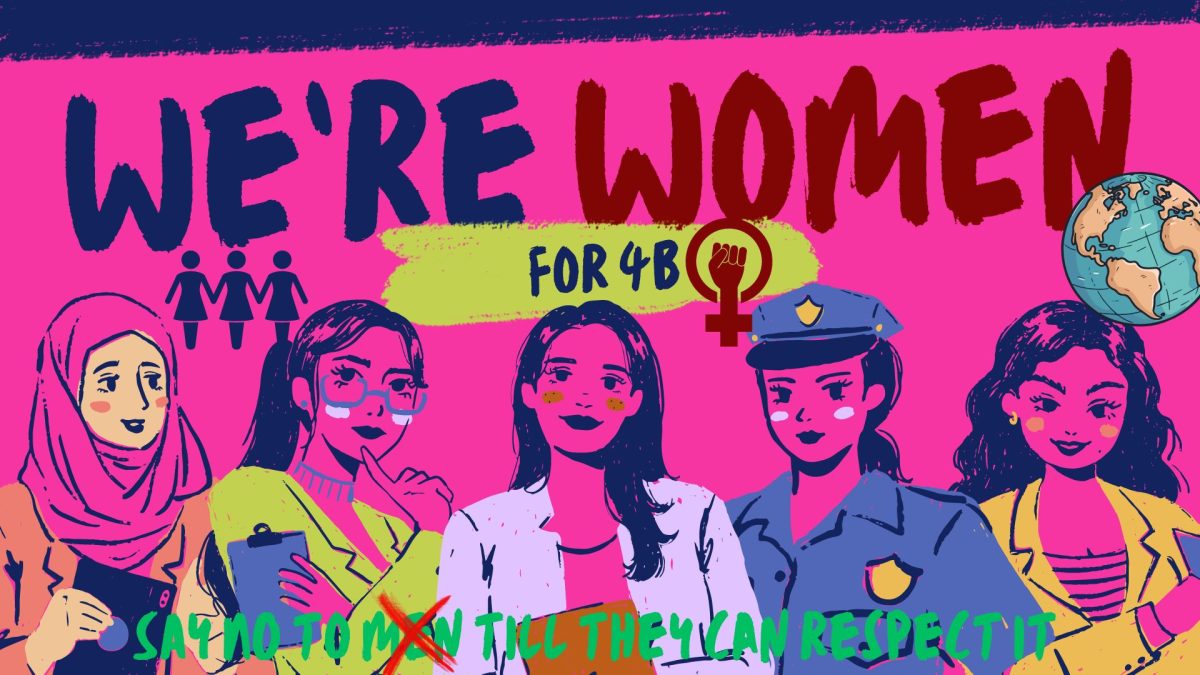
Image from wildkats.com.
“Shortly after the election was called, Wikipedia recounts, “TikTok videos mentioning 4B were viewed hundreds of thousands of times, and Google searches about it spiked by 450%. American women have called the movement the ‘4 Nos’ and ‘Lysistrata.”
Aristophanes’ Lysistrata. The New Dictionary of Cultural Literacy writes of this ancient Greek comedy, “The title character persuades the women of Athens and Sparta, which are at war, to refuse sexual contact with their husbands until the two cities make peace.”
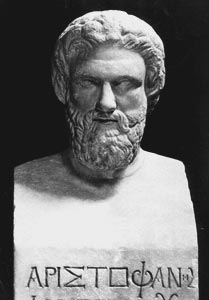
Aristophanes, c. 446 B.C.–c. 386 B.C., Ancient Greek comic playwright from Athens. Bust of Aristophanes in the Uffizi Gallery, Florence.
The Thesaurus of Book Digests offers rather more details: “The Lysistrata was produced on the stage toward the end of the Peloponnesian War…. The women of Athens, who normally lead a cloistered life, seize the Acropolis and open negotiations with the women of Sparta, the enemy state. The scheme of the Athenian women’s leader, Lysistrata, calls for a boycott on all marital relations until their husbands make peace.”
What’s more, the digest continues, “… the seizure of the Acropolis freezes the treasury with its funds for the prosecution of the war…. But the forces of nature are at work and the men are in an equally sad plight…. The terms are soon struck, and the comedy ends with general reconciliation and jubilation.”
“As low comedy,” the digest notes, “the play is unsurpassed among Aristophanes’ works. The frankness and earthy character of its language have made it less popular than many of the others, but its appeal to the universal love of peace on understandable terms raises it above time and place.”
See also “Aristophanes—Ancient Greece’s S.N.L.” here at SimanaitisSays.
Tomorrow in Part 2, we’ll continue with Wikipedia’s description of ancient Greek theatrics as well as Lysistrata-inspired works in the 20th and 21st century.
Now that’s theatrical legs. ds
© Dennis Simanaitis, SimanaitisSays.com, 2025
 Simanaitis Says