
Simanaitis Says
On cars, old, new and future; science & technology; vintage airplanes, computer flight simulation of them; Sherlockiana; our English language; travel; and other stuff
A HOT ’55 CHEVY AND MORE
“AFTER 25 YEARS OF BUILDING CONSERVATIVE six-cylinder automobiles,” R&T wrote, “the 1955 Chevrolet V-8 is an anomaly…. but it certainly appears that a Chevrolet V-8 with optional 180 bhp engine and 4.11 axle will out-accelerate any American car on the market today!”
Here, 70 years later, are tidbits gleaned from R&T’s February 1955 road test of this car, together with “15 Years of Progress,” subtitled “a comprehensive report on Chevrolet performance” in that same issue.

This and the following images from R&T, February 1955.
Particular interesting is the chart comparing specifications and performance data.

“From the performance standpoint,” R&T wrote, “there has been through the years more mis-information regarding the Chevrolet than any one make you can name—with the possible except of Duesenberg.”
The Editor’s Chevys. By 1955 John R. Bond was Editor of the magazine. He had owned and—being John R. Bond—had tested his two Chevrolets, a 1940 Special Deluxe Club Coupe and a 1951 Bel Air Coupe.
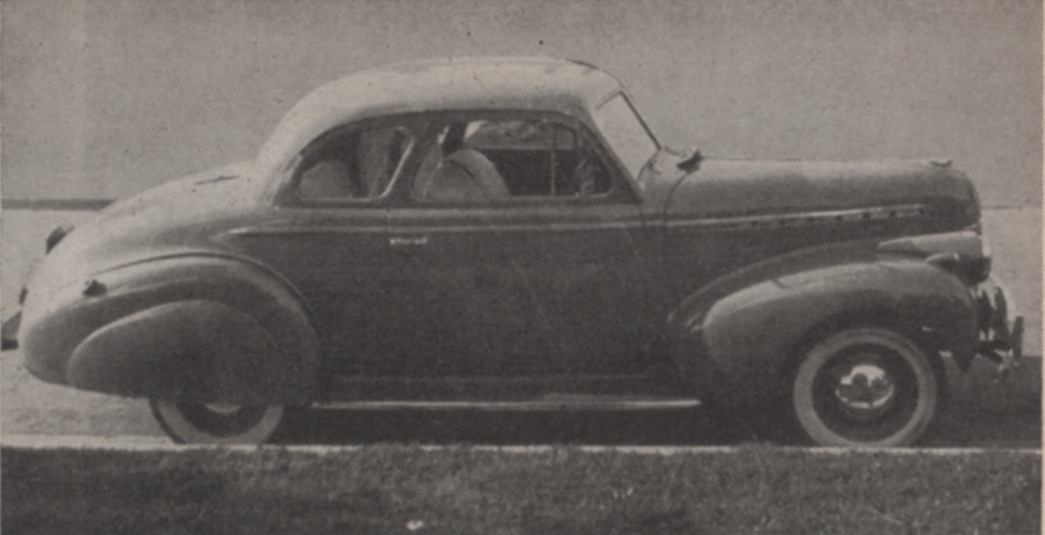
JRB’s actual 1940 coupe.
R&T documented, “The ‘cream puff of the Chevrolet line’ said Consumers Union, but it cost only $826 delivered, including Cleveland’s city tax and $15.00 extra for white wall tires.” My handy CPI Inflation Calculator sets its price in today’s dollars at $18,748.
“At 18,000 miles,” R&T recounted, “the car gave no trouble except that the tappets required re-setting exactly 22 times. In explanation, this was probably due to over-revving during numerous attempts made to keep up with a competitive V-8.”
Hmm… Our kind of car guy.

The editor’s 1951 Chevrolet was road tested in the fall of 1952.
“The Los Angeles dealer,” R&T reported, “couldn’t understand why anyone would want a ‘stick-shift,’ but finally admitted he had one in stock…. Troubles with the ’51 were almost nil. The original equipment battery lasted one year to the day [no doubt the warranty of the era] and once a rear spring U-bolt dropped off”
The ’54 Six. “In June of 1954,” R&T described, “we road tested a Corvette and mentioned that the dealer had also supplied us with a 1954 sedan. This car, with 115 bhp, a manual transmission and standard 3.70 axle was tested at the same time as the Corvette.”

“A 1954 Chevrolet with manual shift gave markedly better performance than earlier models, as shown by the comparison chart below,” the R&T caption read.

And the ’55 Hot V-8. “Just how ‘hot’ is this car?,” R&T asked. “At the time our performance tests began, the odometer read only 1451 miles. Yet an average of 3 tests from zero to 60 mph (actual, not indicated) gave 9.7 seconds…. but our acceleration checks were severely handicapped by the redesigned shift control mechanism—the one serious fault with the car. It was absolutely impossible to make a fast shift from first to second, and given a decent shift lever linkage we are confident that the zero to 60 time can be reduced to 9.2 seconds without speed shifting.”
To put this acceleration in perspective, when I joined the magazine some 24 years later we were still using a 10-second bogey to separate decent acceleration from also-rans.
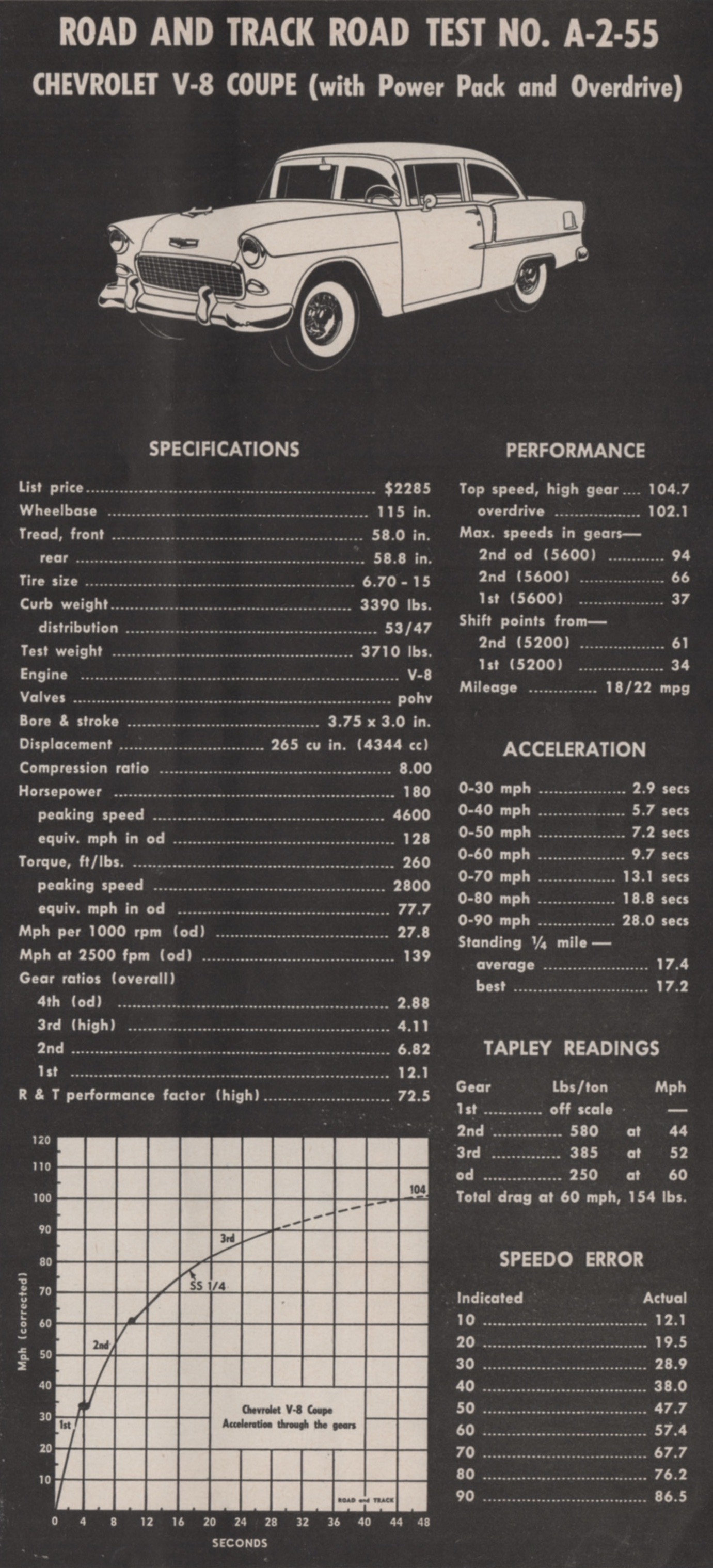
Chevy Handling of the Era. “Like all American cars,” R&T wrote, “the road-holding is steady on straight roads, requires skills and dexterity on winding roads. Our experience with late model Chevrolets is not sufficient to state whether the ’55 handles better than in previous years, as is claimed. Perhaps it does, but there is plenty of room for improvement in this department. Roll angle in a fast turn is about normal for an American car.”

“The steering,” R&T complained, “can be criticized, for it requires about 4.5 turns lock to lock. We say ‘about,’ because there was so much flexibility in the steering mechanism that a careless check, without watching the front wheels, would give 5.0 turns lock to lock.”
Lbs/bhp and Rear-axle Ratio. On another analytical note, R&T observed, “Using advertised horsepower and actual curb weight, 18.9 lbs/bhp is bettered only by two or three American cars. The fact that this car will probably out-perform all of them is attributable to the high performance axle ratio of 4.11:1. Such a ratio is, in turn, feasible and practical only because of the short stroke, high rpm engine.”
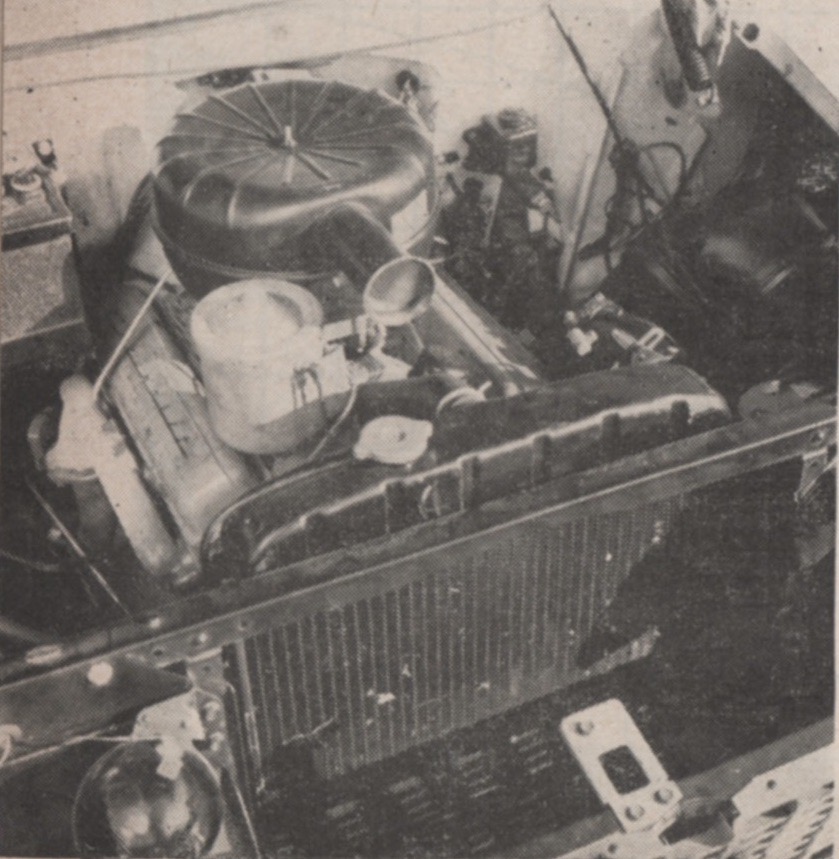
The Chevrolet 90º V-8 had an 8.0:1 compression ratio, displaced 265 cu. in./4344 cc, and produced 180 bhp at 4600 rpm.
“The new V-8,” R&T noted, “is a far cry from the days of the prewar ‘cast iron six’ which peaked at 3200 rpm, would not exceed a timed 80 mph—and never seemed to wear out. Yet the new V-8 should not bear the stigma commonly associated with a ‘high speed’ engine. It peaks at a high speed, but engine revolutions per car mile are no different from the old ‘slow speed’ Chevrolets from 1932 to 1952. More to the point, that all important wear and durability factor, piston speed, has been drastically reduced.”
No wonder the “small-block Chevy” became legendary. ds
© Dennis Simanaitis, SimanaitisSays.com, 2025
 Simanaitis Says
The old six-cylinder Chevies were always noted for smoothness, tho’ i’da taken a Plymouth over one of them or a Ford in the ’30s and ’40s.
’41 Chevies were especially well regarded, and a clean one could bring a whopping $2,500 after the war.
Though Chevy division chief engineer Ed Cole often given credit, the 1932-39 Packard Twelve’s chief engine designer, Al Kolbe, headed the engineers designing Chevy’s new V-8. (The Packard Twelve was originally intended not to supplant the topline 385-ci Custom Eight, but as a 376-ci FWD contender for the 345-ci Buick Series 80/90, FWD being in the public eye thanks to Miller Indy racers and the new Ruxton and Cord L-29, also cheaper because no driveshaft and differential required. But Cadillac unveiled a V-16, essentially a straight eight with the firing impulses halved for less crankpin loading, able to use the existing transmission, a bigger V-8 only unleashing vibration, torque, and thermodynamic woes, in order to move three-ton custom bodies. Packard couldn’t be one-upped by Cadillac with a more is better public, so quickly enlarged their new V-12 to 445, later 473-ci, dropped it in the existing Custom Eight chassis.)
Styling being Generous Motors’ (as a former Cadillac dealer service manager called them) forte, the ’55 Chevy cribbed the concurrent Ferrari’s grille, just as the ’67 Camaro took the Ferrari Lusso’s shape.
Regardless, Chevy got it right with their new V-8, it lasting nearly half a century in ongoing revisions and expansions.
Legendary indeed .
Me, I prefer the “Cast Iron Wonder” inline 6 cylinder engines that made Chevrolet world famous .
My dream car would be a 1937 Business Coupe with options, radial truck tires, a 3.55 final drive ratio (I know a h=guy who makes the R&P) and likely a Chevrolet truck engine be it a ‘Babbit Pounder’ 235 or a nice ’55 ~ ’62 261C.I.D. full pressure oiler .
I want to know : did this ’55 Sedan come with overdrive or just the Saginaw three speed ? .
-Nate
The data panel in the story above suggests that it had 3 sp+OD. For its time, that ’55 looks pretty peppy.
Then there were the real Slow Dawgs: Blue Flame six with a Powerglide (as our family bus/’57 Chevy Two-Ten wagon was equipped). Handling on typical cardboard bias-ply tires was, well, slow down, crank the steering (something like 6 or 7 turns lock-lock) until reaching the desired list, and motor around. Braking was slightly better than opening the doors and dragging your heels, but faded quickly. But the ultimate reason for replacing it was the size of the developing rust pockets in the rear fenders; it was still working fine otherwise after 10 years of mostly in-town SF driving. Oh, and the arrival of a 4th kid; Chevy only had 2 bench seats. Supplemented in ’63 with a VW Beetle, and replaced in ’68 with a Dodge Coronet 3-seat wagon, 318/Torqueflight, extra-large drum brakes (unassisted) that came with the trailer towing package, and power steering so light you could drive with one hand on the wheel hub.
I don’t wish to return to those days. Though a ’94 Honda Accord had brakes that (though assisted) were close to as bad as the Chevy’s.
Vwnate, your ideal Chevy sounds nice, something poetic about inline 6s & straight 8s being the only two engines having natural inherent balance, and other than the yet to be invented radial tires, what Juan Fangio began racing through the Argentine mountains: a ’37 Chevy business coupe with a fabric trunk lid which had to be to save weight.
No Generous Motors product offered overdrive until the ’55 Chevy. Buick Centuries/Roadmasters of the late ’30s, ’40s, came with 3.9:1 axles, unless you ordered the rare no-cost optional “Economy” 3.6 first appearing for ’39. So fitted, one of 1941’s “Compound Carbureted” Centuries or Roadmasters (same car but the Roadmaster had the racier C body) were one of only two cars off a Forties showroom floor able to best an honest 100 (the other was a Packard Super/Custom Super Eight with overdrive). With the Buick 320-ci’s 4 5/8ths stroke and babbitt bearings, even a 3.6 rear cog sounds like a real workout.
Cadillacs on the standard, shorter wb came 3.9, until 1941 when they had 3.77:1. But you could order that year’s 3.36:1 HydraMatic rear cog as an “Economy” rear axle. So equipped, 1941-47 Cadillacs got up to 96+ at the GM Proving Grounds, the manual shift jobs half a mile per hour faster not having HydraMatic’s fluid coupling loss.
MikeB, hear you loud and clear about not wanting to return to those thrilling days of yesteryear, to borrow from the Lone Ranger, and my stick ’02 Civic EX coupe, let alone my girl’s slick ’01 Miata (once i squeeze inside) are another galaxy more relaxing that the cars you cite, tho’ i, too, would’ve taken a Chrysler product over GM or FoMoCo of the ’60s.
Your mentioned your 210 wagon’s slow steering. Just read about Dan Gurney campaigning a bone stock but for Corvette sway bar and brake cooling ducts ’61 Impala in England against concurrent Jag-ue-were 3.8-liter saloons. Gurney’s Impala had 6 1/2 turns lock to lock. This was of course on a road course. Thinking of Grand Prix racers with little as 3/4 of a turn lock to lock (am i right, Monsignor Simanaitis?), cannot even imagine such an undertaking. See below.
Knowing what he was about re: both older auto and prop aero engines, LJK Setright’s two favorite marques were Chrysler and Honda.
That said, if you live where traffic not frenetic and can find some winding back roads, having a 78 1/2-year-old dragon in the garage, fully understand what Vwnate harks to on occasional dry, calm days. Stupor Bowl Sunday is hands down the best, nay, the only day of the year you can halfway relax in an old car in the greater Bay Area, and i imagine my old greater NYC and many other megapolises.
Please pardon the ramble. Autoholicism is a vile disease. Why can’t we be content to drive golf carts, watch NASCAR or TV gladiator games like most blokes?
https://www.roadandtrack.com/motorsports/a23007587/dan-gurney-chevy-impala/
Invoking Grand Prix reminds us that the world’s leading GP driver, Sir Lewis Hamilton, is an outspoken fellow vegan, may that so kick start others this New Year, the better to remain fettled to enjoy whatever beckons or taunts in the garage.
FWIW, my name is Nate .
You’re apparently unaware that in 1951 Chevy upgraded (!) to Bendix brakes, those of us who love the older Chevies were crippled with “Huck” brakes and yes, they were as bad as that name sounds, rhymes with ‘suck’ .
It’s not a terribly hard thing to do to up grade your old 6 lug Chevy to Bendix by swapping over everything from a ’51 ~ ’70 1/2 ton pickup truck .
I’m one who still enjoys driving oldies, my shop truck was a ’49 3100 until my knees gave out, I picked my light truck radial tires very carefully, IIRC they had a 32″ tread diameter, this allowed the ’57 235 and torque tube driveline to make 65 MPH without undue strain .
As far a over drives. ‘Ruckstell’ making of famous Ford overdive kits also sold “Truckstell” overdrive kits for the ’47 ~’54 Advance Design trucks and yes, it too was a bolt on and one can still buy the factory sway bars fitted to that series of Suburbans, makes an incredible improvement .
IIRC the ’55 Chevy sedan had just over 5 turns lock to lock .
I vividly remember driving my ’62 Ford Ranch Wagon briskly in town, it too had way too many turns lock to lock in it’s unassisted steering, upon making a 90 degree turn I’d let go the steering wheel and stamp on the foot feed, watch the spokes of said steering wheel blur as it rapidly unwound .
I still drive my stock ’59 VW Beetle as fast as it’ll go on far remote Farm to Market roads , it’s not actually fast but certainly is quick, I like driving slow vehicles quickly, it’s fun and safer and keeps the mind sharp .
If you can see my avatar that’s me with the hat on my ’37 Harley-Davidson KnuckleHead in Guatemala, Centro America in 1976 ~ fun times .
-Nate
Hah, i recall once letting go of the steering wheel in some ’60s domestic crock while putting my foot in the carb and watching it spin.
But for the life of me, cannot imagine how Dan Gurney bested those Jag 3.8 saloons even with 409-ci and the optional H.D. suspension.
Overdrive makes all the difference in most any old/prewar car, as do radial tires, as you observe, Nate.
Huck brakes. Oy effing ay yi yi vey. A late mechanic/machinist/pilot renaissance man longtime friend and neighbor had, in addition to the blown ’37 Cord 812 Phaeton he bought in 1942 as a very young Pan Am wrench at the Alameda Naval Air Station (“one day some big shot from the Navy came in and told us we were all in the Navy and left. That was it. We just went back to work as usual the rest of the war”) still had his novelist mother’s ’35 Cadillac V-8 Model 355D side-mounted sedan she’d bought new.
“The Lincoln, Chrysler and Pierce dealers all brought up cars to show her. But when the Cadillac salesman arrived, he bled the tires down at the front gate so it had the softest ride.” It had Huck brakes, only scaled up from the Chevy’s. He said they were awful.
Yeah, driving old stuff fun for the charm and hard to quantify visceral pull. I “get” old motorbikes, but since the only time i was a jock was a season on the cross country team and legs come in handy, i went straight from bicycle to cars, with forays on the New York Central/Penn Central commuter trains, subway, hitchhiking in betwixt. I like having a wheel at each corner.
Prosit.