
Simanaitis Says
On cars, old, new and future; science & technology; vintage airplanes, computer flight simulation of them; Sherlockiana; our English language; travel; and other stuff
EXTRACTING LITHIUM MORE EFFICIENTLY PART 2
Yesterday, we learned about challenges of lithium sourcing and recent research in its technology. Today in Part 2, there’s an unanswered question and a novel electrochemical approach.
An Unanswered Question. Science’s Seth Darling notes, “One of the key unanswered questions is how to optimize extraction efficiency (percentage of lithium recovered) while minimizing environmental impact, especially concerning water usage and land disruption. Lithium brines are typically found in arid climates. For local communities in the Atacama Desert in South America, water is a resource far more precious than lithium. Thus, improved water efficiency must be prioritized for new technologies.”

Li et al. are at the Division of Physical Science and Engineering, King Abdullah University of Science and Technology (KAUST), Thuwal, Kingdom of Saudi Arabia.
Li et al.’s DCMF Cell. An Editor’s summary recounts, “The oceans contain substantial aggregate quantities of lithium salts, but the comparatively low concentration makes them hard to separate from sodium and magnesium (see the Perspective by Darling). Li et al. now demonstrate a [Decoupled Membrane-Free, DCMF] method inspired by the batteries themselves …. In this method, iron phosphate electrodes can selectively intercalate lithium from salt water and then release it into fresh water. Charge balance is provided by silver oxidation and reduction at paired counterelectrodes in each medium, keeping all other cations on the salt side.”

A schematic of a DCMF lithium extraction cell. This and the following image from Li et al.
In their Abstract, Li et al. describe, “This design is compatible with harsh brines having magnesium/lithium molar ratios of up to 3258 and lithium concentrations down to 0.15 millimolar, enabling the production of battery-grade (>99.95% pure) lithium carbonate.”
The researchers describe, “Energy savings of up to ~21.5% were realized by efficiently harvesting the osmotic energy of the brines [in which water moves from a dilute solution to a concentrated one]. A pilot-scale cell with an electrode surface area of 33.75 square meters was used to realize lithium extraction from Dead Sea brine with a recovery rate of 84.0%.”
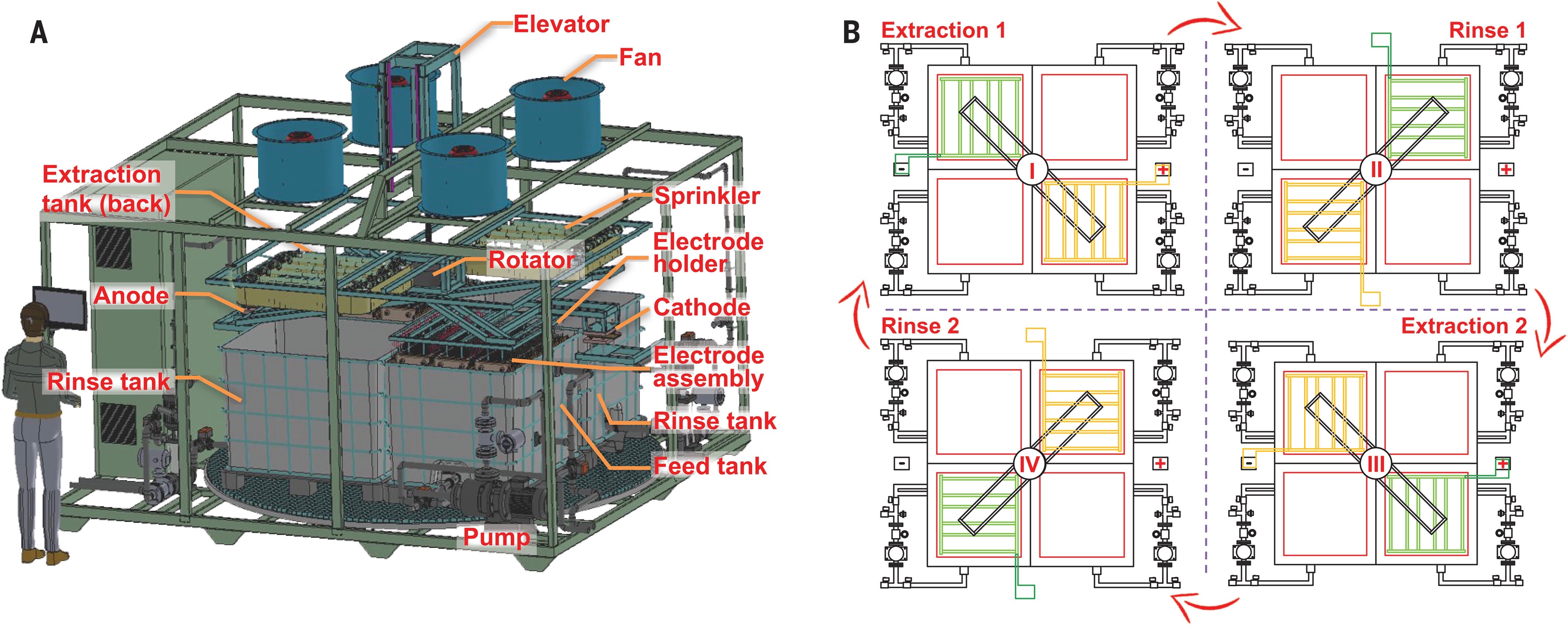
Illustration and operational sequence of a pilot-scale DCMF apparatus.
The researchers say, “We developed a DCMF cell design for lithium extraction from inferior brines, efficiently utilizing osmotic potential to decrease the energy consumption of the system. The extraction cost was competitive with that of lithium extraction from conventional resources, and the design was simple and easily upscalable. We expect the inherent process flexibility of our design to stimulate the integration of innovative ideas into broader applications.”
Work to Come. Darling observes, “… the economic viability of these new methods remains uncertain. Materials such as the Al nanoparticles and anodic Al2O3 membranes used by Song et al. and the solvents and silver electrodes used by Li et al. are generally expensive and need to be replaced by lower-cost materials with comparable performance. Moving forward, artificial intelligence–driven process optimization and life cycle and techno-economic analysis to create a more sustainable and resilient lithium supply chain will enable the clean energy transition.”
Another wild card not mentioned is alternative solid-state battery technology, in which lithium-ion technology is replaced with lithium anodes and a solid electrolyte rather than a liquid one. ds
© Dennis Simanaitis, SimanaitisSays.com, 2024
 Simanaitis Says