
Simanaitis Says
On cars, old, new and future; science & technology; vintage airplanes, computer flight simulation of them; Sherlockiana; our English language; travel; and other stuff
EXTRACTING LITHIUM MORE EFFICIENTLY PART 1
SETH B. DARLING WRITES IN “The Brine of the Times,” AAAS Science, September 26, 2024, that “Tremendous attention focuses on lithium, which is primarily sourced from either hard rock called spodumene or natural brines—solutions containing lithium and other salts found in continental deposits, for example. However, mining lithium often involves energy-intensive, laborious processes.”
Darling reports on two research efforts opening up “opportunities for sustainable extraction from unexploited dilute brines.” One by Li et al. describes “Lithium Extraction from Brine through a Decoupled and Membrane-Free Electrochemical Cell,” AAAS Science,September 26, 2024. The other, by Song et al. describes “Solar Transpiration-Powered Lithium Extraction and Storage,” in the same AAAS Science issue.
Here, in Parts 1 and 2 today and tomorrow, are tidbits gleaned from these three articles about these promising new sustainable technologies.
Today’s Technologies. Darling describes, “Hard rock mining is capital intensive, environmentally taxing, and time-consuming to scale. Brine extraction, although less environmentally harmful, is slow and requires extensive evaporation processes that can take months or even years.”
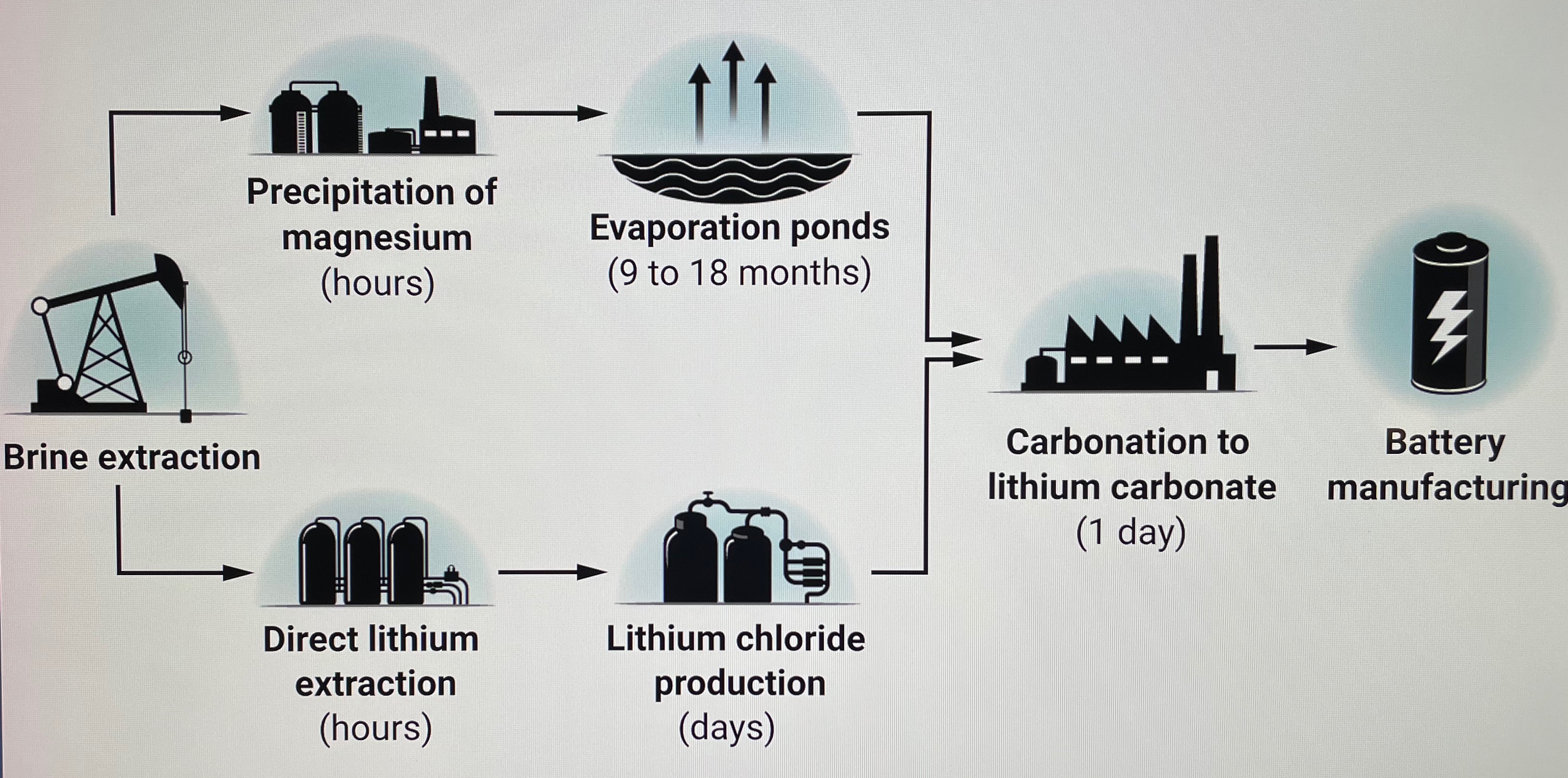
Above, the traditional approach; below, direct extraction. Image from Science, September 27, 2024.
Tomorrow’s Potentials. “One set of ideas called direct lithium extraction,” Darling writes, “bypasses the need for evaporation ponds and implements adsorbents, electrodes, or membranes to selectively separate out lithium directly from underground brine. Another approach keeps the ponds in place but accelerates the evaporation by using energy that is available freely in the environment .”

Song et al. are at the National Laboratory of Solid State Microstructures, College of Engineering and Applied Sciences, Jiangsu Key Laboratory of Artificial Functional Materials, Collaborative Innovation Center of Advanced Microstructures, Frontiers Science Center for Critical Earth Material Cycling, Nanjing University, Nanjing, China.
Sun-Driven Transpiration. Song et al. describe in their Abstract, “Lithium mining is energy intensive and environmentally costly. This is because lithium ions are typically present in brines as a minor component mixed with physiochemically similar cations that are difficult to separate. Inspired by nature’s ability to selectively extract species in transpiration [water evaporation], we report a solar transpiration–powered lithium extraction and storage (STLES) device that can extract and store lithium from brines using natural sunlight.”
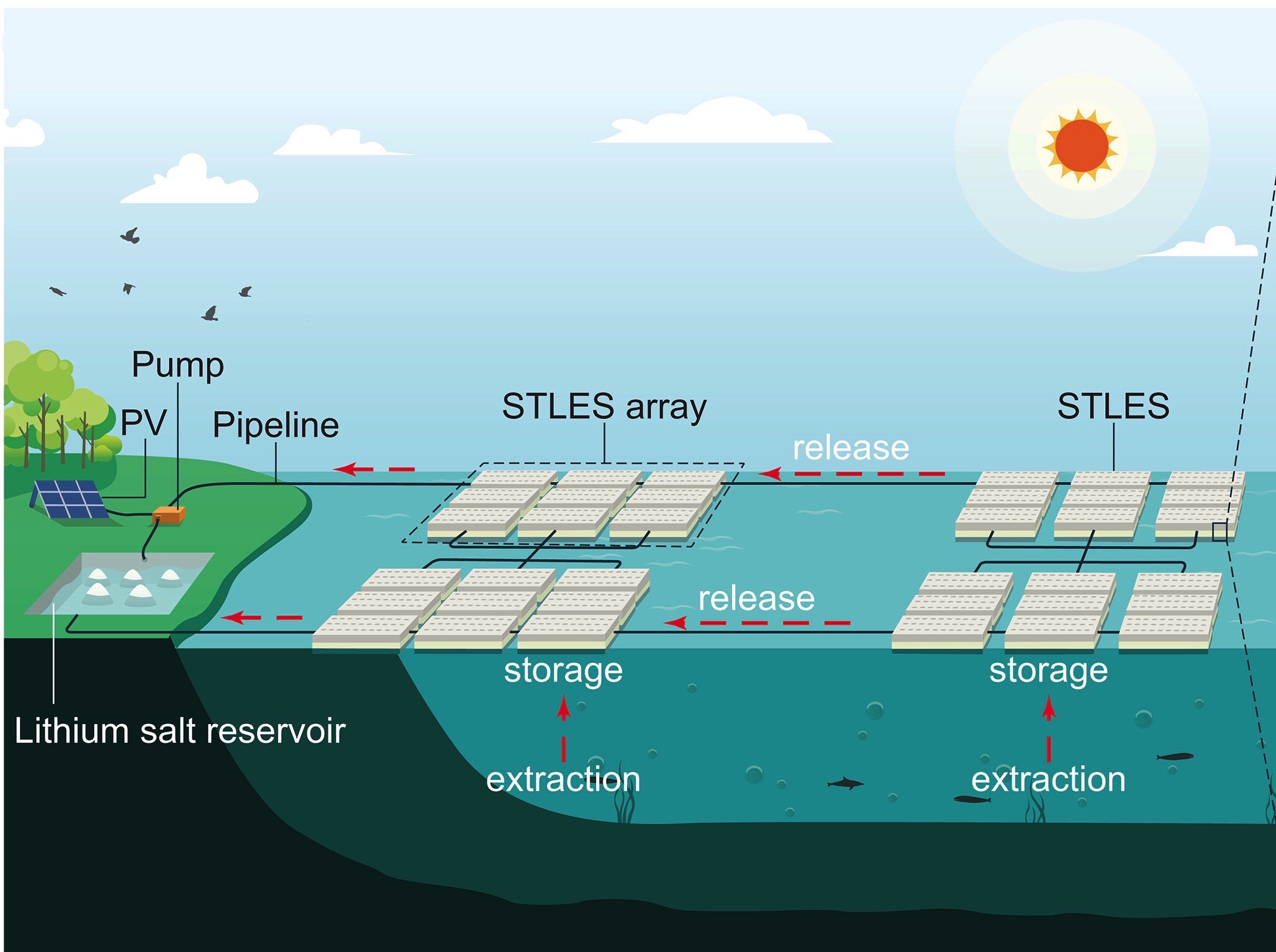
Above, STLES can float and extract lithium from brines using only ambient sunlight as the source of energy. Below, each platform has an array of modules, each with eight layers. Images from Song et al.
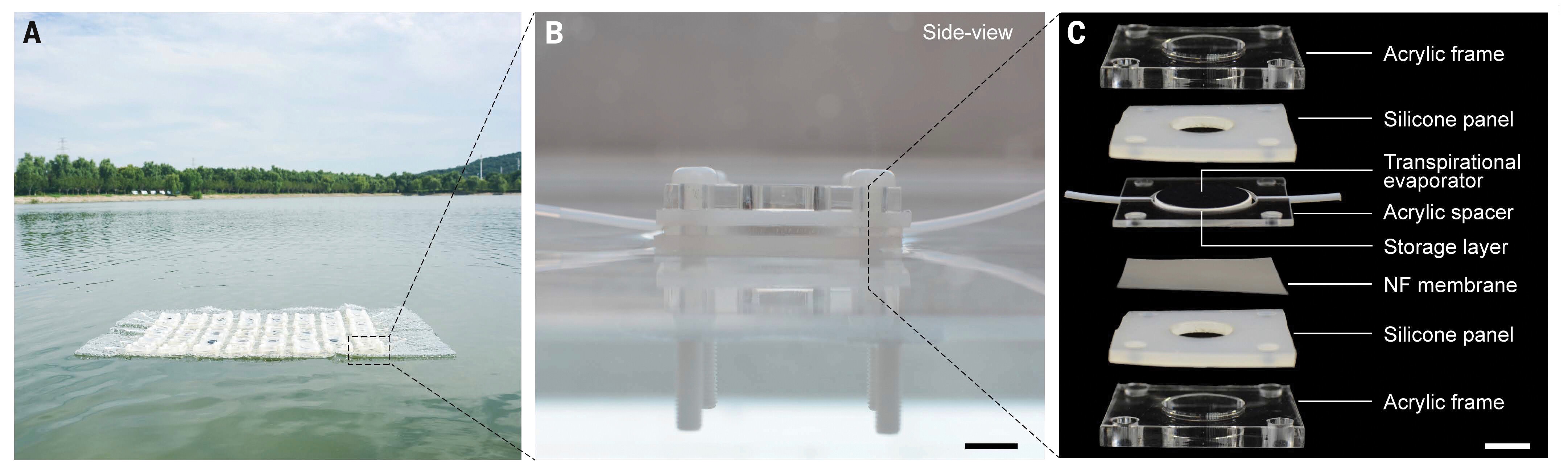
Enhancements to Come. The researchers report, “This STLES design is showcased as a proof of concept and can be further enhanced by integrating advancements in the fields of solar evaporation, membrane, microfluidics, and others. STLES is compatible with different types of membranes, which implies that its lithium extraction performance can benefit naturally from the advancement in membrane technology.”
“The modular configuration,” they note, “enables the combination of multiple STLES to create a large platform that can extract lithium at scale.… The lithium productivity of the STLES platform scales linearly with the number of modules adopted, which highlights the excellent scalability of our approach.”
Tomorrow in Part 2, Science’s Seth Darling raises the issue of water, a crucial aspect in lithium sourcing. And we learn about Li et al. and their DCMF lithium extraction cell. ds
© Dennis Simanaitis, SimanaitisSays.com, 2024
 Simanaitis Says
Another brilliant, and timely, article via Simanaitis Says. While the above bodes better for vital lithium, there are not enough raw materials for the world to swap all ICE (internal combustion) cars for EVs. EVs run on petroleum tires –producing most of the dust in urban areas — and use six (6) times as many minerals as i.c. cars, including cobalt, lithium, nickel, copper, manganese, graphite, zinc, rare earths like neodymium, thallium, and dysprosium, the latters’ extraction requiring huge amounts of carcinogens like ammonia, hydrochloric acid, sulfates.
Much of these minerals are imported from politically unstable regions. Thallium has been a common ingredient in rat poison. It’s tasteless, odorless, and nearly colorless. While those who tested positive hadn’t consumed poisonous levels of the metal, it was enough to cause fatigue, heart arrhythmia, nausea, digestive trouble, neurological problems, and hair loss. The scariest part is that even after patients completed detoxification regimens, thallium continued to show up in their systems.
“We now know that heavy metals are additive and synergistic,” says David Quid, the lead scientist at Doctors Data, PhD in nutritional biochemistry. “If you get a little thallium, and a little lead, and a little cadmium in your system, you’ve got one plus one plus one equals five or six, not just three.” In other words, these metals do more damage when they’re combined. “This stuff bioaccumulates,” he added. “Down the road, it’s going to kick you in the ass one way or another.”
His narrowness of mind, antisemitism, anti-unionism aside, Henry Ford had some ecologically minded ideas, if never coming to fruition, as with his wanting to burn coal in the ground, saving both on transport and sunken landscapes.
As Dennis has profiled here, hybrids far outsell EVs. UN and other studies show animals raised for meat and dairy produce more greenhouse gas than all the world’s cars, trucks, buses, trains, planes, ships combined, so EVs are no panacea. Just another reason every poll of scientists, inc. a 2013 poll of 2,000 UN scientists, and 11,000 in the 11/5/19 Bloomberg News, has them agreeing overpopulation remains our by far biggest problem; their words, “bigger than climate.”
So until we buck the consumer-driven media’s blackout on addressing this overarching juggernaut, EVs are tantamount to Band Aids on the patient hemorrhaging in the ER.