
Simanaitis Says
On cars, old, new and future; science & technology; vintage airplanes, computer flight simulation of them; Sherlockiana; our English language; travel; and other stuff
THREE SISTERS VS THE PESTS—THEORY AND PRACTICE PART 2
YESTERDAY’S PART 1 OFFERED the theory of interplanting corn, beans, and squash for mutual benefit of these vegetables, not to say their cultivators as well. Today we have Sylvia Klyz’s “Companion Planting Three Sisters” describe its practice. Plus I include a recipe for Three Sisters Bowl that I’ll make one of these days.

This and the following images from “Companion Planting Three Sisters.”
Learn From First Americans. “Native Americans,” Klyz recounts, “first practiced the three sisters companion planting and did it by looking for signs in their environment that indicated the right soil temperature and weather. For example they knew when to plant corn when the Canada geese returned or the dogwood leaves reached the size of a squirrels ear.”
She knows her science as well: “The corn provides a natural pole for bean vines to climb. Beans fix nitrogen on their roots, improving the overall fertility of the plot by providing nitrogen to the following years corn. Bean vines also help stabilize the corn plants, making them less vulnerable to blowing over in the wind. Shallow-rooted squash vines become a living mulch, shading emerging weeds and preventing soil moisture from evaporating, therefore improving the overall crops chances of survival in dry years. Spiny squash plants also help discourage predators from approaching the corn and beans.”
What’s more, she writes, “Corn, beans and squash also complement each other nutritionally. Corn provides carbohydrates, the dried beans are rich in protein, balancing the lack of necessary amino acids found in corn. Finally, squash yields both vitamins from the fruit and healthy, delicious oil from the seeds.”

A Supportive Family. Klyz observes, “Corn the oldest sister provides support. Beans are the nurturing sister…. Squash provides protection…. As these three sisters grow and intertwine together they create a strong barrier that is hard for the elements and pests to bring down, just like a supportive family.”
It’s clear that Klyz is attuned to Native American lore. And her observations agree with the most recent of agricultural science as well.
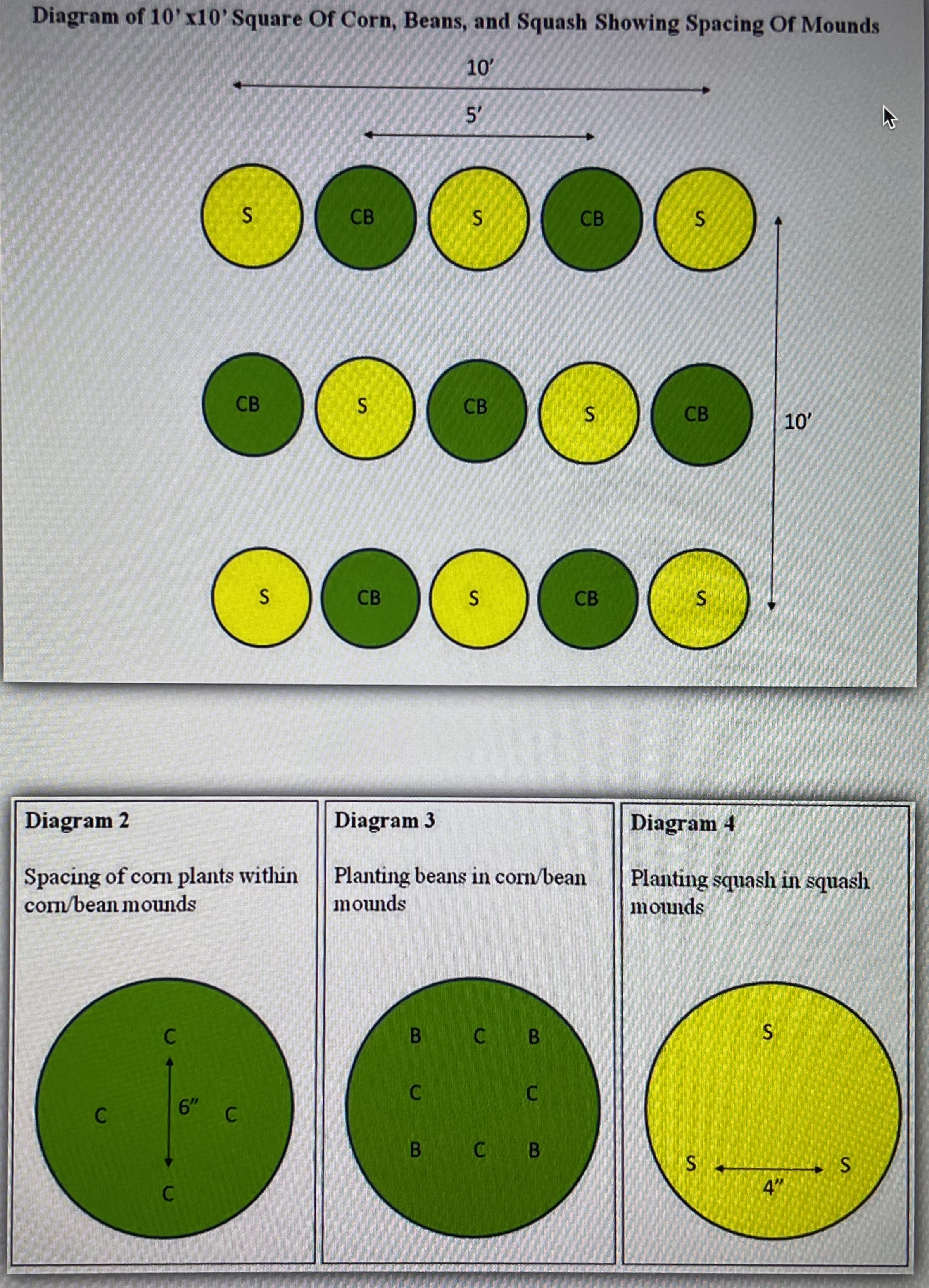
Here’s an example of her spacing mounds for optimal interplanting. Check out Klyz’s website for other details.
She describes planting the corn first, then the beans and squash: “Plant four corn seeds in each mound as shown. When the corn is 4 in. tall, it’s time to plant the beans and squash. First weed the entire patch. Then plant four bean seeds in each corn mound. They should be 3 in. apart from the corn plants. Build your squash mounds in each row between each corn/bean mound. Make them the same size as the corn/bean mounds. Plant three squash seeds, 4 in. apart, in a triangle in the middle of each mound.”
“When the squash seedlings emerge,” Klyz says, “thin them to two plants per mound. You may have to weed the areas several times until the squash take over and shade new weed.”
A Three Sisters Bowl. This recipe by Sean Sherman comes from The New York Times. As you can see, it is not without complications. However if, like me, your ancestors swapped farming implements to work in steel mills, you can buy canned ingredients (pause here to live down surrounding smirks). Onions and the rest, I already have; I’d use arugula.
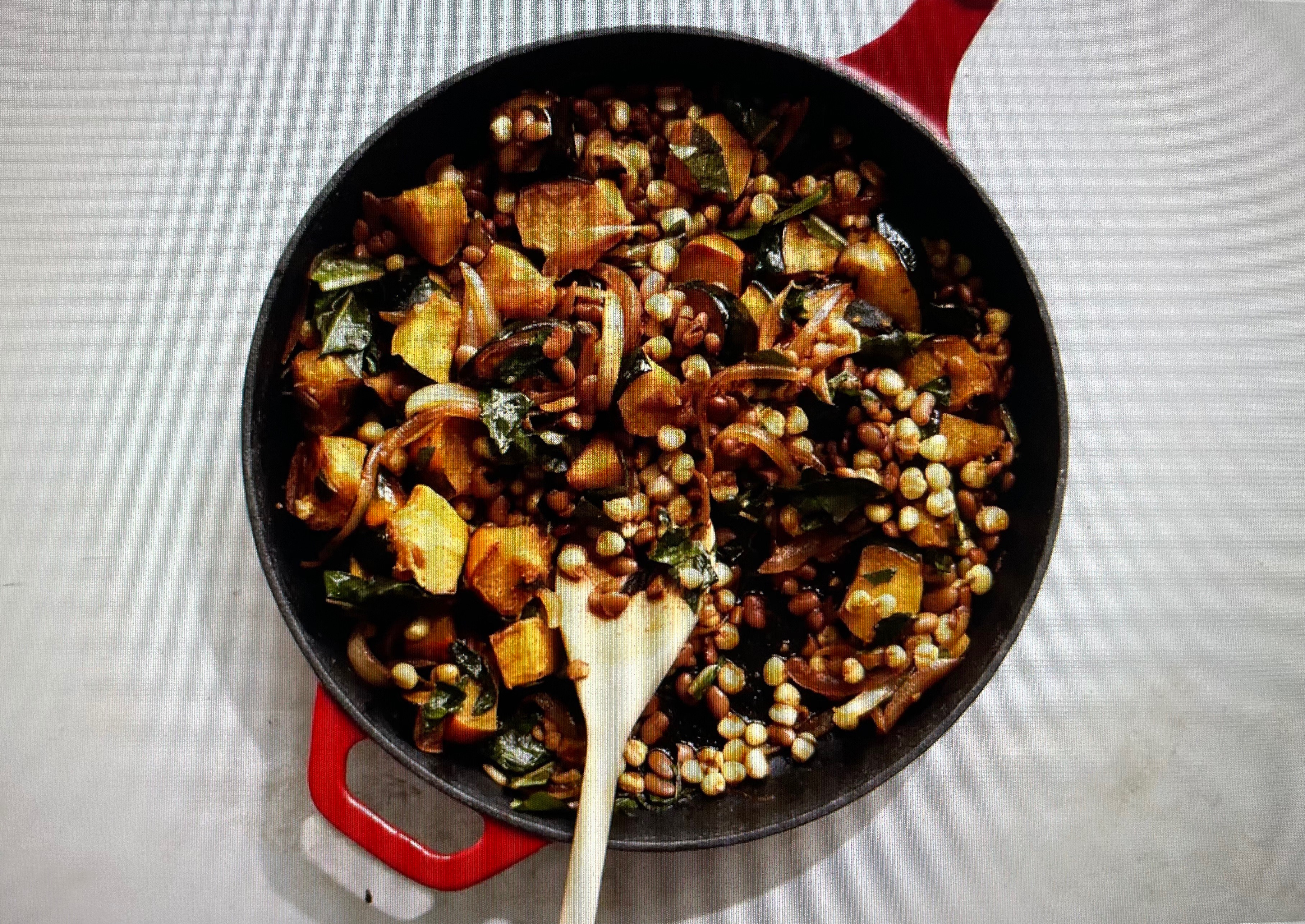
Image by Marcus Nilsson for The New York Times. Food Stylist: Maggie Ruggiero. Prop Stylist: Paige Hicks.
INGREDIENTS
- ½ cup dried hominy
- ½ cup dried brown tepary beans
- 1 small, unpeeled acorn squash (about 1 1/4 pounds), halved, seeds and membranes scraped away, then cut into 1-inch chunks
- 3 tablespoons sunflower oil
- Coarse sea salt
- 1 small yellow onion, halved and thinly sliced
- 1 tablespoon New Mexico Hatch chile powder or any mild smoked red chile powder
- 2 teaspoons chopped fresh sage
- Smoked sea salt
- ½ cup chopped dark greens, such as dandelion greens, kale or spinach
PREPARATION
- Place the hominy and tepary beans in separate medium bowls. Add enough water to each to cover the beans by 4 inches, and soak overnight at room temperature.
- About 3 hours before serving, drain the hominy and the beans and place them in separate 3- to 4-quart pots. Add enough cool water to cover the hominy and tepary beans by 4 inches. Set each over high heat, bring to a boil, then lower the heat and simmer gently, stirring occasionally and skimming any foam that rises to the surface, until tender, about 1 1/2 to 2 hours. Reserve 2/3 cup of the cooking liquid from each type of beans (for 1 1/3 cups liquid). Drain the hominy and the beans and set aside.
- Meanwhile, prepare the squash: Heat the oven to 425 degrees. On a parchment-lined rimmed baking sheet, toss the squash with 1 tablespoon oil and a pinch of coarse sea salt. Arrange the squash in an even layer and roast until golden and very tender, stirring halfway through, 35 to 45 minutes.
- In a large skillet, heat the remaining 2 tablespoons oil over medium-high. Add the onion, chile powder, sage and a generous pinch of smoked salt and cook, stirring occasionally, until the onions are tender, 5 to 8 minutes. Add the reserved 1 1/3 cups cooking liquid and bring to a simmer.
- Add the cooked hominy and beans to the skillet, then stir in the roasted squash and greens. Season to taste with coarse sea salt and serve.
Beans, hominy, and squash outta cans eliminate Steps 1-3. I’m sorry about grandpa tossing out that hoe; I suspect Sean Sherman’s Three Sisters Bowl made with Sylvia Klyz’s ingredients tastes better. ds
© Dennis Simanaitis, SimanaitisSays.com, 2024
 Simanaitis Says
Just rebuilding our veggie space so things are at least 5′ from the house (fire rules). I won’t have 10×10 beds but perhaps I can make it work in 5×5? Will be fun to try next spring.
As for the bowl – looks like some of my weekend lunches – mixes of various veggies and (if I remember to start the night before, or use canned) beans. I’ll have to remember to throw some corn in next time. Somehow, they taste a little different each time as spicing seems not to be a repeatable experiment. 😉
And have you noted, in canned beans, that “Organic” beans have about 2/3 the salt of the “Low Sodium”, which has about 2/3 the salt of regular? Low-sodium diet these days…