
Simanaitis Says
On cars, old, new and future; science & technology; vintage airplanes, computer flight simulation of them; Sherlockiana; our English language; travel; and other stuff
WHENCE WISDOM?
THE NICE NEWS WEBSITE, August 31, 2024, features an article by Rebekah Brandes titled “What Makes Someone Wise? Global Study Finds Cross-Cultural Agreement on 2 Major Factors.”
How could one not read on?
Here are tidbits gleaned from Brandes’ article, a Waterloo News release, and the researchers’ Nature Communications paper published August 14, 2024.

Brandes writes, “Certain people just seem to embody wisdom: grandparents and teachers, the changemakers we admire from afar, the intellectuals whose ideas have influenced our own. However, given that cultures vary widely throughout the globe, it would make sense that the criteria for being deemed ‘wise’ would as well.”

“Wisdom” Differing Here and There? Brandes continues, “Researchers specifically sought to analyze cross-cultural perceptions of wisdom while filling a gap in existing research. Most of the prior scholarship on social judgment has come out of Europe and North America, ‘with a dearth of research on social judgment in the Global South.’ ”

In remedying this imbalance, the University of Waterloo news release describes, “The collaboration among 26 research institutions was coordinated by the Geography of Philosophy consortium and included researchers from North and South Americas (Canada, U.S., Ecuador and Peru), Asia (China, India, Japan, and South Korea), Africa (Morocco and South Africa), and Europe (Slovakia).”
Waterloo News continues, “The study involved 2,707 participants from 16 socio-economically and culturally diverse groups. They were prompted to compare 10 individuals, including scientists, politicians, and teachers, in the context of making a difficult choice in a real-life scenario without a clear right or wrong answer. The participants were then asked to rate the degree of wisdom of these individuals and themselves.”

This and the following from “Dimensions of Wisdom Perception Across Twelve Countries on Five Continents.”
Global Agreement: Reflective Orientation and Socio-Emotional Awareness. Surprisingly, Brandes notes, “Their converging perceptions of wisdom represented two dimensions: reflective orientation ( i.e. thinking logically, emotional control, thinking in many ways, etc.) and socio-emotional awareness (i.e. sense of humor, awareness of bodily expressions, and intellectual humility, etc.).”
Succinctly, in combining thought and empathy the study’s wisdom metrics are “How knowledgable?” and “How Understanding?” Waterloo News says, “Across different cultures and countries, people perceive the wisest people to be logical and reflective as well as able to consider other people’s feelings and perceptions.”
Study Participants’ Self-Perceptions. In the Abstract of “Dimensions of Wisdom Perception Across Twelve Countries on Five Continents,” by M. Rudnev et al., Nature Communications, August 14, 2024, the researchers write, “Additionally, individuals view themselves as less reflective but more socio-emotionally aware than most wisdom exemplars.”
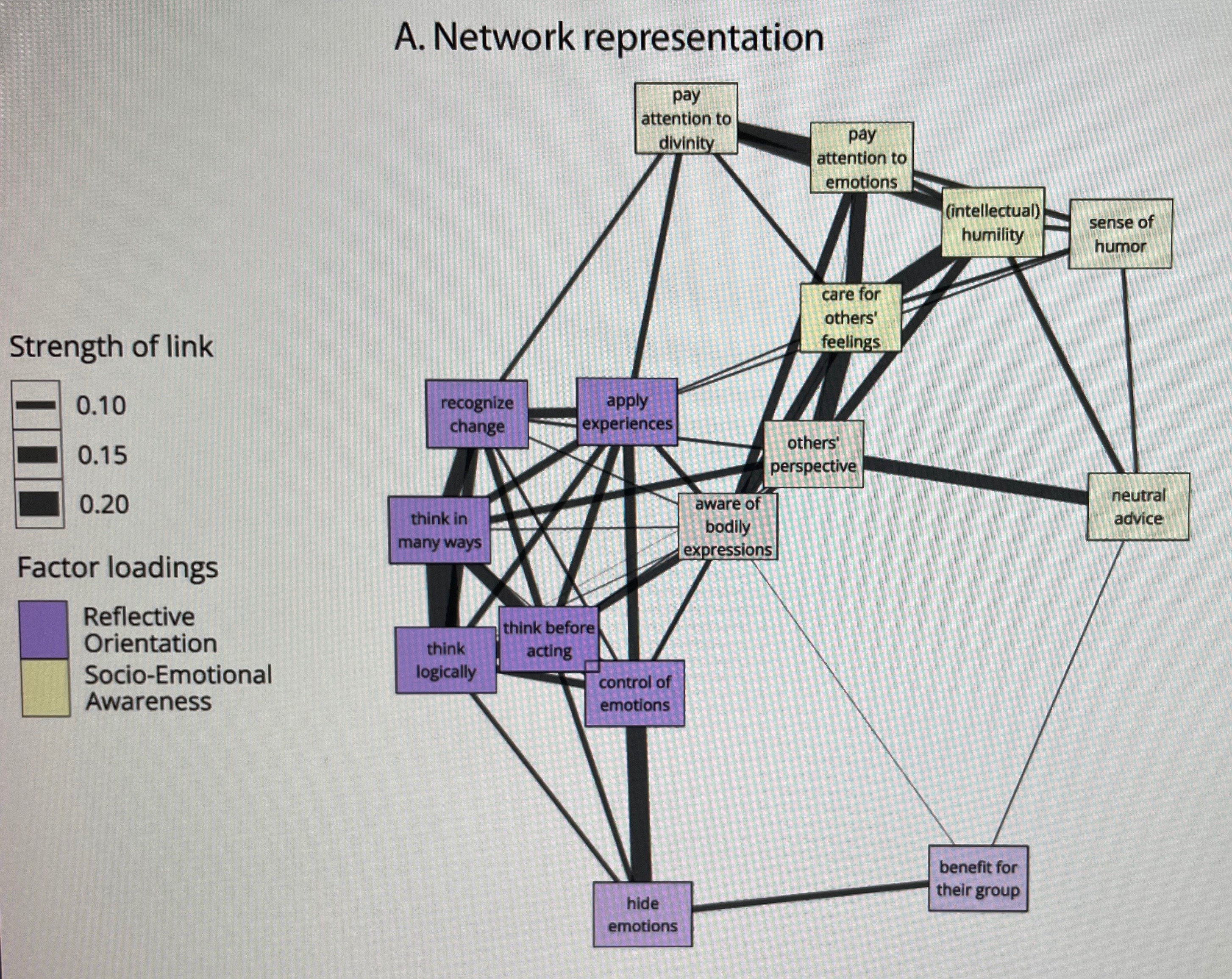
Researchers describe that this network graph representation of items demonstrates closer (and stronger) associations of items making up each factor.
Wisdom Requires Thought and is Enhanced by Empathy. The researchers note, “To elaborate, consider an example of evaluating people who give indiscriminately or people who are mindlessly driven by emotions. These individuals might be admired and revered in some instances, but unlikely to be perceived as wise. Reflective Orientation thus seems to be a necessary condition for obtaining higher wisdom, whereas Socio-Emotional Awareness positively contributes to wisdom only when the first condition is satisfied.”
Is Wisdom Context-Dependent? Brandes concludes, “The team also identified a future area of study that may hold insight. ‘A particularly intriguing question for future research is whether people are more likely to trust individuals demonstrating unique features of wisdom in different contexts,’ the authors wrote.”
She describes, “For example, they could explore whether people are more willing to trust those they rate high in reflective orientation when it comes to complex problem-solving scenarios, while turning to socio-emotional awareness stand-outs for things like offering solace in times of grief.”
As the researchers note in their Abstract, “Our findings expand folk psychology and social judgment research beyond the Global North, showing how individuals perceive desirable cognitive and socio-emotional qualities, and contribute to an understanding of mind perception.”
Heady, but positive thinking indeed. ds
© Dennis Simanaitis, SimanaitisSays.com, 2024
 Simanaitis Says