
Simanaitis Says
On cars, old, new and future; science & technology; vintage airplanes, computer flight simulation of them; Sherlockiana; our English language; travel; and other stuff
KEEPING KEWL BOTH WITH AND WITHOUT VAPOR COMPRESSION PART 1
MY AUGUST 2, 2024, ISSUE OF AAAS SCIENCE has “Sizing Up Caloric Devices,” by Suxin Qian and Ichiro Takeuchi. Its subtitle is also eye-catching: “Emerging solid-state cooling technologies may help reduce overall carbon emissions.”

The Challenge. The researchers note, “The overall carbon footprint from vapor-compression refrigeration is expected to quintuple by 2050. During the 2023 United Nations Climate Change Conference (COP28), over 60 countries signed the Global Cooling Pledge to reduce carbon emissions from cooling systems by 68% by 2050. Different cooling technologies with lower carbon footprints are essential to meet this goal.”

Researchers emphasize the importance of these new technologies: “One key to reducing the carbon footprint of cooling systems is decreasing the use of hydrofluorocarbon (HFC) refrigerants…. HFC molecules are thousands of times more potent than carbon dioxide in global warming potential.”
Here, in Parts 1 and 2 today and tomorrow, are tidbits gleaned from the article about three different cooling technologies, magnetocaloric, electrocaloric, and elastocaloric. We’ll conclude with a personal tale about my 12-year-old Honda Crosstour’s a/c as well.
Sizing Up the Competitors. The researchers arrange existing and proposed devices of thermal transport with respect to two measures: specific cooling power in Watts/gram and absolute cooling power in Watts.
The researchers describe, “Specific cooling power (SCP) is defined as the delivered cooling power in wattage divided by the mass of the refrigerants. SCP can serve as a yardstick to chart the roadmap of nascent technologies, as it effectively captures the competition between the generated caloric effect (cooling) of a refrigerant and the heat loss to the environment from the refrigerant.”
“The absolute cooling power is another important metric for a cooling device,” researchers say. “Scaling up the size of a device or cooling system translates to an increase in cooling capacity in the form of delivered cooling power, and it roughly tracks the maturity of cooling technology, often reflecting investment in the technology.”
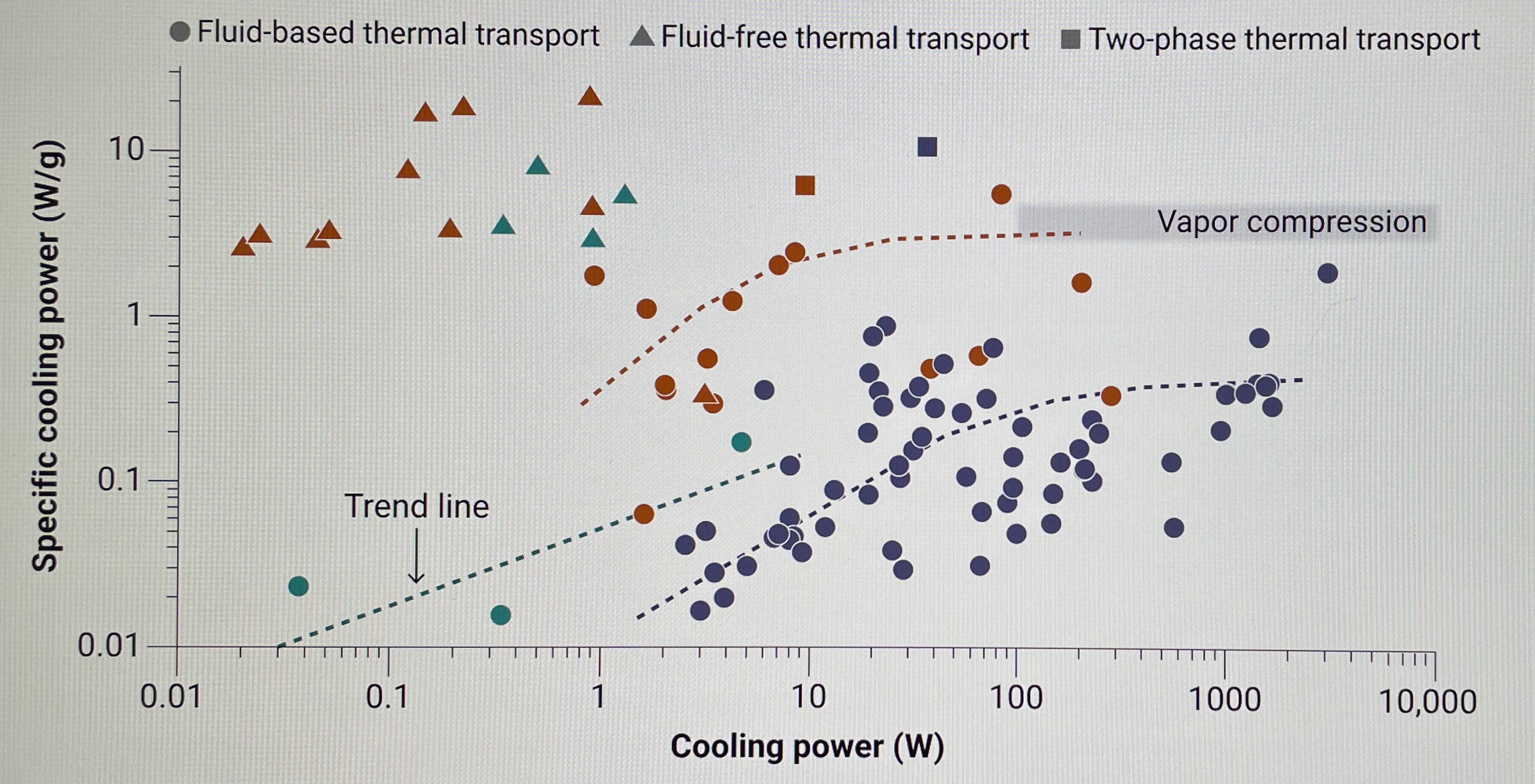
As the researchers note, “Caloric [fluid-free thermal transport] processes take advantage of intrinsically high-efficiency solid-to-solid phase transitions driven by external fields.… In this scheme, the caloric materials are placed in physical contact with the heat sink when the field is on, and then are placed in contact with the heat source when the field is taken off.”
Simple? No, but neither is a vapor-compression system. Tomorrow in Part 2, we’ll learn about these magnetocaloric, electrocaloric, and elastocaloric systems. And have I told you about the a/c of my 12-year-old Honda Crosstour?
© Dennis Simanaitis, SimanaitisSays.com, 2024
 Simanaitis Says