
Simanaitis Says
On cars, old, new and future; science & technology; vintage airplanes, computer flight simulation of them; Sherlockiana; our English language; travel; and other stuff
THE CASE OF THE KERNLESS “f” AND MISFIT “?”
SOME BOOK REVIEWS ARE JUST AS MUCH as I want to know. Others, like Gill Partington’s “Every Watermark and Stain,” London Review of Books, June 20, 2024, encourage me to read the entire book.

What a great tale. Joseph Hone writes about the bibliographic skullduggery of Thomas James Wise, a lowly clerk whose ambitions transformed him into president of the Bibliographical Society of London. Only, as reviewer Partington notes, “As his reputation grew, he was able to play both gamekeeper and poacher…. He was no longer simply a collector of ‘modern first editions’: now he was manufacturing them too.”
Here are tidbits recounting “how this ‘Moriarty of the book world’ met his match in a duo of intrepid young book dealers, John Carter and Graham Pollard.”
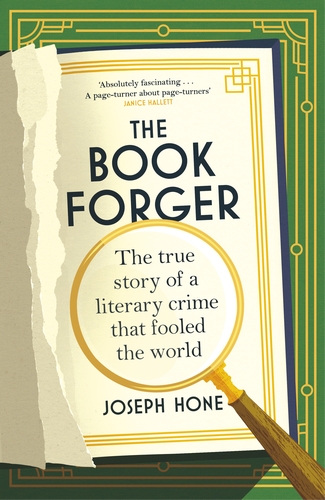
The Book Forger: The True Story of a Literary Crime that Fooled the World, by Joseph Hone, Chatto, 2024.
The Culprit. Partington describes “Wise’s life of crime began innocuously enough in the 1870s, amid the bluestockings and genteel eccentrics of Bloomsbury’s literary societies. He was an obsessive bibliophile, spending every spare moment rummaging through second-hand book-barrows. He sold his rarer finds at a profit to finance his collecting habit, but the most valuable treasures remained far out of his reach.”

Thomas James Wise, 1859–1937, British bibliophile/thief, who collected the Ashley Library, now housed by the British Library, and later became known for the literary forgeries he printed and sold.
Wise’s M.O. Partington continues, “Working by day for the Rubeck trading company, Wise had risen from junior clerk to broker in exotic goods. Books, he recognised, were just another sort of commodity. He was quick to spot gaps in the market, exploiting the tantalising ‘what-ifs’ in publishing history.”
Wise would concoct a tale of a “what-if,” and then forge a work to fill that gap.
As an example, Partington offers, “In 1896 he published Literary Anecdotes of the 19th Century, in which he speculated that Algernon Swinburne’s ‘The Devil’s Due,’ a prose text published in the Examiner twenty years earlier, may also have been printed in pamphlet form for private distribution. Lo and behold, a few months later, Wise himself discovered just such a volume.”
How convenient.
The Bibliosleuths. Partington describes, “Carter and Pollard began their investigation in the early 1930s, homing in on one particular feature of Wise’s pamphlet edition: its ‘kernless f’. In older typefaces the character has an overhanging arm—a kern—which projects over its neighbours. The detail was phased out in the later 19th century as too fragile for machine presses.”
However, one of Wise’s early scams had been Elizabeth Barrett Browning’s Sonnets by E.B.B., conjured out of an alleged sheaf of works slyly slipped into her husband Robert Browning’s pocket and later printed in a very limited 1847 edition.

Image from the University of Oregon: Unbound.
The Case of the Kernless “f” and Misfit “?”. Partington describes, “The ‘f’ of the Sonnets thus gave it away: there was no way it could have been published as early as 1847. Weeks of trawling through type specimen books then produced a match with a particular typeface: Long Primer No. 20, dating from 1883. Many printers used it, but there was another telling quirk in the Sonnets: the question mark seemed to be a misfit, an italic character used in place of the correct symbol. Like a fingerprint, it made the font unique.”
The scam unravels: “But the breakthrough didn’t come until Pollard spotted an 1893 facsimile edition of Matthew Arnold’s Alaric at Rome. The text displayed both the kernless f and the misfit question mark. Pollard only had to flip to the book’s front matter to see who had set the type: Richard Clay and Sons. But there was another important piece of information there too: the facsimile had been commissioned by Thomas James Wise.”
“In 1934,” Partington recounts, “Pollard and Carter published their exposé of the affair, An Enquiry into the Nature of Certain Nineteenth Century Pamphlets, printed, in a nice touch of irony, by Clay and Sons. Wise lapsed into silence, and an announcement in the TLS from his wife finally stated that ill-health prevented him from carrying on further ‘public correspondence’ about the matter. His death came just three years after Pollard and Carter’s book was published. He never confessed.”
Today, Partington notes, “ ‘Wiseana’ has become collectable in its own right—valuable precisely because it is the authentic work of a master forger.” Yet, Partington also observes, “Even the mahogany bookshelves housing his prized Ashley Library, dismantled after his death, turned out to be veneer.” ds
© Dennis Simanaitis, SimanaitisSays.com, 2024
 Simanaitis Says