
Simanaitis Says
On cars, old, new and future; science & technology; vintage airplanes, computer flight simulation of them; Sherlockiana; our English language; travel; and other stuff
CAN YOU WHISPER ME NOW?
“STAND WITH YOUR EAR UP AGAINST THE TILE WORK in the domed intersection of walkways on the lower floor of Grand Central Terminal,” Atlas Obscura describes, “and you’ll discover a secret: a corner-to-corner whispering gallery. Even the quietest sweet nothing, soft song, or whispered threat can be heard, even over the din of crowds.”

Image by NUTTCOUPONS via Atlas Obscura.
Atlas Obscura continues, “This remarkable acoustic oddity is caused by the unusually perfect arches that compose the gallery. The distinctive tile work in the gallery is known as ‘Guastavino’ tiles, named for the patented material and methods of Spanish tile worker Rafael Guastavino, whose meticulous work and herringbone patterns can be admired here and elsewhere in the city.”
Elsewhere Too. Indeed, there are examples of Guastavino’s works at Detroit’s newly restored Michigan Central Station, Boston Public Library’s McKim Building; Asheville, North Carolina’s Basilica of St. Lawrence; Philadelphia’s University of Pennsylvania Penn Museum; the University of California, Berkeley’s Hearst Memorial Mining Building; and the Nebraska State Capitol.
The National Trust for Historic Preservation website notes, “One of Manhattan’s lesser-known examples is the vaulted arcade under the approach to the Ed Koch Queensboro Bridge, designed and built by the R. Guastavino Company in 1909 to serve as a fruit and vegetable market.”
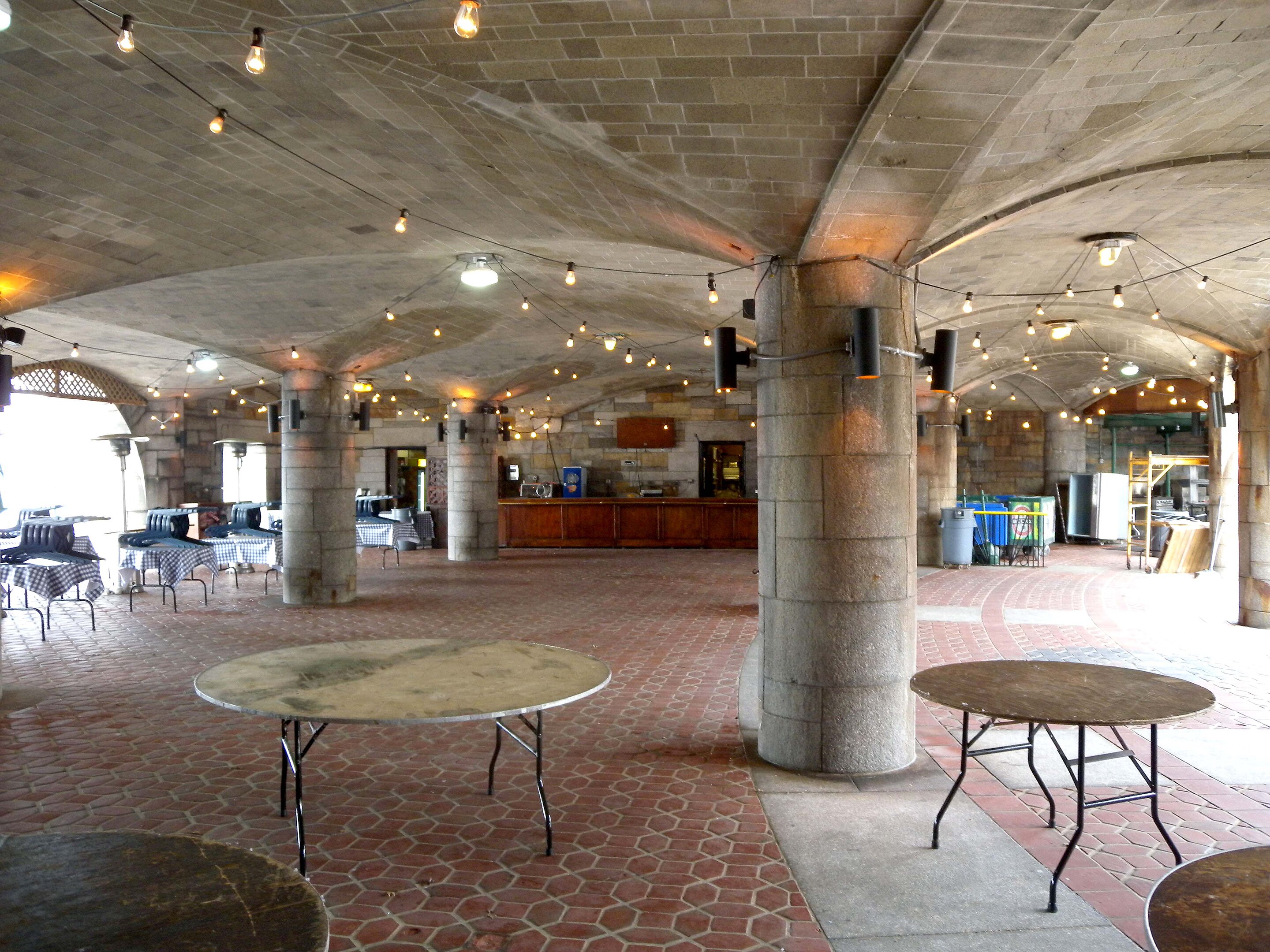
Another is New York City’s Cafe at the 79th Street Boat Basin. Image by Jim.henderson via Wikipedia.
Guastavino, The Builder. Wikipedia describes, “Rafael Guastavino Moreno, 1842–1908, was a Spanish building engineer and builder who immigrated to the United States in 1881; his career for the next three decades was based in New York City.

Rafael Guastavino Moreno, Spanish-born 1842, immigrated to the U.S. in 1881.
Guastavino Tile Theory. “Guastavino vaulting,” Wikipedia describes, “is a technique for constructing robust, self-supporting arches and architectural vaults using interlocking terracotta tiles and layers of mortar to form a thin skin, with the tiles following the curve of the roof as opposed to horizontally (corbelling), or perpendicular to the curve (as in Roman vaulting).”

Constructing the Boston Public Library’s McKim Building: Above, steel I-beams provide structural support for shallow tile arches. Middle, Rafael Guastavino inspecting recently laid tile. Below, four completed arches. These and the following image, c. 1889, from Boston Public Library via Wikipedia.


Wikipedia continues, “The Guastavino terracotta tiles are standardized, less than 1 inch (25 mm) thick, and about 6 by 12 inches (150 by 300 mm) across. They are usually set in three herringbone-pattern courses with a sandwich of thin layers of Portland cement. Unlike heavier stone construction, these tile domes could be built without centering. Supporting formwork was still required for structural arches which established a framework for the ceiling.”

A Guastavino ceiling, 1889.
Guastavino Tiling Today. Wikipedia recounts, “In 2012, a group of students under supervision of MIT professor John Ochsendorf built a full-scale reproduction of a small Guastavino vault. The resulting structure was exhibited, as well as a time lapse video documenting the construction process…. Ochsendorf, a winner of the MacArthur Foundation ‘genius grant,’ also wrote the book-length color-illustrated monograph Guastavino Vaulting: The Art of Structural Tile, and an online exhibition coordinated with the traveling exhibits.”

The Oyster Bar, Grand Central Terminal, Warren & Wetmore/Reed & Stern, 1912. Image from Professor Ochsendorf’s presentation.
You’ll see Professor Ochsendorf didn’t whisper in the National Building Museum. He could have, though, near the Oyster Bar. ds
© Dennis Simanaitis, SimanaitisSays.com, 2024
 Simanaitis Says