
Simanaitis Says
On cars, old, new and future; science & technology; vintage airplanes, computer flight simulation of them; Sherlockiana; our English language; travel; and other stuff
WEALTHIEST COUNTRIES?
SO WHO’S GOT THE MOST DOUGH? In one simple answer, it depends. Wealthiest in Gross Domestic Product? In GDP/capita? In any other measure defined by something or other?
This calls for some Internet sleuthing. Here are tidbit gleaned from a variety of sources.

Gross Domestic Product. My first Internet sampling comes from Investopedia’s “The Top 25 Economies in the World,” by Caleb Silver, May 29, 2024. Silver writes, “GDP is an estimate of the total value of finished goods and services produced within a country’s borders during a specified period, usually a year. [Nominal] GDP is popularly used to estimate the size of a country’s economy and its impact on the global economy.” Another, Purchasing Power Parity Adjusted GDP, uses a “basket-of-goods” comparison.
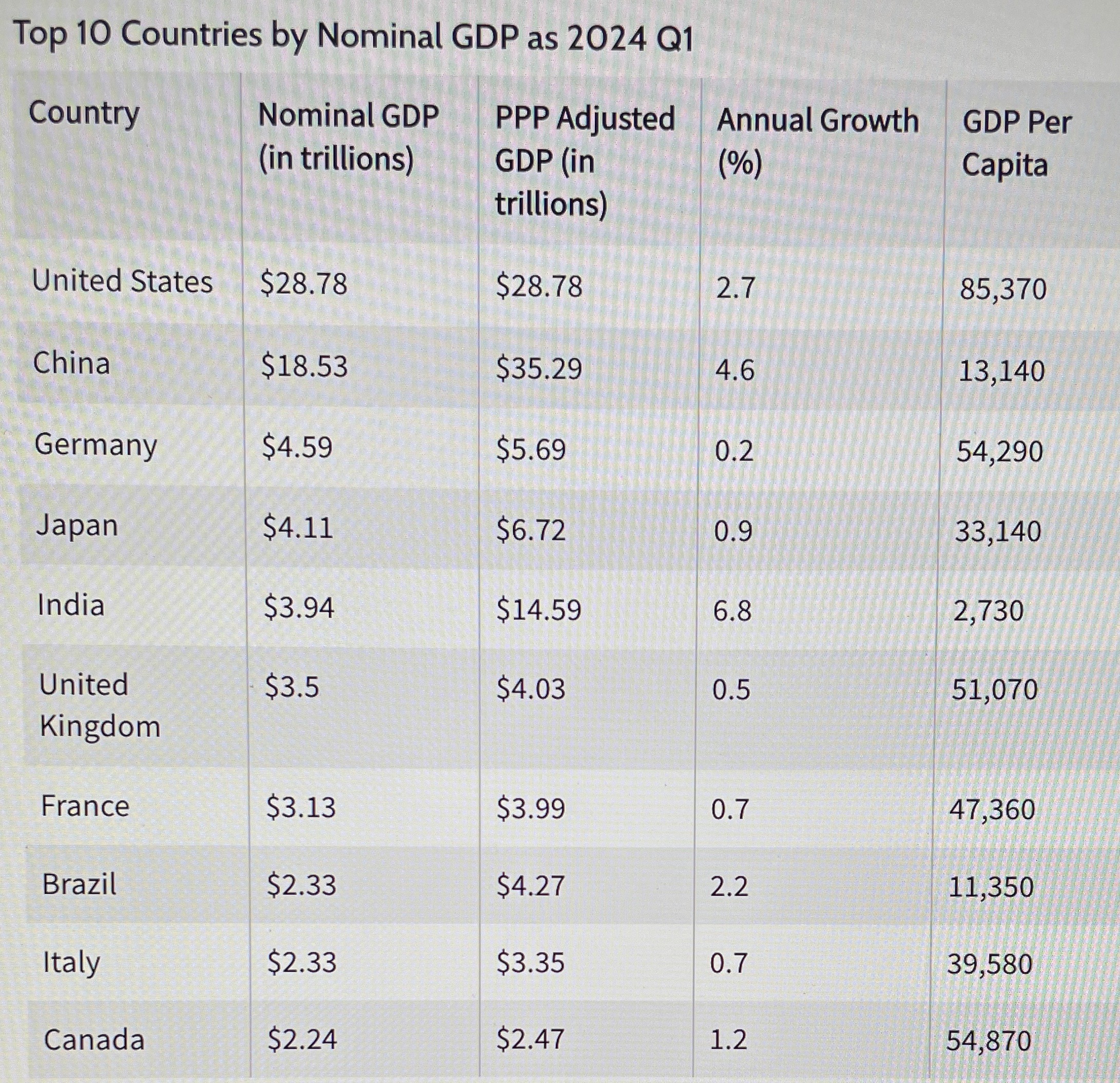
This and the following image from Investopedia.
Key Points. Silver notes, “The United States’ economy is the largest in the world as measured by nominal GDP. The biggest contributor to that GDP is the economy’s service sector, which includes finance, real estate, insurance, professional and business services, and healthcare.”
“The U.S. economy,” Silver writes, “is at the forefront of technology in many industries, but it faces rising threats in the form of economic inequality, rising healthcare and social safety net costs, and deteriorating infrastructure.”
For China, No. 2: “Coupled with an industrial policy that encourages domestic manufacturing, this has made China the world’s number one exporter. Despite these advantages, China faces some significant challenges, such as a rapidly aging population and severe environmental degradation, which has slowed its growth.”
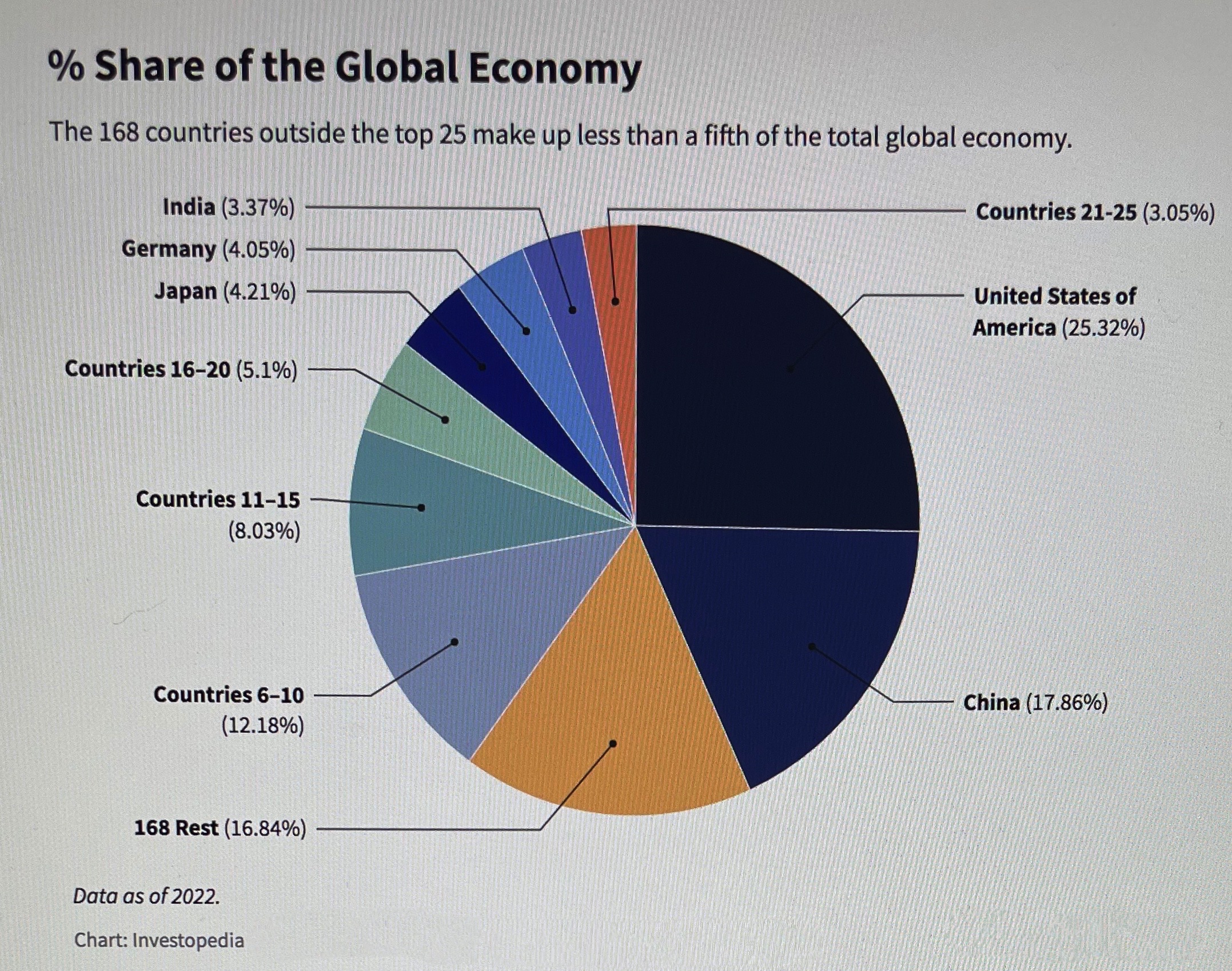
The 168 countries outside the top 25 make up less than a fifth of the total global economy. Note as well that the Investopedia listings include our other measuring stick: per capita data.

Per Capita Wealth. Global Finance offers an interesting variation in its per capita analysis: “The Race to be the World’s Richest Country/Territory,” by Luca Ventura, May 3, 2024.
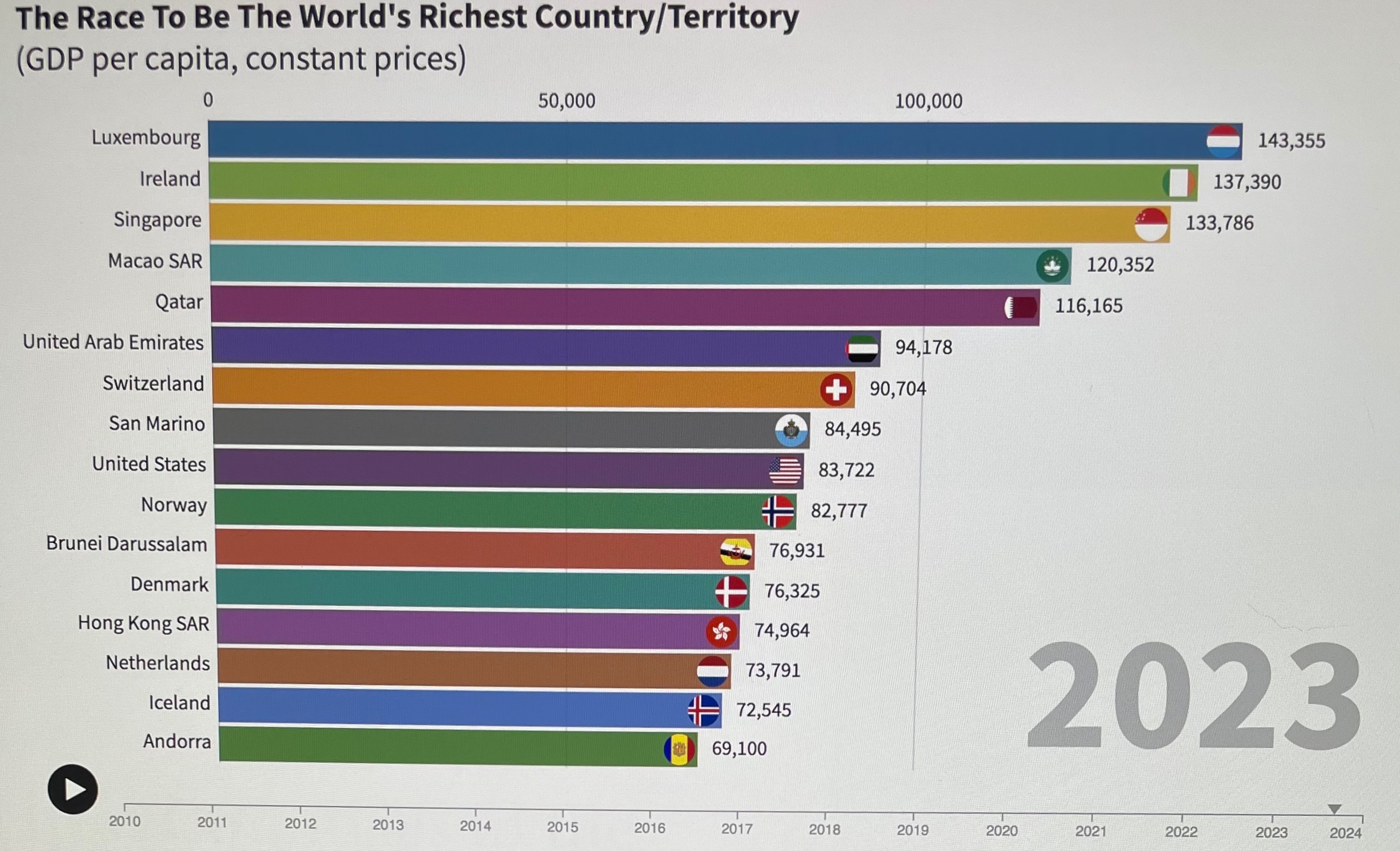
Image from Global Finance. I’ve paused this evolving graphic at late 2023; visit the website to see it in action.
Key Points. Ventura writes, “Many people would probably be surprised to find that many of the planet’s wealthiest nations are also among the tiniest. Some very small and very rich countries—like San Marino, Luxembourg, Switzerland and Singapore—benefit from having sophisticated financial sectors and tax regimes that attract foreign investment, professional talent and large bank deposits.”
“Others like Qatar and the United Arab Emirates,” Ventura continues, “have large reserves of hydrocarbons or other lucrative natural resources. Shimmering casinos and hordes of tourists are good for business too: Asia’s gambling haven Macao remains one of the most affluent states in the world despite having endured almost three years of intermittent lockdowns and pandemic-related travel restrictions.”
Tax Dodges. Ventura adds, “The IMF [International Monetary Fund] has warned repeatedly that certain numbers should be taken with a grain of salt. For example, many nations in our ranking are tax havens, which means their wealth was originally generated elsewhere which artificially inflates their GDP.”
He continues, “While a global deal to ensure that big companies pay a minimum tax rate of 15% was signed in 2021 by more than 130 governments (a deal that has yet to be implemented due to the opposition of legislators and politicians in many of them), critics have argued that this rate is barely higher than that tax havens like Ireland, Qatar and Macao.”
“It is estimated that over 15% of global jurisdictions are tax havens and the IMF has estimated further that by the end of the 2020s, about 40% of global foreign direct investment flows could be attributed to shrewd tax-evading tactics, up from 30% in the 2010s. In other words: these investments pass through empty corporate shells and bring little or no economic gain to the population where the money ends up.”

From a Tourist View. As this website’s name suggests, DailyPassport evaluates “The 10 Wealthiest Countries in the World” from a tourist’s point of view. Rachel Gresh writes, “The world’s most affluent countries have more in common than their wealth—many are also home to some of the world’s most famous tourist sites. From the spectacular modern architecture of Singapore and Qatar to the natural wonders of Iceland and Norway, these countries are not only great places to live but also great places to visit.”
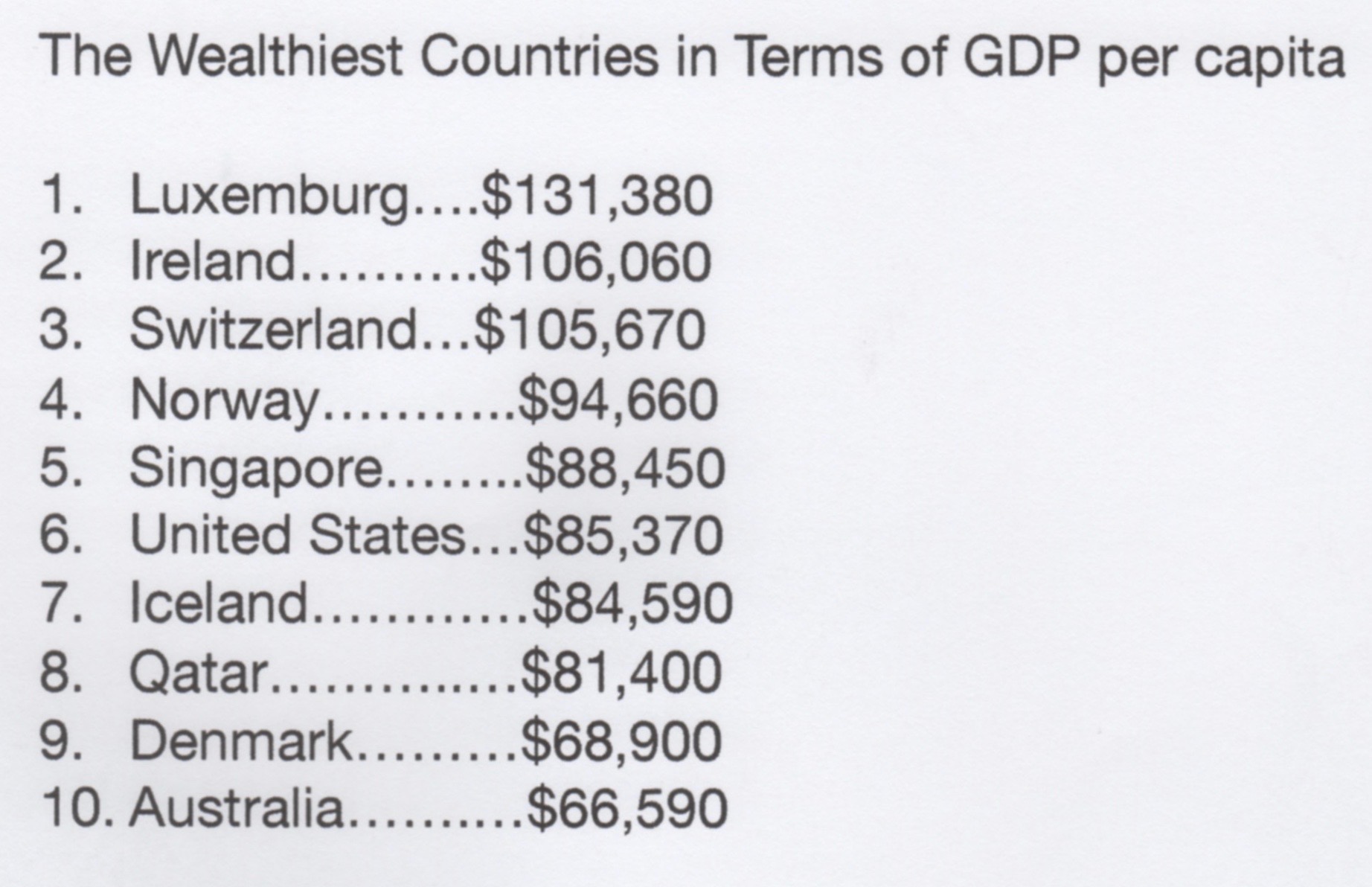
This list complied from DailyPassport.
Key Points. Gresh cites Luxembourg’s banking, steel, and industrial sectors along with the capital’s fortified medieval city. She also mentions Ireland’s corporate tax policies as well as Switzerland’s banking and finance. Tax dodges, anyone?
Also, though, Gresh cites Singapore being the top exporter of computer microchips, the U.S.’s top exporting of refined petroleum, Qatar’s top exporting of petroleum gas, Denmark’s pharmaceuticals, and Australia’s coal, wheat, and iron ore.
Little Iceland? Its sheer beauty of geysers, hot springs, glaciers and even an active volcano attract tourists. Its aluminum and seafood industries are pluses as well. ds
© Dennis Simanaitis, SimanaitisSays.com 2024
 Simanaitis Says
The above is welcomed, overdue perspective, given the IMF’s point of such havens’ inflated figures taken “with a grain of salt.”
Meanwhile, only in the US is oncology listed as part of GDP. Not surprising as we are the sickest of all modern industrial democracies.
https://www.commonwealthfund.org/publications/issue-briefs/2023/jan/us-health-care-global-perspective-2022