
Simanaitis Says
On cars, old, new and future; science & technology; vintage airplanes, computer flight simulation of them; Sherlockiana; our English language; travel; and other stuff
JAGUAR R1 FORMULA 1 CAR—VIRTUAL TESTING PART 1
BY THE MILLENNIUM, TELEMETRY had become firmly embedded into Formula 1. And in the year 2000, F1 had its inaugural United Grand Prix at Indianapolis Motor Speedway (not to be confused with the Indy 500’s inclusion on the Drivers World Championship calendars 1950-1960). R&T took advantage of this by performing a virtual telemetry-based test of the Jaguar R1. Here in Parts 1 and 2 today and tomorrow are tidbits gleaned from that article, together with some contrasts of today’s F1 cars with those of the 2000 season.
This, note, is in contrast to R&T’s (and my) hands-on experience with the Benetton B186 in 1986.
“The technical wizards of Jaguar Racing,” R&T wrote in March 2001, “were amenable, and in time we were knee-deep in bits (and bytes) of F1 data. We were also fascinated by what information wasn’t forthcoming, by what was met by a polite yet firm, ‘Sorry, we don’t talk about that.’ ”
I was the author of this article, aided and abetted by Road Test Editor Patrick Hong with his stop watches and Stalker radar gun. Both of us were granted spiffy First Corner vests at the 2000 U.S. Grand Prix giving us opportunity to complement the Jaguar telemetry data.

FIA Formula One Technical Regulations, Then and Now. Back in 2000, the FIA Formula One Technical Regulations totaled 45 pages; the 2023 version runs to 183 pages.
I wrote back then, “What follows here is a collection of F1 tidbits gleaned from all this, together with thoughts on the tantalizing ‘not availables’ that still persist.”
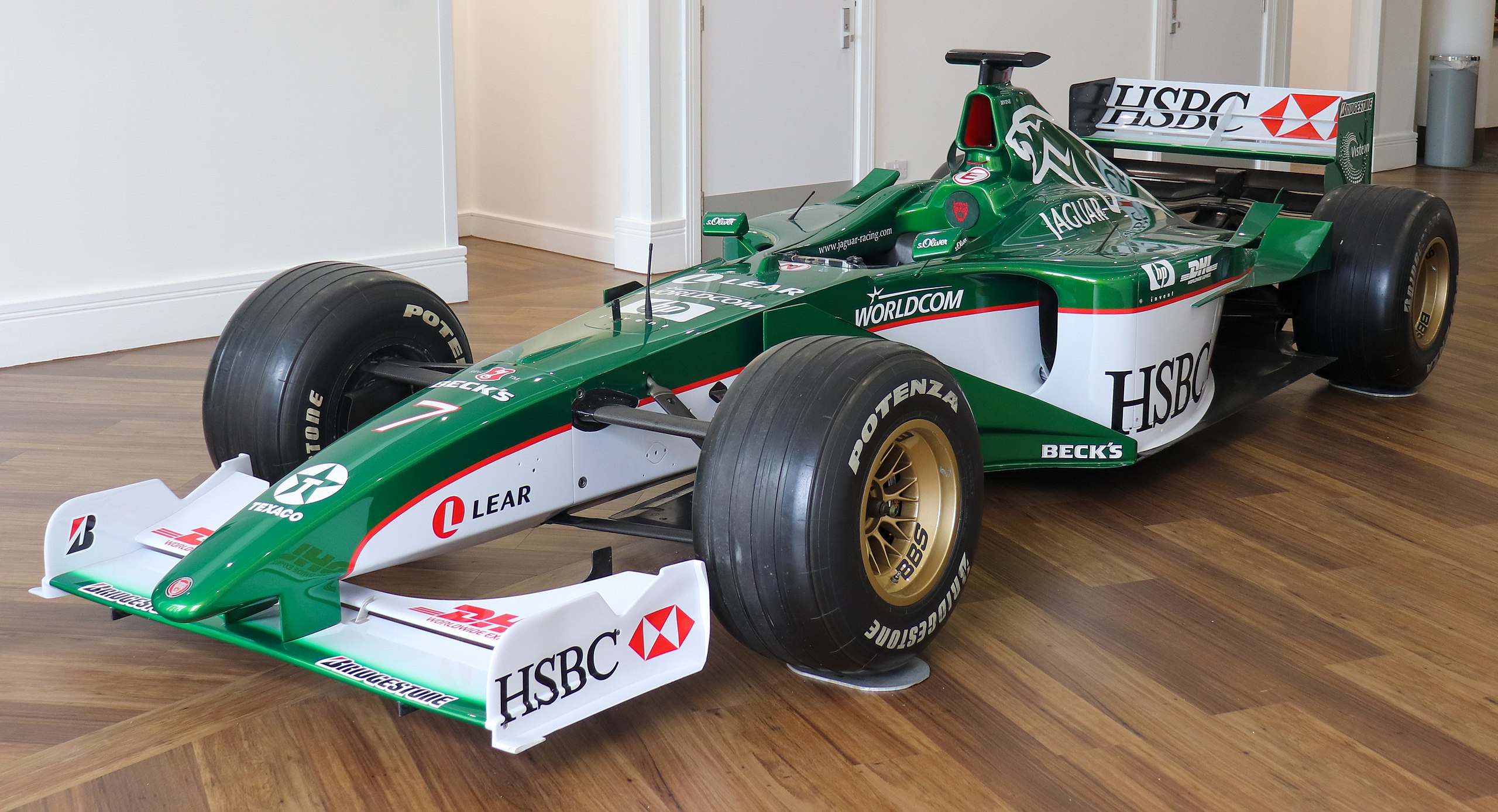
The 2000 Jaguar R1-07 at the British Motor Museum, Gaydon. Image by Vauxford from Wikipedia.
Engines. “As is common knowledge,” I noted, “today’s F1 car is an open-wheeled race car powered by a normally aspirated engine displacing no more than 3000 cc. Maybe less familiarly known are that these cylinder must be circular (some time ago, Honda fooled with motorcycle-derived cylinders that weren’t) and that there must be precisely 10 of them (the FIA got nervous when deep-pocketed carmakers mused about raising the ante to 12).
It’s evident that the complexities of today’s turbocharged 1.6-liter 90-degree V-6 hybrid powerplants occupy much of that extra 138 pages of regulations.
Engine Revs. I continued back in 2000, “Although its displacement is limited and its intake air naturally aspirated, an F1 engine’s revs are free—and its sounds are spine-tingling. Jaguar admits to an 18,000-rpm redline, power peaking at a nominal 800 bhp at 17,500. It’s odd to hear ‘driveability’ discussed in this context, but then again they’re talking about power ‘low in the rev range—around 13,000.’ ”
For 2014-2021, F1 engines were electronically limited to 15,000 rpm. They’re currently unrestricted, though turbocharging and energy-conversion goals have had people carping about subdued fury. See “Can You Hear Me Now?”
Weight. I noted that weight “(definition: ‘of the car with driver, wearing his complete racing apparatus, at all times during the event’ must not be less than 600 kg (1323 lb.).” Safety considerations such as halo structures have increased this today to a minimum of 798 kg (1759 lb.), not including fuel. And since 2010, refueling during the race is prohibited. Today’s cars start with a maximum of 110 kg (243 lb.) of fuel; they’re required to have 1 liter remaining at the finish for possible analysis.
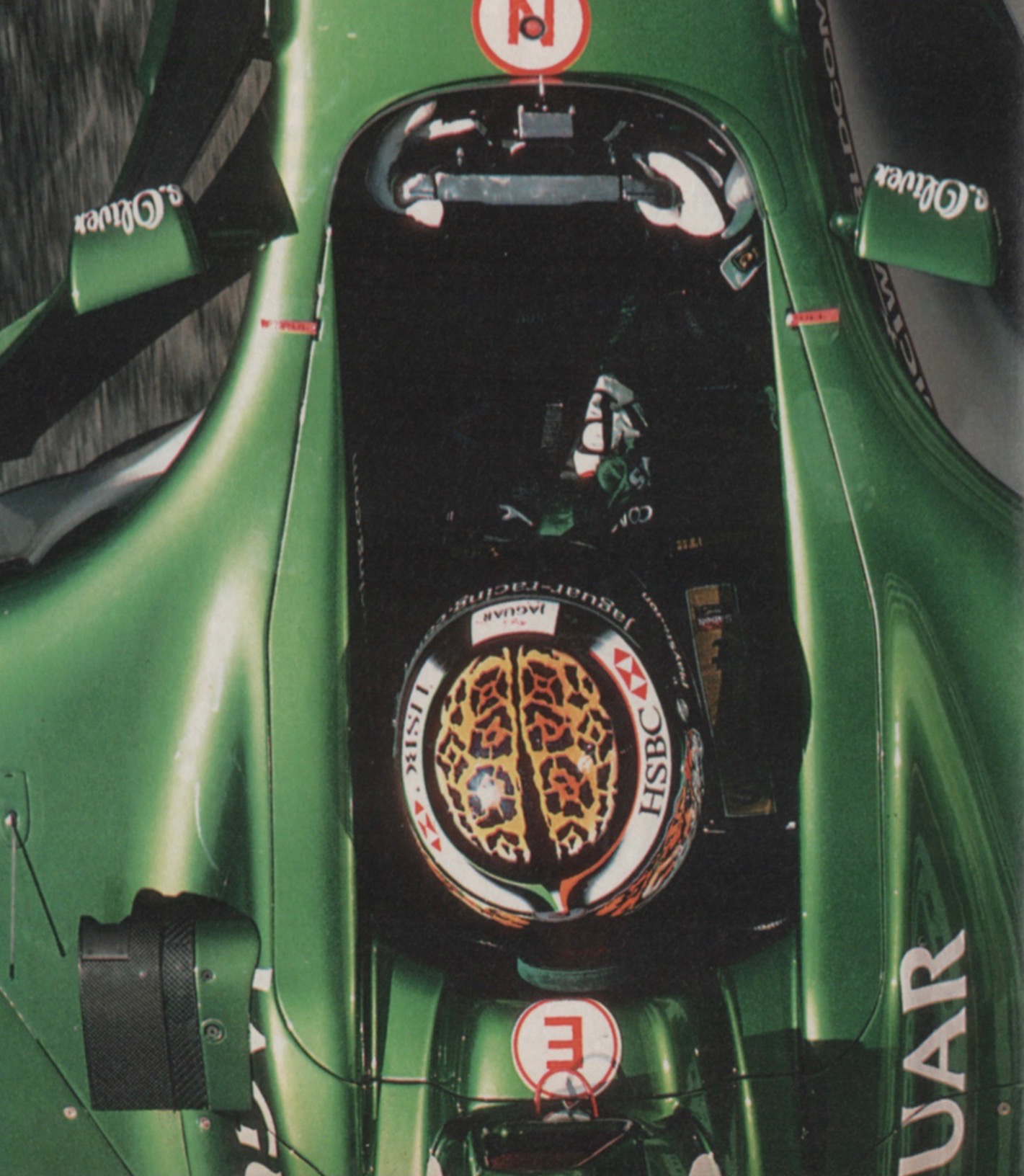
Missing from the 2000 Jaguar R1 were any modern F1 halo safety structure and driver HANS head restraint. This and the following image from R&T, March 2001.
A familiar TV sight at race end today is fully kitted drivers—including their HANS, compulsory since 2003— being weighed.
Ballast. “And, in fact,” I noted back in 2000, “like most of the grid, the Jaguar R1 is engineered to rather less than this, perhaps by as much as 100 lb., and ballasted up to the minimum. Some teams use tungsten, others use depleted uranium, most say ‘no comment’ when asked what—or especially, where—the ballast is.”
Today’s regulation describes, among other aspects, “Ballast designated for the sole purpose of achieving driver weight specified in Article 4.6.2 must: a. Be entirely located to the car between the front and rear extent of the cockpit entry template. b: Be attached securely to the survival cell and sealed by the FIA. c: Be clearly identified.”
That is, back in 2000 varied positioning of ballast was a tool for fine tuning a car’s handling circuit-to-circuit. Today’s regulation implies it’s an equalizer of driver-to-driver weight.

Tomorrow in Part 2, we’ll continue R&T’s (er… my) analysis of the 2000 Jaguar R1. Does 0-160 mph in 6.2 seconds tantalize your interests? ds
© Dennis Simanaitis, SimanaitisSays.com, 2024
 Simanaitis Says