
Simanaitis Says
On cars, old, new and future; science & technology; vintage airplanes, computer flight simulation of them; Sherlockiana; our English language; travel; and other stuff
THE SANTOS=DUMONT DEMOISELLE PART 2
BIOGRAPHICAL DETAILS OF ALBERTO SANTOS=DUMONT were offered in Part 1 yesterday. Today we focus on the 1908 Demoiselle, his last aeroplane design and my latest GMax project.
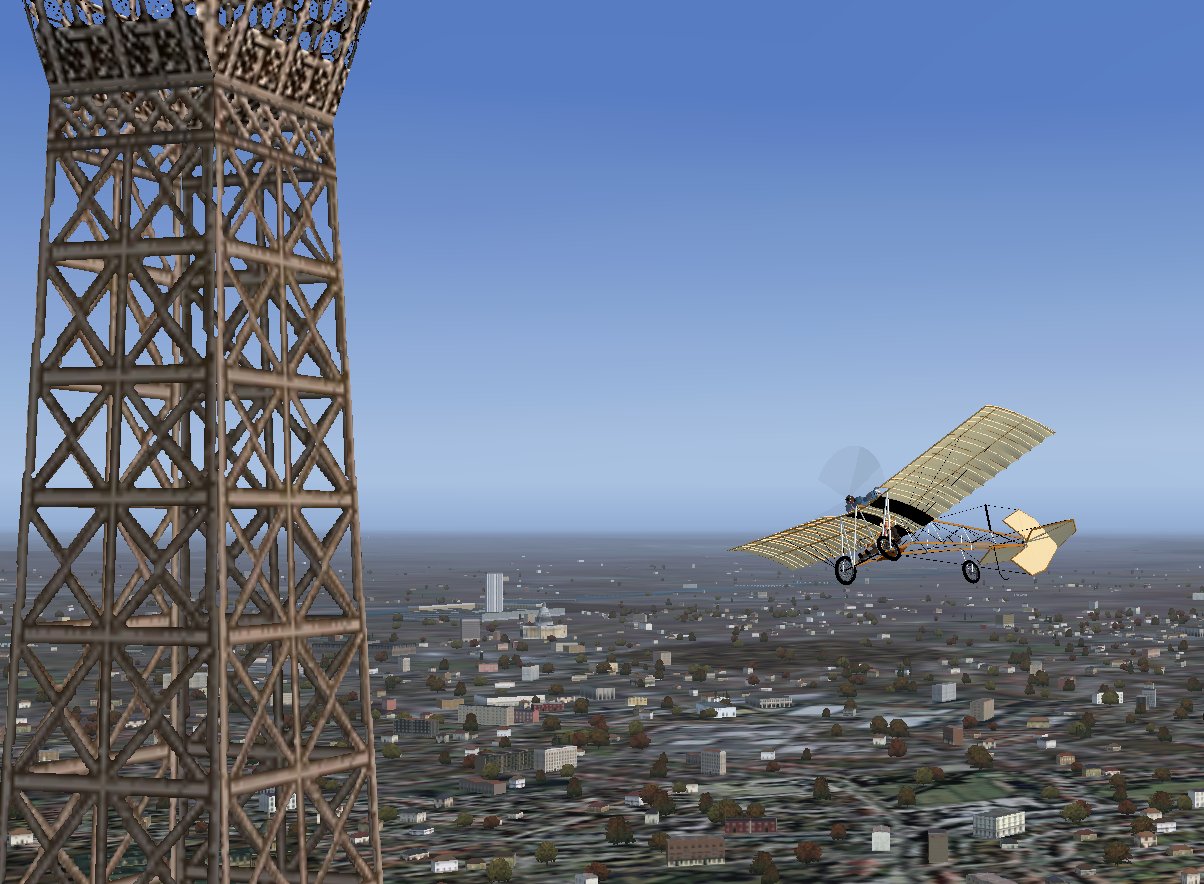
An Ur-Ultralight. Quite rightly, today the Santos=Dumont Demoiselle is called the world’s first ultralight; its empty weight was a mere 242 lb. As noted in Wikipedia, “The fuselage consisted of three bamboo tubes forming the primary longerons, of about 5 cm (2 in) diameter, connected by oval steel tubes. For ease of transportation the bamboo tubes were divided into two sections, joined together by brass sockets.”

“The parallel-chord wing,” Wikipedia continues, “had two spars made of ash and bamboo ribs. All versions had a pair of lightweight thin-tube radiators mounted under the wing, running the entire meter chord of the wing.”

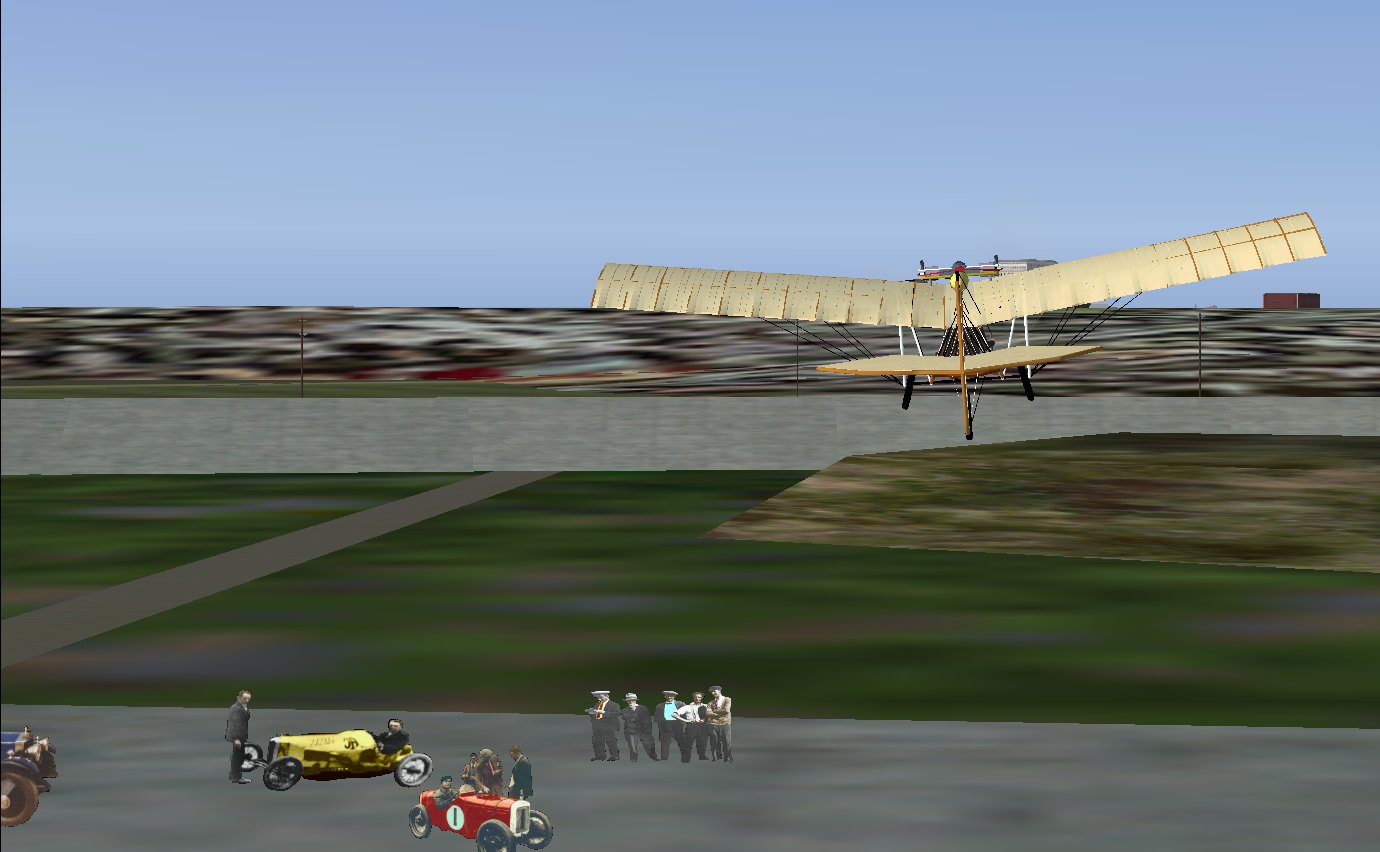
My Santos=Dumont and his Demoiselle visit Brooklands.
The GMax wing structure could be made visible in the final model by setting an appropriate Opacity level of the wing covering. (Alas, it results in some odd opacities of other components in some views.)

Roll control was achieved by wing warping, though only in the downward direction on early variants. Santos=Dumont activated this by means of a transverse-pivoting joystick that fitted into the back of his jacket. Glenn Curtiss activated early ailerons with a similar idea, a shoulder cradle that would allow him to “lean into a turn” with his June Bug.
A Cruciform Tail. Santos=Dumont gave his Demoiselle integrated yaw and pitch control with a combined rudder/elevator. A cruciform fixture at the end of the boom structure achieved this.

At first, this posed a challenge for GMax actuation of its dual-axis operation. (Typically, the software uses separate Elevator and Rudder coding.) Solving the problem was application of a “ghosted” object performing the one motion linked to the other. (A similar trick is used to get both fore/aft and left/right actuation of a conventional joystick.)

The Engine. Santos=Dumont experimented with a variety of powerplants (and locations) in the Demoiselle. Indeed, early versions had propellers of fabric-covered frameworks; only later versions used wooden props.

My Demoiselle featured a wood prop. (It would have been fun to model the framework one, but I came upon Wier’s fine resource only after having completed my Demoiselle.) Also, I chose to model the particular engine because I found a fine photo of the Clément-Bayard.

Above, the Clément-Bayard twin-cylinder opposed engine. Image by FlugKerl2 from Wikipedia. Below, my rendering, front and rear.


Some sources have a Darracq opposed twin as a Demoiselle powerplant; others claim its cooling system was patented by Santos=Dumont. As described by Adriano Batista Dias (cited in Wikipedia), “When the Darracq company tried to claim the engine design, Santos Dumont went to court to get his project released into the public domain.” Recall from Part 1, he did a similar thing with the complete Demoiselle plans.


Modeling Alberto Santos=Dumont. Modeling people has never been a GMax forte of mine. Indeed, long before GMax, the modeling software had much more limited parts count to encouraged me to invent Little Red Head (a simple cube to represent a generic pilot).
Others in GMax have turned human modeling into an art. I have a generic person with articulated features. With subtle changes, it becomes pioneer Louis Blériot (with his luxuriant mustache) or my pal Viola

Alberto Santos=Dumont, as modeled for my Demoiselle.
In honor of Albert Santos=Dumont (known as a flashy dresser), I made sure to include his Panama hat.
Bom voo, Alberto! (Assuming that Brazilian Portuguese is identical to Google Translate Portuguese.) ds
© Dennis Simanaitis, SimanaitisSays.com. 2024
 Simanaitis Says
Thanks for adding the Demoiselle to your collection, Dennis. It’s always been my favorite pre-war aircraft. The big advantage of GMax is we’ll never have to worry about those antique engine fluids leaking all over the pilot.
The contrast between Santos=Dumont releasing everything to the public domain and the Wrights aggressively protecting their ideas, as well as those they borrowed from others, in court, is striking. The Wrights were really outliers in the cooperative early years of aviation.
l agree. Indeed, follow the Glenn Curtiss “June Bug” link above amplifying this.