
Simanaitis Says
On cars, old, new and future; science & technology; vintage airplanes, computer flight simulation of them; Sherlockiana; our English language; travel; and other stuff
GREAT (AND NEAT-O) LAKES
THE INTERESTING FACTS website offered a tidbit that the Great Lakes hold more that 20 percent of the world’s fresh water, six quadrillion gallons of it: “That’s so much water,” Interesting Facts recounts, “that if you spilled the entire contents of the Great Lakes throughout the Lower 48, the entire contiguous U.S. would be submerged in nearly 10 feet of water.”
Gad.

This got me gleaning tidbits about Lakes Superior, Michigan, Huron, Erie, and Ontario from a variety of sources.
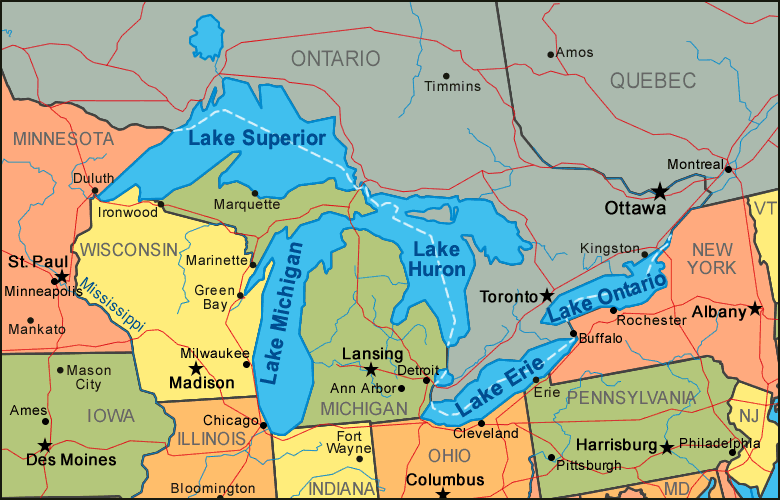
Image from geology.com.
Mnemonically Speaking. This particular ordering is useful in that it arranges the Great Lakes roughly from left to right, west to east. Geographyrealm.com offers a mnemonic: “Super Man Helps Every One.”

Image from geographyrealm.com.
Take a Bow, Superior. In relative surface area, the order is Superior, Huron, Michigan, Erie, and Ontario. Indeed, according to hourdetroit.com, “Lake Superior is the largest freshwater by surface area at about 31,700 square miles. The deepest point of Lake Superior is 1330 feet, which is taller than the Empire State Building. Lake Superior has more water than the other Great Lakes combined.”
Here’s a size mnemonic offered by Geographyrealm.com: “Super Heroes Must Eat Oats.”

The Shortest Great Lakes Mnemonic: “HOMES.”
The Funniest Mnemonic. The funniest Great Lakes mnemonic I encountered was from r/memes:

Image from reddit.com.
Ice Age Origins. The Great Lakes resulted from the last Ice Age some 14,000 years ago. Glacier weight gouged out portions of the continent, and when the Earth warmed the five lakes were formed by melted water. With the exception of Lake Erie, the holes were deep enough so that depths are below sea level.
Today’s Great Lakes. HourDetroit recounts that “more than 30 million people live in the Great Lakes basin, which covers part of the United States and Canada. This accounts for about 10 percent of the U.S. population and more than 30 percent of the population of Canada.”
Lake Michigan lies completely with the U.S. The others have water borders with both countries.
By the way, HourDetroit notes that “There are currently 20 Native American tribes in the Great Lakes region.
Cleveland Summer Sun Setting in the North?? When I was a kid flying model airplanes in Cleveland, I enjoyed seeing the sun set into Lake Erie. Canada, of course, was north of the U.S. Ergo, the sun was setting in the north, right?
I confess to be well into the age of reason before I realized that Cleveland’s coastline, particularly on its East Side where I lived, was canted decidedly southwest to northeast, hence provoking my misunderstanding.

Image from Google Maps.
Climate Change Implications. On July 9, 2020, Earth Observatory NASA reported, “When the usually chilly Great Lakes feel like bath water, you know it has been a warm summer. When the water is that warm at the beginning of July, you know that some records are in jeopardy.”
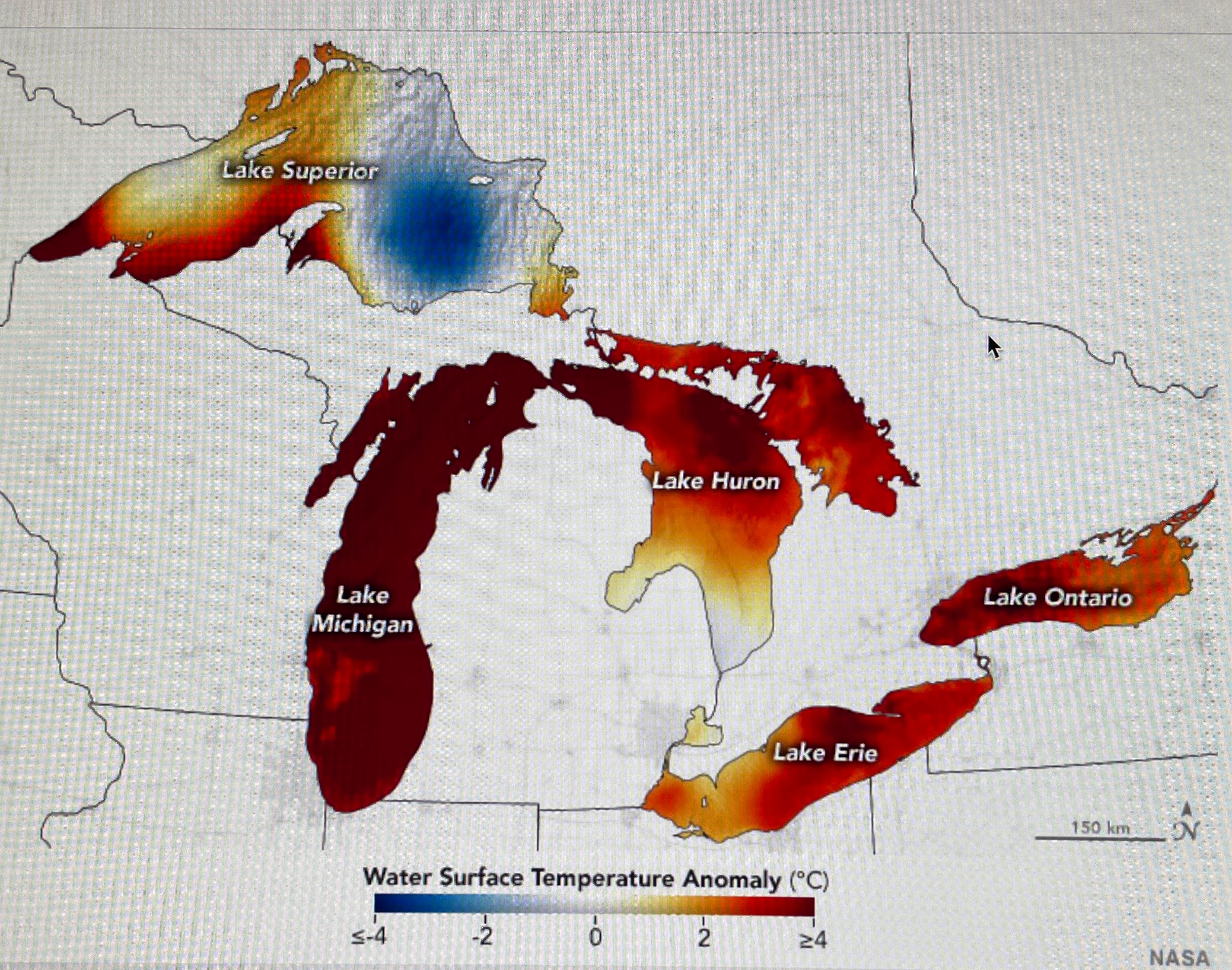
Image from earthobservatory.nasa.gov.
“The map above” the website reports, “shows water surface temperature anomalies for July 9, 2020; that is, how much the surface layer of each lake was above or below the long-term average temperature (2003-14) for this time of year. The data come from the Multiscale Ultrahigh Resolution Sea Surface Temperature (MUR SST) project, based at NASA’s Jet Propulsion Laboratory. MUR SST blends measurements of sea surface temperatures from multiple NASA, NOAA, and international satellites, as well as ship and buoy observations.”
Add to this a tidbit gleaned from Interesting Facts: “68.7 percent of the world’s fresh water is held in ice caps and glaciers.” Hmm… What happens when these start gouging and melting?
Jus’ askin’. ds
© Dennis Simanaitis, SimanaitisSays.com, 2024
 Simanaitis Says
An interesting take on the Great Lakes. Their most recent formation started somewhat earlier – about 14,000 years ago on the retreat of the Wisconsin Glaciation. People came soon after. This glacial retreat is the same event that gave us the rolling topography that we enjoy today on our drives around the perimeter go the Great Lakes. The attached link gives a better sense of that ice retreat.
Hi, guadala,
I suspect you’re an early-bird reader. I corrected my original “3000 years” to your “14,000 years” around 6:15 a.m. in my own post-final editing.
(I joke about having run from drugstore to drugstore correcting R&Ts. This time you got there sooner; thanks.)
Lucky catch – I am a now retired Quaternary Geologist. Also, until lately, a loyal R&T reader. I still have a copy of the R&T Road Test Annual for 1966 (Porsche 911 on the cover). This was the same year I obtained my drivers licence.
Yowsah. Staggering thought, the opening paragraph, all the more as the Great Lakes’ average depth only around 200 feet. As a small boy in Detroit, remember looking out from Lake Huron’s beach and thinking it vast as the ocean i’d viewed from Santa Barbara.