
Simanaitis Says
On cars, old, new and future; science & technology; vintage airplanes, computer flight simulation of them; Sherlockiana; our English language; travel; and other stuff
CARFREE (CAREFREE?) LOCALES PART 2
BARCELONA’S SUPERBLOCK CONCEPT was Part 1’s topic yesterday. We continue today with more locales developing the idea of carfree (and maybe more carefree?) urban areas.
Ginza Strolling. As noted by Let’s Travel Around Japan, this wonderfully glitzy street in Tokyo has long been “a car-free promenade from 12:00 to 18:00 (17:00 between October and March) on Saturday, Sunday, and National Holiday.”

I recall many an entertaining stroll up, down, or around Ginza. Note the proximity of Kabukiza and, though not identified on this map, the Bridgestone Museum of Art, which used to be in Ginza 1-chome. It’s now relocated as the Artizon Museum a bit farther north in Kyobashi 1-chome.
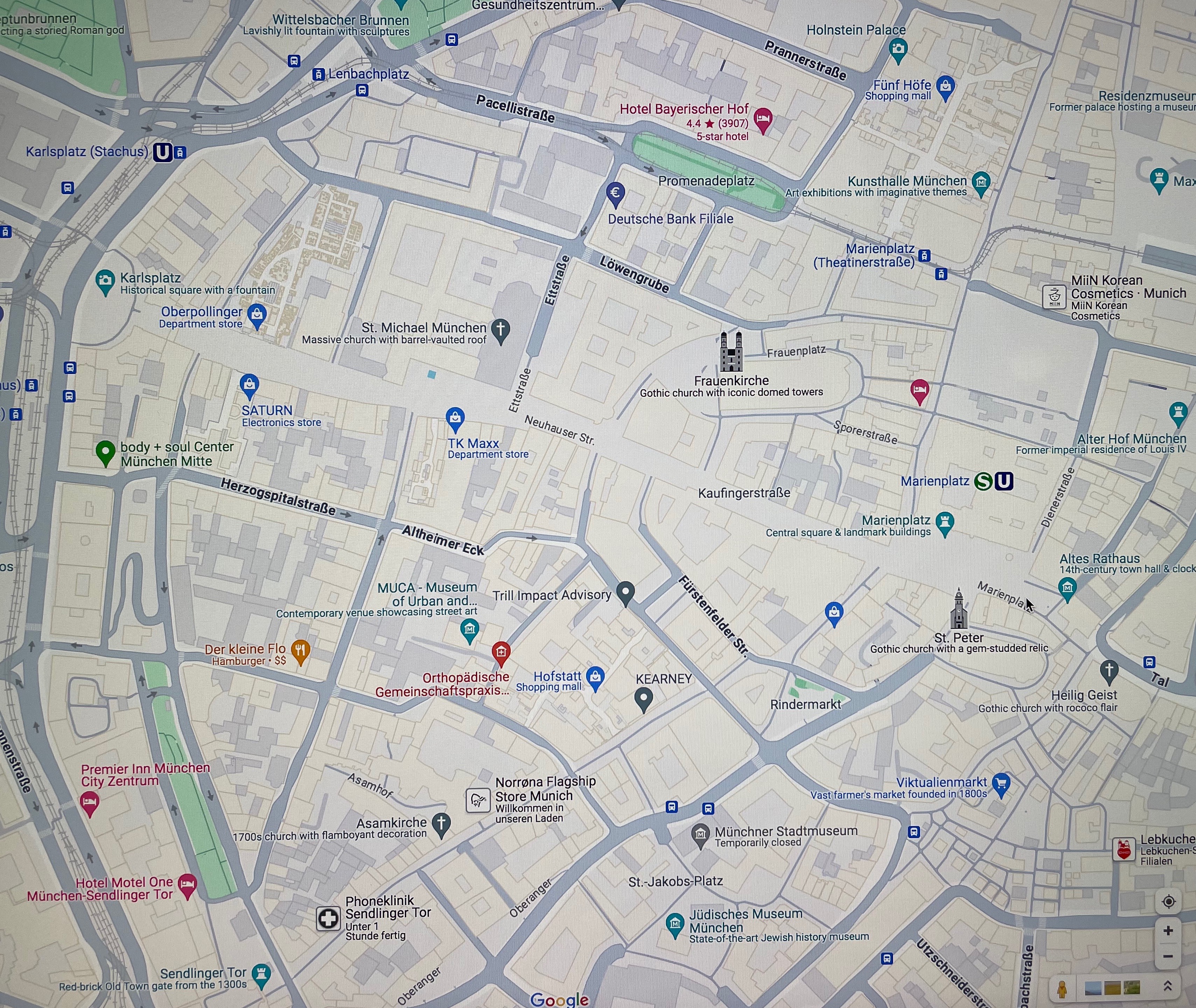
Marienplatz Strolling. Marienplatz is part of a giant pedestrian mall in central Munich extending from Karlsplatz on the northwest to the Viktualienmarkt and beyond to the southeast. Kaufingerstrasse is aptly named (“buyer’s street”). It’s where I found numerous neat CDs at Ludwick Beck department store, my first pair of large perfectly round glass frames, and other assorted goodies. Just northeast of Marienplatz is Haxnbäurin and its scrumptious Schweinhaxe (rotisserized pork knuckle).
Cycling the Garten and Vicinity. Munich’s Englischer Garten was where I survived my first European bicycling experience. It wasn’t scary even when I mixed it up with other cyclists (and cars!).
Another Marienplatz Adventure, Thankfully Not Mine). The Thrillist website describes an errant GPS application directing American tourists to drive onto Marienplatz. Geez, no wonder all those people were looking aghast.

Pedaling It Into Paris. Carlton Reid reports in Forbes, April 6, 2024, a “French Revolution: Cyclists Now Outnumber Motorists in Paris.” Academics at L’Institut Paris Région surveyed how people in Paris and its environs use transportation. Reid describes, “Between October 2022 and April 2023, 3,337 Parisians aged 16 to 80 years old were equipped with GPS trackers to record their journeys for seven consecutive days.”
Reid continues, “In the suburbs, where public transit is less dense, transport by car was found to be the main form of mobility. But for journeys from the outskirts of Paris to the center, the number of cyclists now far exceeds the number of motorists, a huge change from just five years ago. Most of the journeys recorded were commuter trips.”
What’s more, Reid says, “The institute’s transportation report was published on April 4. It found that the way Parisians are now traveling from the suburbs to the city center, especially during peak periods, has undergone a revolution thanks in part to the building of many miles of cycleways.…Those cyclists now on the streets and roads of central Paris are not Spandex-clad professionals as seen on the Tour de France but everyday transportation cyclists.”
Big Apple Car-Free Earth Day. A press release from the New York City Department of Transportation says, “NYC DOT will celebrate the 54th anniversary of Earth Day on Saturday, April 20, with seven signature car-free streets and 46 community-organized locations as part of Open Streets: Car-Free Earth Day.”

Details are given in the release. Included are three Manhattan thoroughfares, Dyckman Street from Broadway to La Marina, St. Nicholas Avenue from 181st Street to 190th Street, and Broadway from East 17th Street to West 46th Street. Brooklyn, Queens, The Bronx, and Staten Island have selected venues as well.
Non-Big Appler that I am, I needed to scan a map to understand the Broadway stretch. I thought it ran more or less north/south.
It does, sorta. It’s most of Manhattan’s Street/Avenue grid that’s rotated 29 degree clockwise from true.
I wonder which Manhattan venues would profit from superblocking. I’d vote for Times Square, Washington Square, and Jumel Terrace to Jumel Place. ds
© Dennis Simanaitis, SimanaitisSays.com, 2024
 Simanaitis Says