
Simanaitis Says
On cars, old, new and future; science & technology; vintage airplanes, computer flight simulation of them; Sherlockiana; our English language; travel; and other stuff
CELEBRATING LATE-19TH-CENTURY LITERARY ART
“THE VOGUE FOR LITERARY POSTERS,” Leah Greenblatt writes in The New York Times, April 5, 2024, “burned briefly, beginning in 1893 and lasting not much more than a decade.”
And what a decade! Greenblatt continues, “But the body of work it produced often hewed closer to fine art than advertisement, and slyly captured the zeitgeist of the times.”

Here are tidbits gleaned from her review of The Art of the Literary Poster and from its IndieBound listing.

The Art of the Literary Poster, by Allison Rudnick, preface by Leonard A. Lauder, contributions by Jennifer A Greenhill, Rachel Mustalish, and Shannon Vittoria; The Metropolitan Museum of Art/Yale University Press, 2024.
IndieBound writes, “Spurred by innovations in printing technology, the modern poster emerged in the 1890s as a popular form of visual culture in the United States. Created by some of the best-known illustrators and graphic designers of the period—including Will H. Bradley, Florence Lundborg, Edward Penfield, and Ethel Reed—these advertisements for books and high-tone periodicals such as Harper’s and Lippincott’s went beyond the realm of commercial art, incorporating bold, stylized imagery and striking typography.”
The book, IndieBound notes, is based on the renowned Leonard A. Lauder Collection.
Bearings. This ad emphasized the nexus of fitness and intellectualism in the late 1800s. Bearings was a cycling magazine.
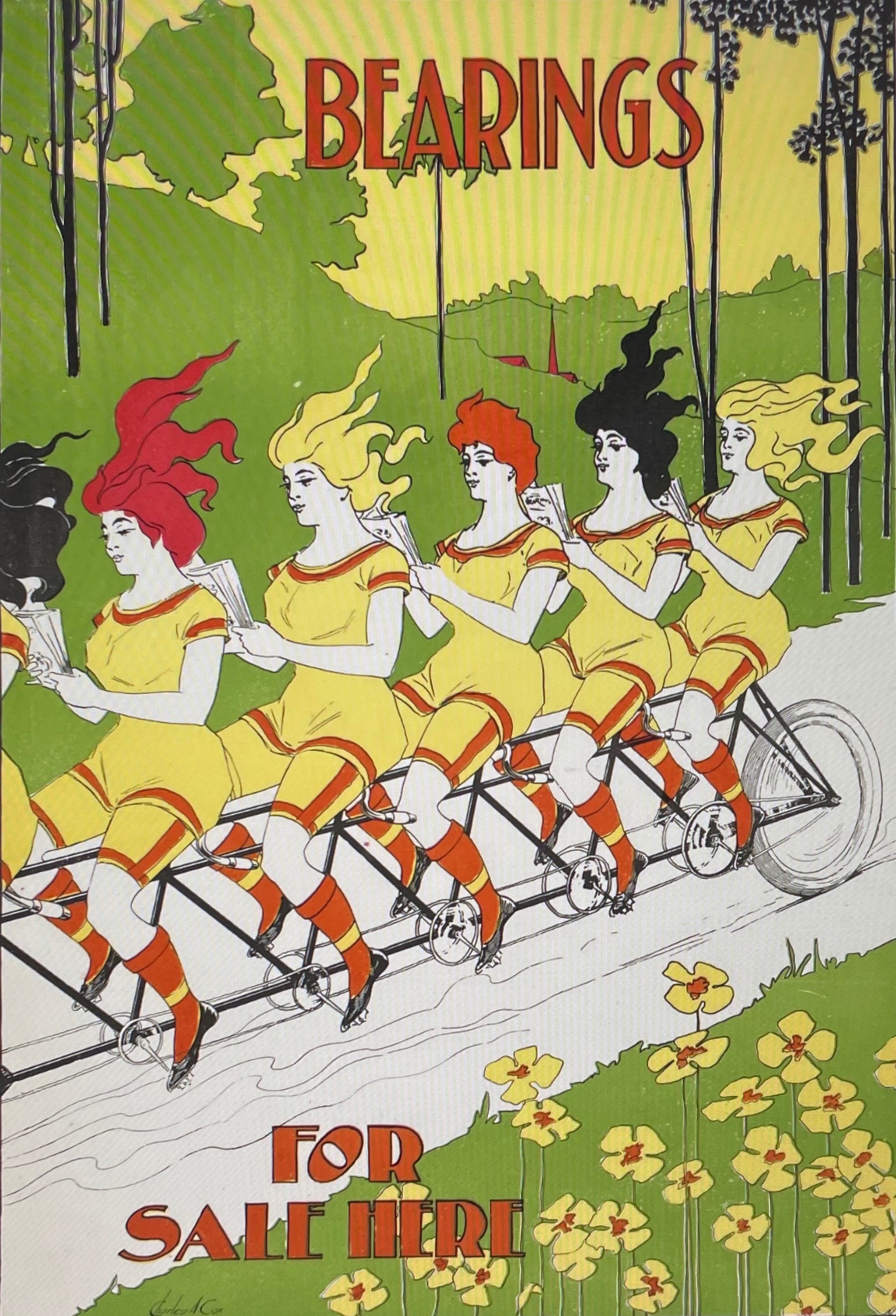
Charles Arthur Cox, 1896. This and the following images from The New York Times, from The Metropolitan Museum of Art, Leonard A. Lauder Collection of American Posters, Gifts of Leonard A. Lauder.
In today’s context, I can’t help but mentally replace the magazines in their hands with smart phones.
Product Placement. A more direct product placement, this stylish cyclist artfully displays her favorite magazine.
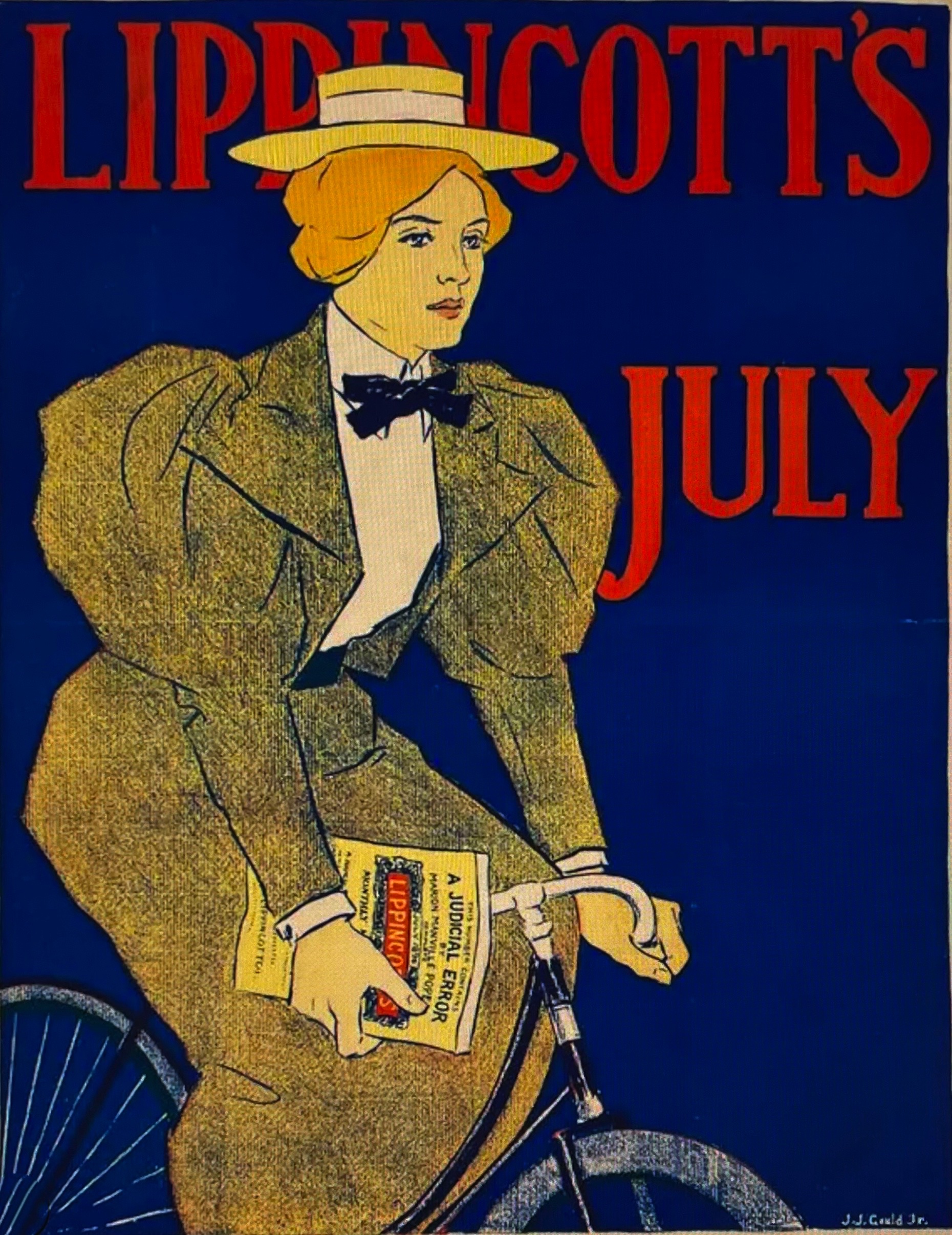
Joseph J. Gould Jr., 1896.
The Opulence of Peacocks. The Fin de Siecle (no cycling pun intended) was an opulent era. I particularly like the lushness of these peacocks from Le Journal de la Beauté.

Above, according to my Baedeker’s Northern France, 1894, 10 centimes was only 2¢ U.S., quite a bargain. Below, this lush bird is identified as the work of Will H. Bradley, 1895.

The New York Times, Sunday, Feb. 9. I thought I’d have a good puzzle in identifying which year of the era had a February 9 on a Sunday. A clue in the upper right suggests 1895, but no, artist Edward Penfield must have completed the artwork in advance. February 9, 1996, was a Sunday.

One of the articles cited has a followup here at SimanaitisSays. See “Wha’Cha’Call’It in Old Manhattan?”
Two Sweethearts. I am fascinated to learn more about the two blondes in the Copeland and Day ad.

Arabella and Araminta illustration by Ethel Reed, 1895.
IndieBound lists the book today as “selected by scholars as being culturally important, and is part of the knowledge base of civilization as we know it.” The reprint costs $29.95. The online CPI Inflation Calculator (which goes back only to 1913) sets $2 of that year worth $63.74 now.
To me, the two young ladies are sweethearts at whatever the price. ds
© Dennis Simanaitis, SimanaitisSays.com, 2024
 Simanaitis Says
I received an email that you had shared a file with me on OneDrive. Legit or scam?