
Simanaitis Says
On cars, old, new and future; science & technology; vintage airplanes, computer flight simulation of them; Sherlockiana; our English language; travel; and other stuff
HOLMES AND A.I. PART 2
YESTERDAY IN PART 1, WE BEGAN EXPLORING how attuned the world’s greatest consultive detective would have been with Artificial Intelligence. We continue here in Part 2 with more analyses. There’s also a modern sleuthing mystery. And a concluding thought on Holmes’ cognitive skills.
Human Intuition. Peter Smulovics is Executive Director at Morgan Stanley, Microsoft MVP, Member of Technical Oversight Committee, Chair of Open Source Readiness, InnerSource, Emerging Technologies in The Linux Foundation, and an FSI Autism Hackathon organizer. I suspect as well he’s an avid Sherlockian.
In “Sherlock vs A.I.,” Smulovics describes, “The essence of Sherlock Holmes lies in his exceptional powers of deduction, honed through acute observation and logical reasoning…. Yet, in today’s context, A.I. algorithms are designed to process vast amounts of data, analyze patterns, and derive conclusions at an unprecedented speed and scale. Could even Holmes match the computational prowess of these A.I. systems?”
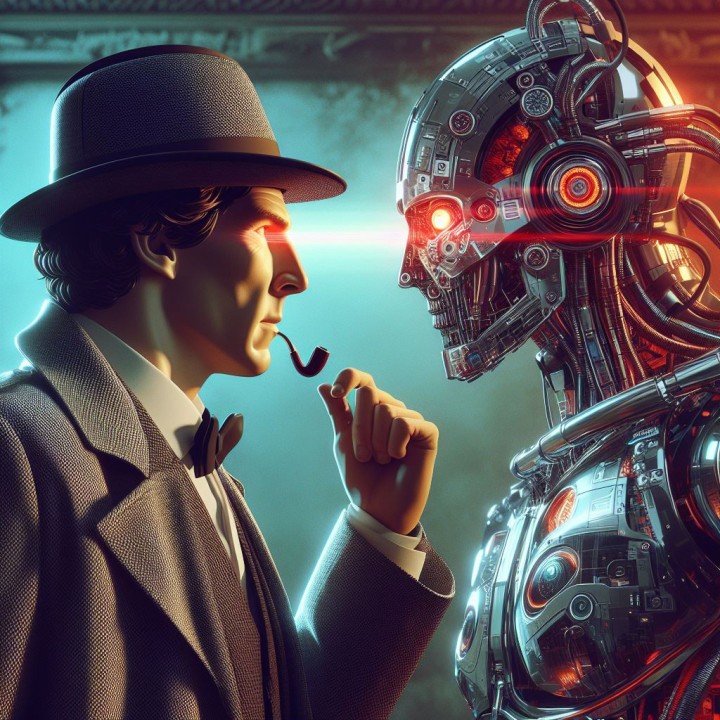
Smulovics continues, “However, where Sherlock Holmes might maintain an edge is in his uniquely human traits. His intuition, creativity, and emotional intelligence provide a depth of understanding that machines, with their rigid programming, struggle to replicate. Holmes’ ability to empathize, understand motives, and perceive nuances of human behavior goes beyond raw data analysis—an area where A.I. still struggles to excel.”
“Moreover,” Smulovics observes, “Holmes’ capacity for imaginative leaps and ‘out-of-the-box’ [i.e., ‘improbable’] thinking, often fueled by his vast knowledge across diverse subjects, remains an aspect where A.I. currently lags. While A.I. can process and analyze information, it lacks the inherent curiosity and improvisational skills that enable Holmes to connect seemingly unrelated dots and arrive at groundbreaking conclusions.”
Smulovics suggests, “Holmes’ methods, while classic and rooted in human cognition, could be augmented and enhanced by the precision and speed offered by A.I. creating a formidable partnership that marries the best of both worlds.”
A Modern Sleuthing Mystery. Imagine: The leading robotics specialist for Britain’s A.I. program is found dead. A sleuth carrying on the family tradition gets involved. “Can this modern PI beat a machine in a race to pinpoint a murderer?” asks IndieBound in its review of Howard J. Rankin’s latest book.

Sherlock Holmes versus Artificial Intelligence: The Race to Solve a Murder Mystery, by Howard J. Rankin, Howard J. Rankin Books, 2023.
IndieBooks writes, “Pitting his intellect against the forensic expert android, Sherlock notes persons of interest and subtle clues while trying to trip up his programmed partner. And as their vastly different methods cause them to clash, the renowned detective is shocked to realize he might have met his match in a robot….”
Holmes’ Black-box Acknowledgment. In A Study in Scarlet, Holmes admits, “It was easier to know it than to explain why I know it. If you were asked to prove that two and two made four, you might find some difficulty, and yet you are quite sure of the fact.”
Hence, it’s likely the world’s greatest consulting detective wouldn’t have been fazed by LLMs, Discriminative and Generative A.I., and even the odd hallucination. Recall he tripped on cocaine occasionally. ds
© Dennis Simanaitis, SimanaitisSays.com, 2024
 Simanaitis Says