
LOTUS SPORTS AND 26 YEARS LATER PART 2
YESTERDAY R&T found the 1957 Lotus Sports to be likable enough, but “for which we can discover no useful purpose.” It was not inexpensive and would not be particularly competitive in its racing class. “What kinda nut would want a car like this?” I asked.
Well, it turns out one of my R&T pals, Peter Egan, fit the bill in October 1983 when he wrote “Crate Expectations.” (I love his title.) Here in Part 2 are tidbits gleaned from this article.
Replacing an Earlier Project. Peter wrote “Being eyeball deep in canceled checks from my Lotus 7 restoration project (talk about bent and rusted iron), I decided the cheapest solution to this craving was to convince the Good Editor, the Beneficent Publisher and the Kind Business Manager that what this magazine needed was a really good kit car, to be assembled as a magazine project. It worked.”
But a Kit Car? “The very words ‘kit car’… ” Peter wrote, “conjure up immediate images of a disreputable parody of some nice British roadster tarted up with too much upholstery, fake louvers, the wrong steering wheel, phony exhaust plumbing, a picnic basket where the engine should be and a tell-tale set of Volkswagen mufflers whistling from beneath the rear deck.”
A Westfield to the Rescue. June 1983 R&T carried English correspondent Doug Nye’s account of the Westfield sports car “and gave all of us,” Peter wrote, “a vicious dose of the dreaded English Sports Car Lust, a disease many believed had been eradicated by modern technology.”

The Westfield. This and other images from R&T, October 1983.
“With its tubular space frame and riveted aluminum panels,” Peter recounted, “the Westfield is very close in design to the original 11. It differs only in the use of fiberglass for the upper body panels (molds lifted from the Lotus aluminum), heavier-duty tubing and a few extra braces to handle the rigors of street and pothole, and a slightly lengthened cockpit section to accommodate tall drivers and the Sprite driveshaft.”
“Like most early Lotus cars,” Peter noted, “the 11 was always available in kit form with a variety of proprietary engines, so a modern-day kit seems like an extension of—rather than an affront to—tradition.”
Airfreighted from England. “If you think it’s expensive to airmail a Christmas card to your aunt in London,” Peter noted, “try sending a car…. Take our advice and let Willard Howe get you one by boat. Have patience and it shall make you rich.”

Humans are transformed into an adequate R&T forklift.
Three Packages. Peter described the three packages: “… one for the chassis parts, one for the 1965 MG Midget engine and transmission, and the last containing the chassis and primer-gray fiberglass bodyshell. This arrived covered with plastic wrap, criss-crossed with yellow tape reading ‘FRAGILE’ and filled to the gunwales with random Westfield parts.

Like Christmas Morning. Peter said, “Unloading the pieces from the chassis tub was about as close to Christmas morning as anything I’ve experienced since the earlier part of my arrested childhood.”
Truly DIY. Peter observed, “Not one printed word of instructional material was included with the kit, but unless you’re the sort of person who accidentally bolts exhaust headers to the rear axle, the relative position of parts is pretty self-evident. The Westfield is basic automobile at its best.”

The Wiring Harness. “I spent two nights going blind on wiring diagrams,” Peter admitted, “trying to track down wires that led to nonexistent 4-way flashers and seatbelt buzzers before throwing the MG wiring loom at a nearby stack of empty beer cans and cigarette butts.”
Peter enlisted the help of two friends “who have restored many old British cars and profess actually like making up wiring looms. (Too much Guinness. Or not enough.)”
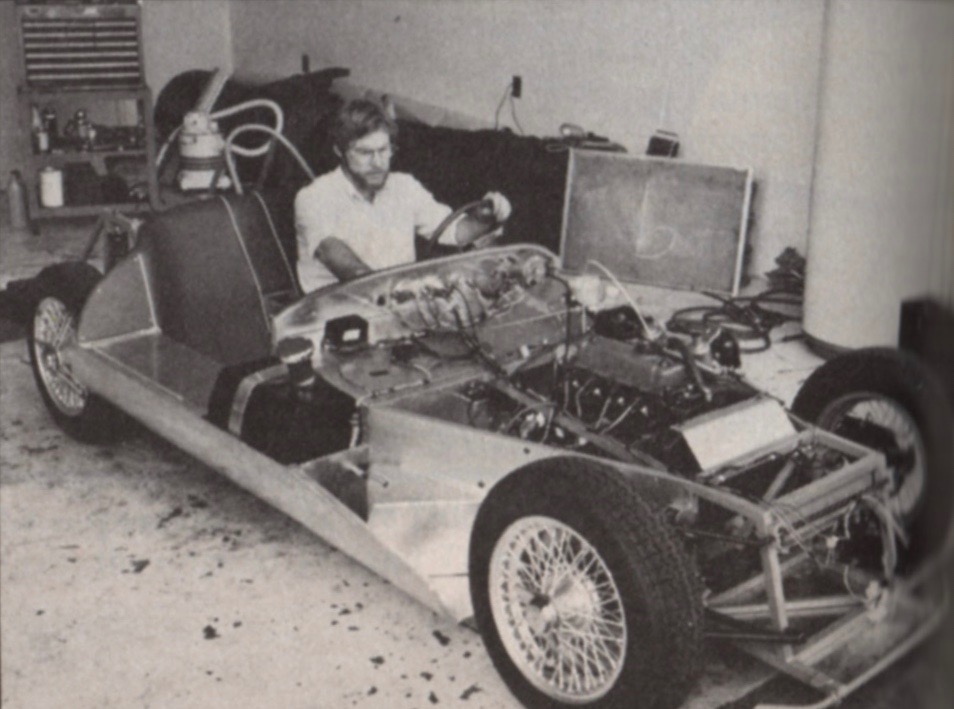
Peter and the Westfield.
A First Drive. “I took the car out for a midnight drive,” Peter described, “and the throttle immediately stuck wide open (minor adjustment). Otherwise the car ran, felt and sounded beautiful. Without the weight of the bodywork it felt like a go kart and accelerated like hell, almost leaping down the road under bursts of acceleration.”
Painting. Peter recounted, “We sent the bodywork out to a paint shop while the fine mechanical details were being looked after. I’ve painted at least two dozen cars myself and now have lungs I image to be about two thirds filled with Bondo, primer dust and paint spray, so I prefer to farm it out these days. We chose a soft white paint with a medium blue racing stripe down the middle of the car.”

Kim Reynolds does his part in vehicle development.
Summing Up. Peter concluded, “Suffice it to say that when the sun is just rising on a Sunday morning and you just happen to own a cap and a pair of goggles, the Westfield is not a bad thing to have lurking in your garage.”
Crate Expectations indeed. ds
© Dennis Simanaitis, SimanaitisSays.com, 2024
 Simanaitis Says