
Simanaitis Says
On cars, old, new and future; science & technology; vintage airplanes, computer flight simulation of them; Sherlockiana; our English language; travel; and other stuff
HYBRID CARS REVISITED
IT’S LOOKING LIKE I MIGHT HAVE BEEN RIGHT (if premature) fourteen months ago when I wrote “Why Not Hybrids?” A recent Automotive News, March 4, 2024, is brimming with accounts of automakers as well as respected analysts recognizing HEVs (hybrid electric vehicles) and PHEVs (plug-in hybrid electric vehicles) as offering advantages over BEVs (battery electric vehicles), particularly in today’s transitional period. Here are tidbits gleaned from Automotive News.

Toyota “Prioritizing Demand.” Possibly Washington Too. Automotive News’ Larry P. Vellequette writes, “The CEO of Toyota Motor North America believes that battery electric vehicles will make up about 30 percent of the U.S. new-vehicle market in 2030, half the target the EPA sought last year — a goal the agency is reportedly reconsidering.”

Ted Ogawa, CEO of Toyota North America. Image from Automotive News.
“We are respecting the regulation,” Ogawa told Vellequette, “but more important is customer demand…. Regulation-wise, we would have to prepare something like credit purchases.”
Recall, Tesla made $1.79 billion selling such emissions credits last year, almost $9 billion since 2009. Gulp. I thought Tesla was an automaker, not a hedge funder.
‘Rockin’ ’ Hybrids, Bigger Spiffs Electrify February Sales. Larry P. Vellequette and David Phillips report in the same Automotive News, “Hybrids are just rockin’, ” David Christ, head of the Toyota division at Toyota Motor North America, told Automotive News after results were released Friday. Christ said consumers are coming into dealerships seeking out hybrids, and because the automaker has inventory on dealer lots again, they are cross-shopping powertrains.”
They continue, “Honda Motor Co. reported a similar trend, with overall sales up 32 percent to 110,110, and sales of its electrified vehicles reaching a record level for February. Honda brand sales rose 38 percent, offsetting a 6.1 percent decline at Acura. February marked a full year of monthly sales gains for the Honda brand.”
Consumer Reports Cites Hybrids Among Top Cars. Automotive News’ Hannah Lutz writes in the same March 4, 2024, issue, “The majority of Consumer Reports‘ top model choices for 2024 are electrified. Six of the entries on the organization’s top 10 list have a conventional hybrid or a plug-in hybrid variant…. PHEVs gained prominence on the Consumer Reports list this year, aligning with their presence in the market.”
She quotes Jake Fisher, senior director of automotive testing at Consumer Reports: PHEVs are “the most misunderstood powertrain. But it’s really a good choice for a lot of people if they understand what they’re getting into.”
Image from Automotive News.
Lutz notes, “A conventional hybrid has an internal combustion engine and an electric motor that work together to run the vehicle. Plug-in hybrids also have an internal combustion engine and an electric motor, but their chargeable batteries are utilized first. The gasoline-powered engine kicks in once the batteries are depleted.”
Also, she observes, “PHEV sales expanded 60 percent in 2023, a higher rate of growth than electric vehicles or conventional hybrids, according to Consumer Reports‘ analysis. Automakers are taking note as the pace of battery-electric vehicle sales slows. General Motors last month said it would bring PHEVs back into its portfolio after previously promising a full EV future.”
Will a PHEV Save You Money? “Consumer Reports” says Automotive News, “analyzed the fuel costs of conventional hybrids, plug-in hybrids, and battery-electric vehicles in California, Massachusetts, Florida, and Washington…. The firm considered consumers who drive 40 miles a day, charge their EVs and PHEVs each night, and take four 500-mile road trips annually.”
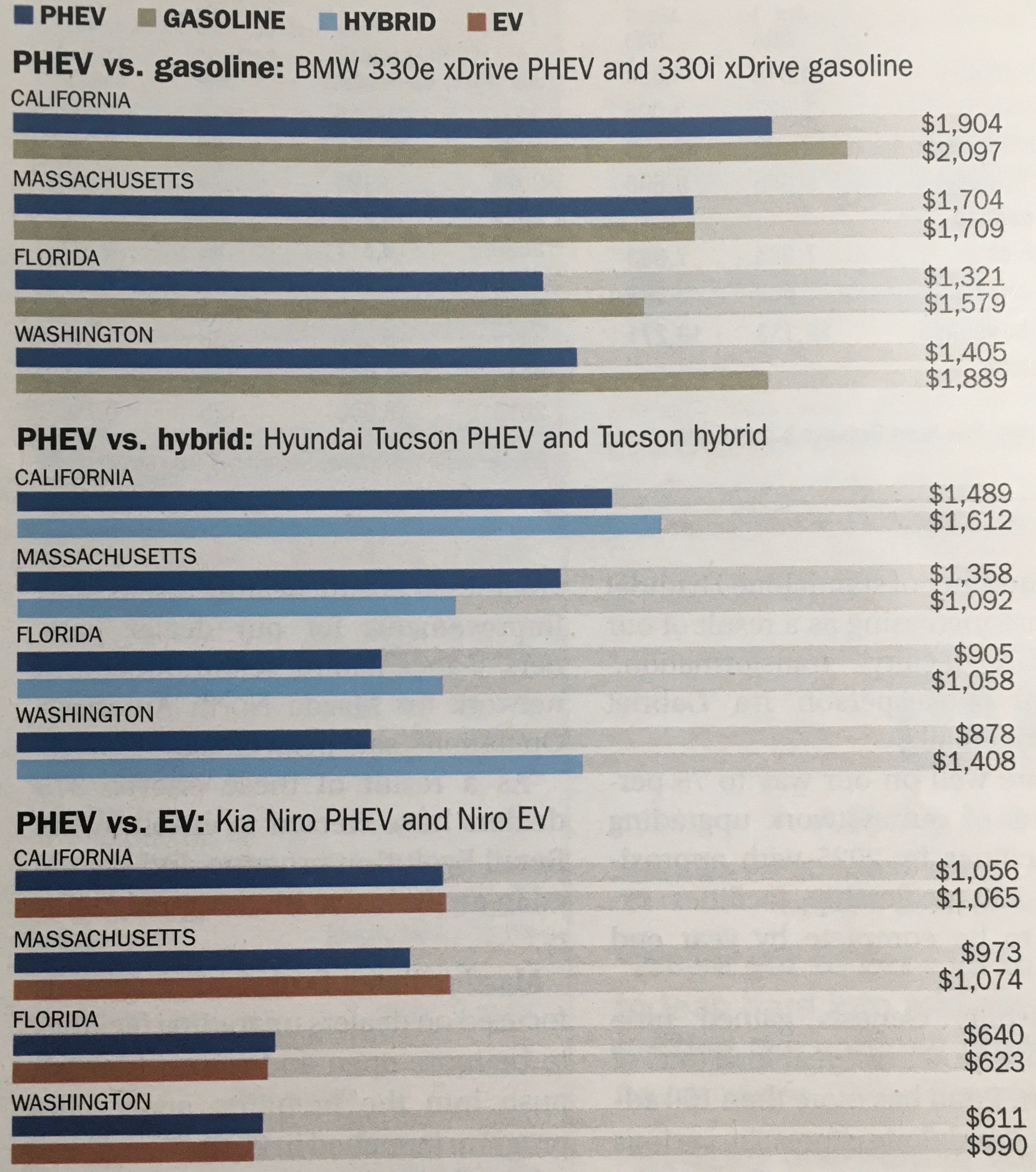
Image from Consumer Reports via Automotive News.
On Path to EVs, Plug-in Hybrids Gain Momentum. A week later, March 11, 2024, Automotive News’ Hannah Lutz reports, “Although they make up less than 2 percent of the market, PHEVs have gained prominence as one of the auto industry’s paths to reducing carbon emissions. General Motors said it would add PHEVs to its lineup, a reversal from previous plans, and Toyota reemphasized its confidence in a hybrid-heavy portfolio.”
Burns, Borroni-Bird, and Mitchell Got It Right. Back in 2010, Reinventing the Automobile: Personal Urban Mobility for the 21st Century suggested the following scenario for optimal mobility in the 21st century.
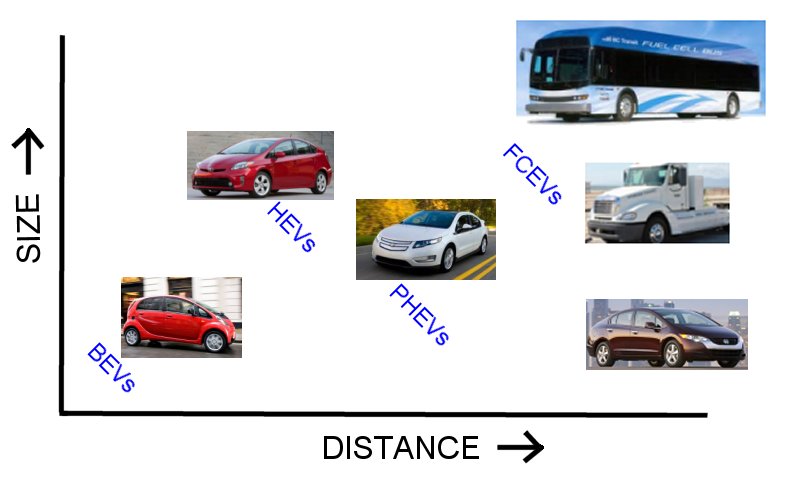
Image from Reinventing the Automobile.
BEVS are envisioned as optimal small cars in urban use. (Less range anxiety, space efficient.) FCEVs fit the needs of larger vehicles over longer distances. (Fuel cells are highly efficient, centralized infrastructure.) And note where HEVs and PHEVs meet the Goldilocks optimum for many of us. ds
© Dennis Simanaitis, SimanaitisSays.com, 2024
 Simanaitis Says
“Plug-in hybrids [ ] chargeable batteries are utilized first. The gasoline-powered engine kicks in once the batteries are depleted.” A better understanding: Minimal battery management allows holding the charge on the highway and saving the battery for slower speeds. And “holding the charge” means normal hybrid behavior, not ICE only.
M7 last ICE got 29.7 mpg lifetime. My first PHEV with 22 mile battery got 58 mpg for a year, $13/mo to charge. The current PHEV with 41 mile battery is doing 104 mpg yearly, ~$35/mo to charge at 16.5¢ per kWh. EPA says it emits on av 31% of the grnhse gases emitted from the typical 2024 ICE only auto. Fewer than 30% of my miles are gas powered. And old Road & Track fans will appreciate . . . the last RWD ICE had 240hp, first AWD PHEV had 400hp, the new AWD PHEV 455 (not to mention 523 lb ft!).
With perhaps 15% of the negative EV consequences on the mining industry, rare earth elements processing, the power grid, and potential global turmoil, a PHEV is the optimum compromise I think.
The three PHEVs tested by CR have an av battery range of 29 miles, which helps explain the performance of my 41 mile battery.
Compared to the already laudable PHEV results at CR, the emergence of solid state batteries for PHEVs (as suggested by Gill Pratt, Chief Scientist and Executive Fellow for Research of Toyota Motor Corporation, CEO of Toyota Research Institute, and Executive Advisor of Toyota Central R&D Labs) may be EV’s undoing, as has been the case with many a Government Sponsored Enterprise. But, Akio Toyoda is smiling.
Another cogent piece from Dr. Simanaitis, and a good closing point by Bill U above.
There are not enough raw materials for the world to swap all ICE (internal combustion) cars for EVs. EVs run on petroleum tires (producing most the dust in urban areas), and use six (6) times as many minerals as i.c. cars, including cobalt, lithium, nickel, copper, manganese, graphite, zinc, rare earths like neodymium, thallium, and dysprosium, the latters’ extraction requiring huge amounts of carcinogens like ammonia, hydrochloric acid, sulfates.
Much of these minerals are imported from politically unstable regions. Thallium has been a common ingredient in rat poison. It’s tasteless, odorless, and nearly colorless. While those who tested positive hadn’t consumed poisonous levels of the metal, it was enough to cause fatigue, heart arrhythmia, nausea, digestive trouble, neurological problems, and hair loss. The scariest part is that even after patients completed detoxification regiments, thallium continued to show up in their systems.
“We now know that heavy metals are additive and synergistic,” says David Quid, the lead scientist at Doctors Data, PhD in nutritional biochemistry. “If you get a little thallium, and a little lead, and a little cadmium in your system, you’ve got one plus one plus one equals five or six, not just three.” In other words, these metals do more damage when they’re combined.”This stuff bioaccumulates,” he added. “Down the road, it’s going to kick you in the ass one way or another.”
The above is yet another reason the every poll of scientists shows them agreeing overpopulation is our by far biggest problem, their words, “bigger than climate.” 60 Minutes ran a segment about overpopulation causing mass species extinction. The New York Times articles about overpopulation engendering, fostering pandemics.
UN and other studies show animals raised for meat and dairy produce more greenhouse gas than all the world’s cars, trucks, buses, trains, planes, ships combined. Every study not overtly or covertly funded by meat, dairy, egg industry comes to the same conclusion. The single best way to prevent heart diseases, hypertension, cardiovascular ills, inflammation, high blood pressure, diabetes, cancer, macular degeneration, dementia (now termed type 3 diabetes), Alzheimer’s is a plant-based, vegan diet.
Pardon thesis, but if we’re serious, we need to stop rounding up the usual suspects and triage.
PPS. Believe me, many of us who own ancient i.c. dragons driven judiciously or occasionally for no good reason at all are hardly living in the past curmudgeons, Luddites, lamenting the good ol’ days that never were. We live in today’s world, recycle every scrap, and our distaff well know the fashion industry the biggest polluter in the world after only oil. Some of us aren’t just environmentalists, but avid gardeners and arborists.
However….until we curb overpopulation, encourage having “one or none” or adopting, here and around the globe, we’re sunk. Meanwhile, please see Tad Friend’s “Value Meal” p. 42 of the 9/30/19 New Yorker magazine.
Again, pardon this epistle’s length, but the hour is late, so the educated, perhaps connected souls drawn to this wondrous website should do everything to buck the consumer-driven media’s blackout on discussing what the world’s scientists agree our biggest by far problem.
For example, the resulting light pollution interrupts human circadian rhythm, causing breast cancer in women.