
Simanaitis Says
On cars, old, new and future; science & technology; vintage airplanes, computer flight simulation of them; Sherlockiana; our English language; travel; and other stuff
DOES CAROLINE SEE THE SAME COLORS I SEE?
I CONFESS I’M A BETTER READER than podcast listener, but those I listen to invariably come from the BBC. On March 11, 2024, I got attracted to one following my usual 6:00 a.m. BBC World Service. It asked, “Do We All See the Same Colour?”
BBC’s Caroline Steel said, “CrowdScience listener Gregory wants to know what affects the way we see colours of the world. Could eye colour have anything to do with it?”
A good question, Caroline. I acknowledge that I have bright blue eyes super-tuned not that long ago through cataract surgery that has given me exceptional perception of blue sky and 20/15 vision.

May I introduce you to the BBC’s Caroline Steel.
She reports, “I’m a science presenter, radio producer, and I perform science shows on stage. I have a background in physics, but an interest in anything I don’t know much about.”
What a refreshing point of view. Here are tidbits gleaned from her podcast together with my usual Internet sleuthing.
For those who want to hear the podcast first.
Trichromatic Vision. Most humans have trichromatic vision: Our eyes contain receptors of three colors (sorry about the spelling, Caroline; I’m a Yank), blue, green, and red. According to Wikipedia, we’re only midpack among vertebrates in this regard.

This and the following image from Wikipedia.
Most birds, for example, have four receptor types and can see ultraviolet light (300-400 nm) as well. Dogs and most placental animals are dichromatic, sans red receptors.
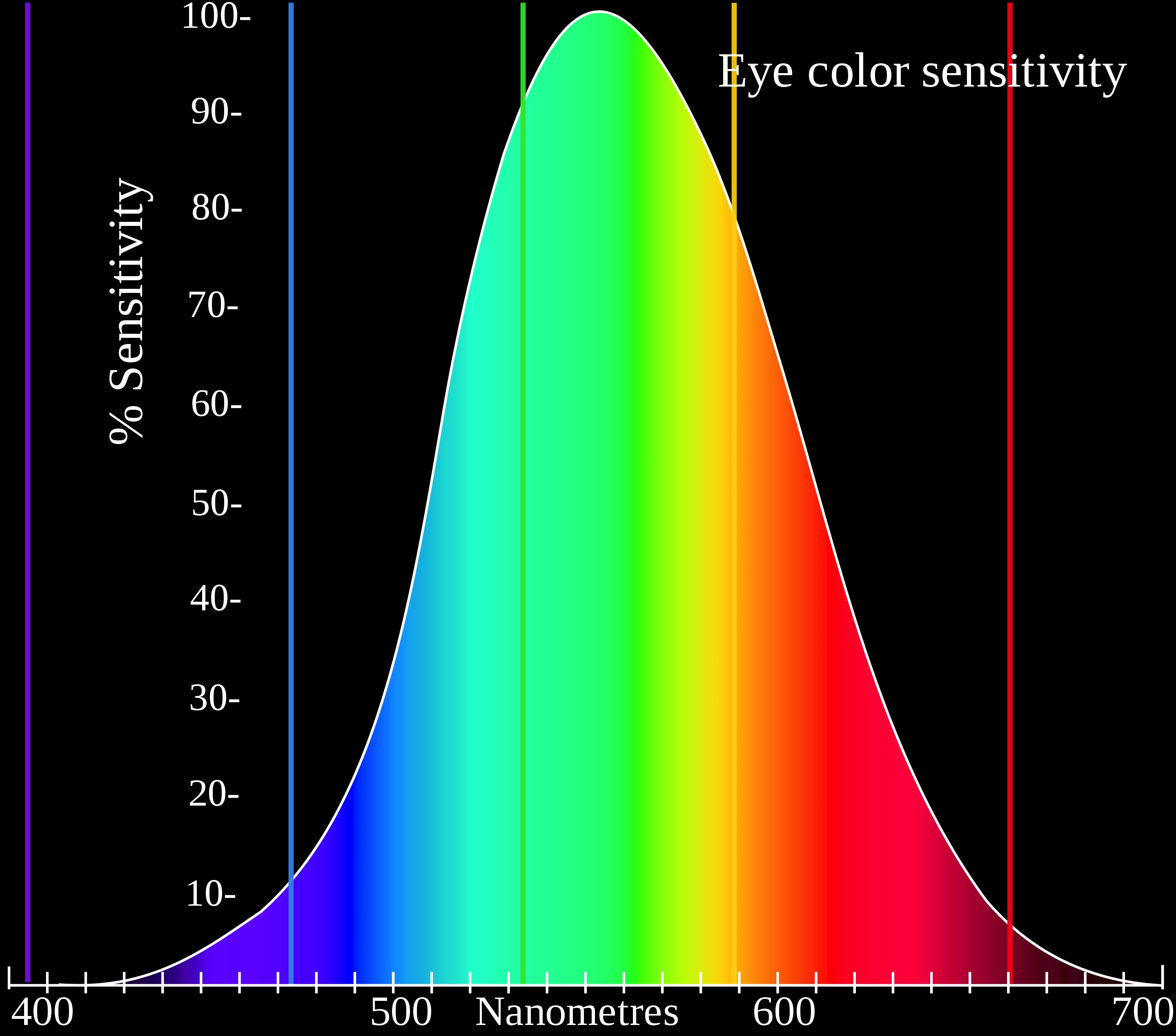
Humans sense relative brightness as a function of wavelength. Image from Wikipedia.
Is Caroline’s Green My Green? Caroline had opportunity to experience color-matching through a microscope by viewing a circle, the bottom half set to a selected point in the spectrum, the upper half adjustable by the viewer to match the preselected color. In general, she found, perceptions generally agree, though person-to-person and even an individual’s perceptions vary in accommodating different circumstances.
Sunglass Accommodation, For Example. Sunglasses change colors on initial perception, but with time the mind accustoms itself to the tint.
Ah, But My Blue is Bluer Than Caroline’s. She has brown eyes, and the specialist says the color of the iris affects perception, especially for blue-eyed people versus those of other pigmentation. Apparently the blue iris is less opaque than the others, has less affect on the incoming light, and one result is an apparent increase in perceived brightness.
Changing Conditions, Short- and Long-term. Our lenses yellow with age, though these long-term changes aren’t really noticeable. But changing conditions (like those sunglasses accommodations) can be perceived.
A Dominant Eye. Caroline is given an experiment measuring accommodation time to changing colors, with curious results. It turns out she has a dominant eye which reacts more quickly than the other.
They don’t discuss it in the podcast, but I wonder if my left-eye dominance, i.e., using a camera or telescope (or misaiming an ROTC rifle), would yield similar results.

Blind to Color. Caroline learns that 1 in 200 women and 1 in 12 men are color-blind. A British football fan who happens to be color-blind describes the confusion of watching one team kitted out with red jerseys and black numbers and the other, with just the opposite. He also cites cooking chicken as a quandary: how to known when it’s done?
Caroline says rugby has taken a first step in resolving the spectator problem: No longer does green-kitted South Africa vie with red-kitted Chile.
There’s less red/green blindness near the equator than in northern climes. For example, color-blindness is all but nonexistent in Fiji.
One theory suggests that as folks migrated north and as agriculture developed, there was less evolutionary advantage in being able to distinguish crop colors. I wonder if the 1/200 versus 1/12 evolved simply because you-know-who was left with the scutwork of searching for berries and other wild foodstuff.
Another theory suggests that blue eyes evolved in response to those northerners appreciating all the more the occasional clear day.
Thanks, Caroline, for the podcast, including other tidbits left ungleaned. ds
© Dennis Simanaitis, SimanaitisSays.com, 2024
 Simanaitis Says
I’ve read that blue eyes are a mutation. Very many babies are born with blue eyes and they change after some time. I would guess this depends on how prevalenet the recessive mutation is in you. My mom has blue eyes. I had blue eyes for about 1 1/2 years, and then they changed to hazel.