
Simanaitis Says
On cars, old, new and future; science & technology; vintage airplanes, computer flight simulation of them; Sherlockiana; our English language; travel; and other stuff
NESSIE TIDBITS PART 1
I TEND TO BE A SKEPTICAL SORT (my mathematics training rates proof above supposition) and I dislike anagrams (which sounds irrelevant but of which more anon). These two personality quirks, though, got me interested in the Loch Ness Monster. Without going into absurd detail (which, I warn you, exists), here are tidbits about Nessie gleaned from Brewer’s Dictionary of Phrase and Fable, Wikipedia, and other Internet sleuthing. Full disclosure: I find the hoaxes a lot more entertaining than the “what ifs.” And I came upon scads of good stuff, enough for Parts 1 and 2 today and tomorrow.

Origins. Wikipedia says, “The earliest report of a monster in the vicinity of Loch Ness appears in the Life of St. Columba by Adomnán, written in the 7th century AD.” Briefly, Irish monk Columba was visiting Scotland and saved the life of a colleague attacked by a water beast in the River Ness. Columba made the sign of the cross, said “Go no further. Do not touch the man. Go back at once.”
Gee, didn’t he mean “farther”?
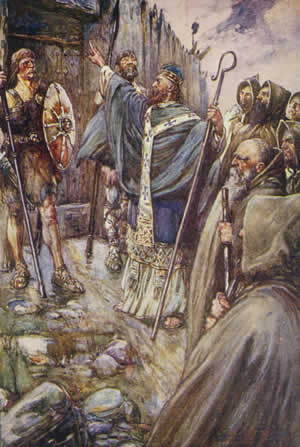
St. Columba, apostle to the Picts. Image by Joseph Ratcliffe Skelton from Wikipedia.
“Skeptics question the narrative’s reliability,” says Wikipedia, noting that “water-beast stories were extremely common in medieval hagiographies, and Adomnán’s tale probably recycles a common motif attached to a local landmark.”
Wikipedia also talks about the Oilliphéist, a similar beast in Irish folklore: “The monster swallows a drunken piper named Ó Ruairc (O’Rourke). The piper is either unaware of his predicament or is completely unperturbed and continues to play inside the Oilliphéist’s stomach. The monster becomes so annoyed with Ó Ruairc’s music that it coughs him up and spits him out.”
Indeed, the Oilliphéist and I do not differ in this opinion of Irish folk music.
A Legend Grows. So Does the Monster. Brewer’s recounted, “On 22 July 1933 a grey monster some 6ft (1.8m) long was spotted crossing a road near Loch Ness, and subsequent ‘sightings’ reported a strange object some distance out in the water. Descriptions of it varied, so that two years later its length was said to be nearer 20ft (6m) and its appearance a cross between a seal and a plesiosaur, with a snake-like head at the end of a long neck and two flippers near the middle of its body.”

Brewer’s Dictionary of Phrase and Fable, revised by Adrian Room, Harper Collins, 1999.
“From then on,” Brewer’s said, “it became a continual object of media attention.” And touristic interest.
Its description continued to grow: Wikipedia writes, “Modern interest in the monster was sparked by a sighting on 22 July 1933, when George Spicer and his wife saw ‘a most extraordinary form of animal’ cross the road in front of their car. They described the creature as having a large body (about 4 feet (1.2 m) high and 25 feet (7.6 m) long) and a long, wavy, narrow neck, slightly thicker than an elephant’s trunk and as long as the 10–12-foot (3–4 m) width of the road…. Spicer described it as ‘the nearest approach to a dragon or pre-historic animal that I have ever seen in my life.’ ”

Image by Starablazkove courtesy Wikipedia from “Aug 22, 564 CE: Loch Ness Monster Sighted,” National Geographic.
Gosh.
Tomorrow in Part 2 we’ll begin with photos of Nessie. Or is one a Labrador and the other just a toy?
© Dennis Simanaitis, SimanaitisSays.com, 2024
 Simanaitis Says
Both “further” and “farther” have the same dictionary definition.
Mrs Grimbly, R.I.P., taught us that “farther” was for actual distance, “further” was for conceptual. (She also corrected us for saying “Can I open a window?” when we meant “May I…”)
Further research on the OED website (as opposed to the iPhone app) reveals the following:
Farther (adj & adv) c1330-
Farther (v) c1570-
Further (adv, adj, v) Old English
Further (v, n –> furtherance) 1526-1796
So it would seem that Columba/Adomnan used the only word available in the seventh century.
Your Mrs. Grimbly reminds me of my 5th Form English teacher, Miss Roe (when I was at school in the UK) who was a stickler for correct spelling and grammar. Each essay was returned with comments requiring that misspelled words be written out three times, and grammatically corrected sentences be written out once, and resubmitted. If the resubmission had errors, spelling errors had to be written out 100 times and sentences 10 times.
It was rumoured that she was a leading authority on Shakespeare in the UK, and we believed it because she was so old that we were convinced that she knew him personally (she was in her late eighties when she taught us at a private school).
The school itself was around in Shakespeare’s time, founded in 1577, but sadly closed down in 1976 in its 399th year.
I like the rumour about your Miss Roe and Shakespeare. I suspect we spread similar rumors about Mrs. Grimbly.
Thanks both for another look at Nessie, and farther/further, the latter i still have to double-check in anything written for public consumption.
Much as we all love a mystery, and the remotest chance of some creature surviving, as with a recent New Yorker piece on the Tasmanian tiger, perhaps an oft overcast, gloomy, and large lake in the Scottish Highlands, second largest in Scotland, fourth largest in all Britain, as deep or deeper than our Great Lakes, abetted by a population given to both prose and drink, inevitably hosts such a grand fable.
And what of Nessie’s kith and kin, ex-wives/husbands?