
Simanaitis Says
On cars, old, new and future; science & technology; vintage airplanes, computer flight simulation of them; Sherlockiana; our English language; travel; and other stuff
RUM-RUNNERS OF THE AIR PART 1
THE EIGHTEENTH AMENDMENT OF THE CONSTITUTION and its enforcing Volstead Act, 1919, prohibited the manufacture and sales of alcoholic beverages. Note, however, it didn’t outlaw the possession or consumption of the stuff. Or the thirst for it.

Prohibition? Really? And, as admitted by the Educator Resources of the National Archives, “Enforcing Prohibition proved to be extremely difficult. The illegal production and distribution of liquor, or bootlegging, became rampant, and the national government did not have the means or desire to try to enforce every border, lake, river, and speakeasy in America. In fact, by 1925 in New York City alone there were anywhere from 30,000 to 100,000 speakeasy clubs.”
See “Texas Guinan—Not Just Another Indicted B.S. Artist here at SimanaitisSays.
“The demand for alcohol,” Educator Resources continues, “was outweighing (and out-winning) the demand for sobriety. People found clever ways to evade Prohibition agents. They carried hip flasks, hollowed canes, false books, and the like.”
The New York Times, January 20, 1924. And enterprising aviators enhanced the supply, as described by Howard Mingos in “Rum-Runners of the Air: Stories of the Fliers Who Ply Their Contraband Trade on Our Landward Borders and Coasts,” The New York Times, January 20, 1924. Here in Parts 1 and 2 today and tomorrow are tidbits about these aerial activities gleaned from this article as well as from my usual Internet sleuthing.

WWI Pilots Seeking Kicks. Mingos wrote, “All were young: many had their first go at life during the last days of the war and have never recovered from the disappointment of the armistice which kept them from getting over enemy lines. And so wherever there was a boundary, they have come to look upon it as an objective.”
“There is no check,” Mingos observed, “on a pilot’s bootlegging activities. His machine is not licensed. Nor is he. There is no law compelling registration of the aircraft. [Only Canada had strict regulations in this regard.] “And nearly all the bootlegging planes have been acquired from the Government. They have been sold at bargain-basement prices from the surplus war equipment.”

See “Flying 1918” for details on buying and flying a Curtiss Jenny for $50.
Spotting for Sea-going Bootleggers. Mingos described, “There is a highly perfected system among the bootleggers off the coast…. In order to keep in touch with their exact location the land agents employ pilots to carry a ‘rum-spotter’ out to sea. This man knows which boat he is looking for. With a pair of powerful glasses he can chart the exact spot toward which to send the mosquito boat.”
Just Sightseeing…. “One of these flying boats,” Mingos recounted, “was a common sight over New York, where it seemed to be doing a good business carrying sightseers. Nearly all of its patronage, however, came from the rum-spotters, who paid from $200 to $300 for each trip off Sandy Hook.”
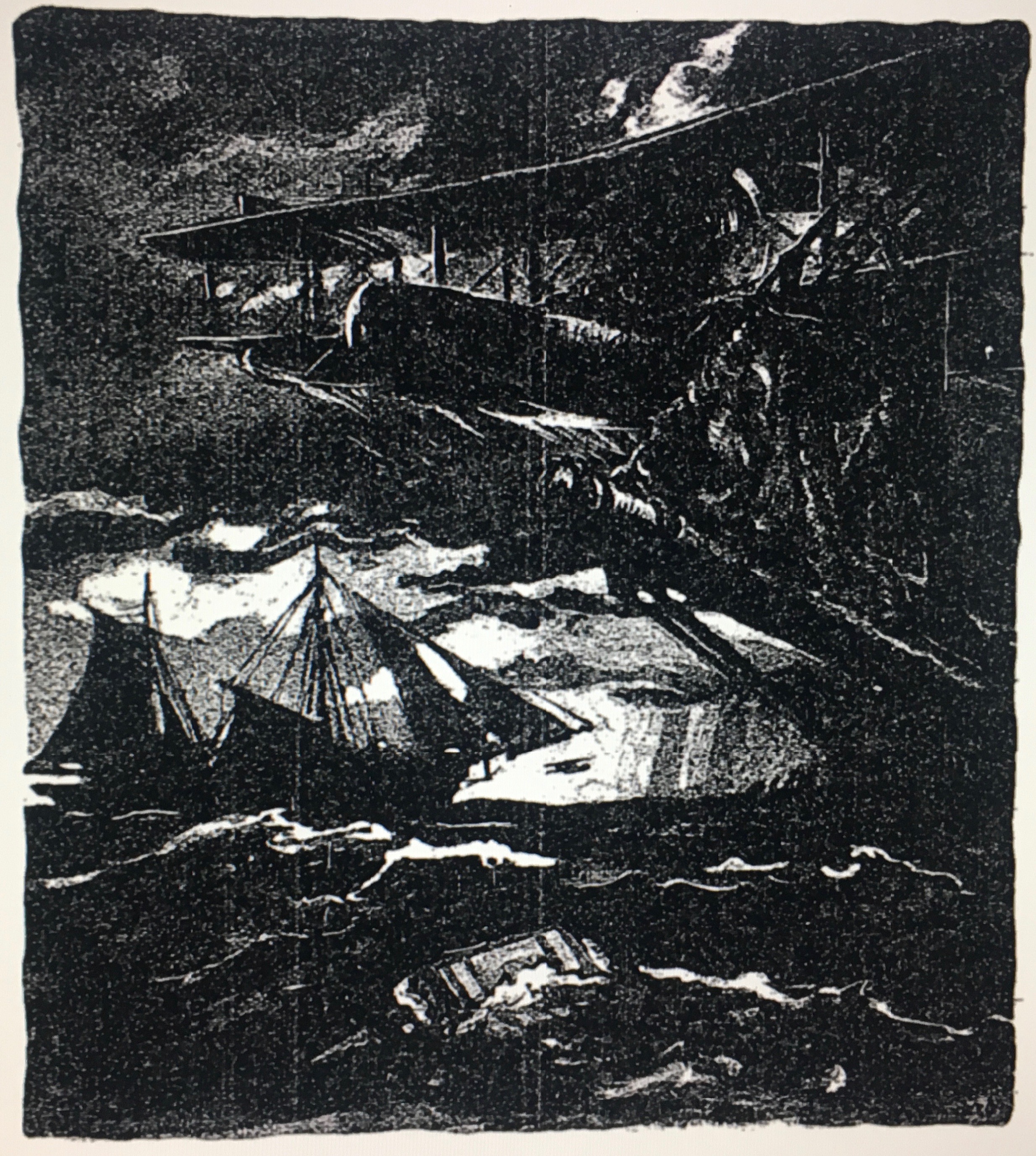
Image from The New York Times, January 20, 1924.
Even this passive activity was fraught with adventure: In one instance, Mingos related, “Once over the rum fleet the spotter was trying to signal the schooner with which he wanted to communicate. At that point the engine played out and the little machine came down on the waves which were then being kicked up with a wicked wind.”
“The rum fleet disappeared,” Mingos wrote. The hapless pilot, his mechanic, and the rum-spotter were left in a stormy sea. “They dared not smoke, for in trying to fix the engine they had flooded it with gasoline. This has seeped down into the hull and there was no saying where it lay ready to be ignited.”
Through that night, the next day, and another night, “The waves rolled over the wings and constantly drenched them. They allayed their thirst with the oily, rusty water from the radiator, and managed to crawl out on the upper wings and at either end fasten an undershirt as a signal of distress.”
At Last—Rescue! Mingos continued their tale: “Toward morning, when they were half asleep with exhaustion, there came a bumping, jarring sound and a hoarse voice shouting profane greetings. A small boat from a schooner picked them up. They were soon on board a rum-runner.”
“ ‘Any chance of putting us ashore?’ asked the pilot.”
“Not a chance in the world. I’ve got a juicy cargo here, m’lad, and can’t take the risk. At that, maybe we can send you back in one of the launches.”
A Happy Ending, Sorta. Along came the launches, into which the hootch had to be transferred. “The aviators helped along with the others,” Mingos recounted, “and thus found favor with the commander who agreed to take them ashore.”
The moral to this tale is unclear. A passive bit of rum-runner spotting turns into active rum-running and ends successfully for all (except for the pilot’s flying boat).
Tomorrow in Part 2, Mingos relates tales of active aerial rum-running from the onset.
© Dennis Simanaitis, SimanaitisSays.com, 2024
 Simanaitis Says
Cool. Air-mailing the rum. More volume by boat, though.
Just for fun: making wine at home during Prohibition – https://grapecollective.com/articles/prohibitions-grape-bricks-how-to-not-make-wine
Drat, need to read more closely. Pilots were just spotters.
Wonderful story, grazie. It reminds me of the 1935 incident in the wondrous Wind, Sand, and Stars when after 19 hours and 44 minutes in the air, Saint-Exupéry, along with his mechanic-navigator André Prévot, crashed in the Libyan desert, surviving by drinking doped dew from the aircraft’s fabric wings.
Prohibition was such a farce that US Sen. James Reed, once mayor of Kansas City, offered his recipes for pumpkin gin and applejack on the Senate floor.
A new angle on rum-running for many of us above. Meanwhile, back on terra firma, little wonder many a chauffeur, doubling as gardener or handyman during the Depression, took a special pride and care of his employer’s car, even helping select the chassis to be sent to Brunn, Derham, Judkins, LeBaron, Rollston, Willoughby, because running hooch in his boss’s Packard, Pierce-Arrow, Lincoln or Chrysler Imperial under the cover of night could land him further upriver in Ossining (Sing Sing).
Looking forward to part 2.
Prosit.