
Simanaitis Says
On cars, old, new and future; science & technology; vintage airplanes, computer flight simulation of them; Sherlockiana; our English language; travel; and other stuff
MIND THE GAP? NO, MIND THE MAPS PART 1
AS RECOUNTED BY VOICE OF AMERICA, February 15, 2024, “For anyone with even a passing acquaintance with London, the city’s Tube map is as iconic as the red buses or the black cabs.” Indeed, long-time readers of SimanaitisSays may recall “Mind the Gap,” January 10, 2013, which noted, “Through the genius of engineering draftsman Harry Beck, Underground routes are completely understandable. In 1931, Beck devised the first transport map that was—and remains—topological rather than geographic. That is, station connections are its key, not where these stations actually appear in London geography.”

The London Underground, an icon of transportation map design dating from 1931.
London’s Overground. “Now,” Voice of America says, “London Mayor Sadiq Khan hopes to bring some clarity to the suburban rail network that was established in 2007 through the effective merger of previous routes, and has grown to carry more than 3 million customers a week across more than 160 kilometers of railway and 113 stations. His solution, following widespread consultation, is simple—giving them names and new colors.”

A sign for the new Windrush line, which was unveiled by Major of London Sadiq Khan in London, February 15, 2024. Image from VoA.
Here in Parts 1 and 2 today and tomorrow are tidbits about the Overground Six gleaned from VoA, together with my usual Internet sleuthing.

Lioness. This route runs through Wembley Stadium in north London, its name honoring the recent achievements of England women’s football team. (Our VoA calls it “soccer.”) The Lioness route is shown on the new map as double yellow lines.

Details of the Lionesses, the football team, not the railcars, are offered by Wikipedia: “They reached the final of the UEFA Women’s Championship in 1984 and 2009, and won in 2022, marking the first time since 1966 that any England senior football team had won a major championship. At the 2023 World Cup, the Lionesses won their group, winning all three matches. England subsequently defeated Nigeria, Columbia, and Australia in the knockout stages to reach their first World Cup final, where they lost 1–0 to Spain.”
Mildmay. This new line, says VoA, “honors a small charitable hospital in east London that played a crucial role caring for those with HIV/Aids in the early days of the illness in the 1980s. It will be shown as double blue lines on the map.”

Wikipedia says that Mildway, a contractor to the country’s National Health Service, “is the only hospital in the United Kingdom specialising in HIV/AIDS care and related conditions, and the only one in Europe specialising in the treatment and rehabilitation of HIV-associated neurocognitive disorders.

Austin Street premises of Mildmay Mission Hospital in 1892. Image from Wikipedia.
Wikipedia notes, “Mildmay Mission Hospital was opened in 1877 by Catherine Pennefather (widow of Reverend William Pennefather) and a group of other so-called Mildmay Deaconesses in a disused warehouse behind St Leonard’s Church, Shoreditch, in the heart of the Old Nichol rookery.”
Windrush. This line, VoA recounts, “commemorates the ship that landed near London in 1948, carrying more than 800 passengers from the Caribbean to new lives in Britain. A number of the stations on the line have historic Black communities, such as Peckham Rye and West Croydon. It will be shown as double red lines on the map.”
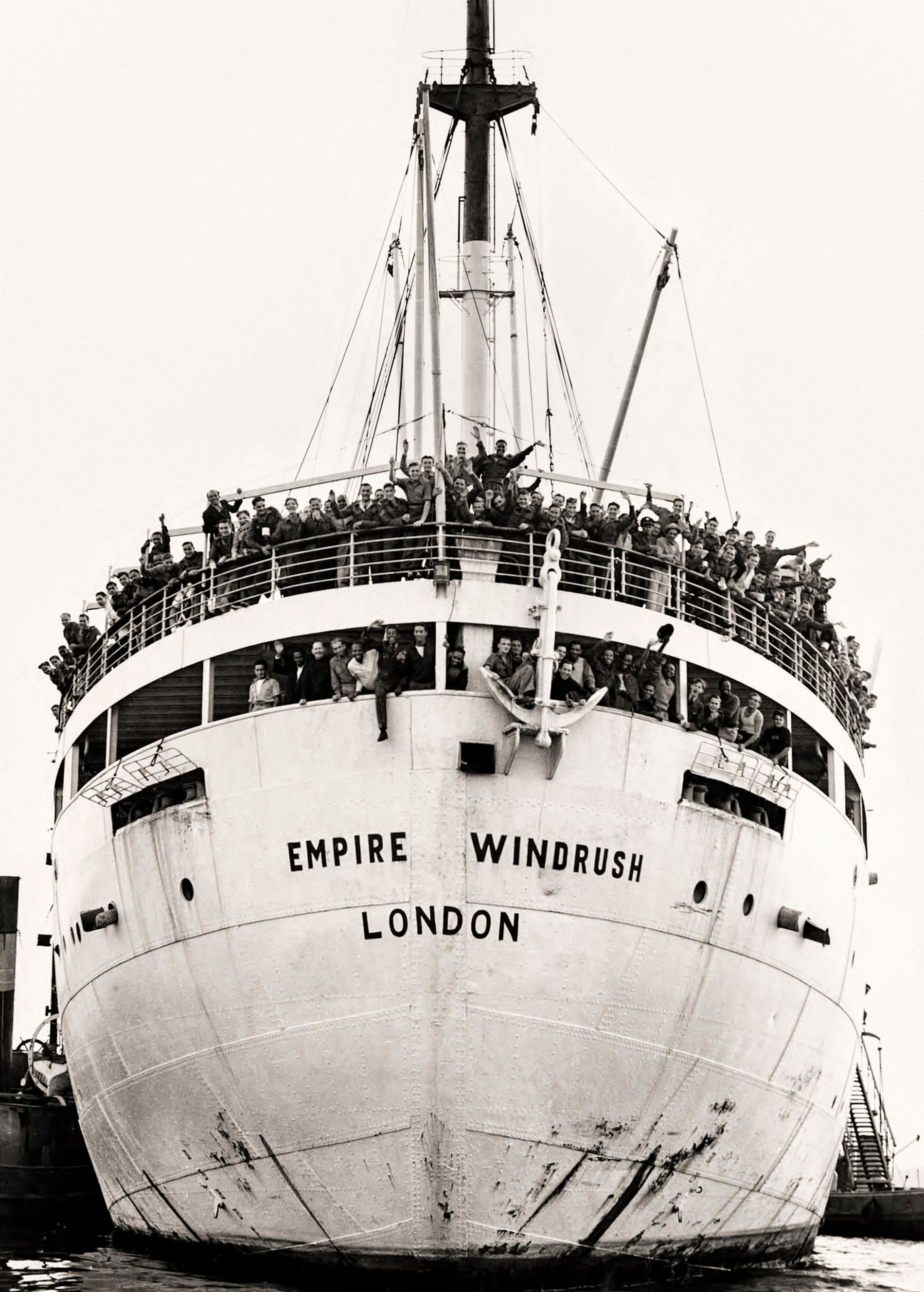
HMT Empire Windrush arrives at the Port of Tilbury on the River Thames on June 22, 1948. Image from nationalgeographic.co.uk.
On July 27, 2023, BBC describes a controversy concerning HMT Empire Windrush and its June 22, 1948, docking in Tilbury, Essex. Its passengers from the British Caribbean had been encouraged to migrate to the U.K. by virtue of the 1948 British Nationality Act which gave people from colonies the right to live and work in Britain. However, subsequent inaction and action (including a 2010 destruction of their landing cards) caused turmoil for what’s now known as the Windrush Generation.
In Part 2 tomorrow we’ll describe the other three Overground lines, with an added wild card of a (temporarily) missing River Thames. ds
© Dennis Simanaitis, SimanaitisSays.com, 2024
 Simanaitis Says
Mildmay hospital seems to have been a transportation pioneer, sporting a futuristic vehicle in its 1892 premises photo. Good old Wikipedia!
Ha. Good catch on their caption.
Turns out TFL has some PDFs with the new names at their website. A little cleaner than what you found. Though your background info is very interesting. Thanks!
Total system: https://tfl.gov.uk/cdn/static/cms/documents/tube-map-with-the-new-lo-names.pdf
Overground: https://tfl.gov.uk/cdn/static/cms/documents/london-overground-map-autumn-2024.pdf
Then: subway maps for the win! I was sure I had seen a subway-map rendition of Roman Roads at some point here, but the search isn’t spitting it out. Fun little piece: https://sashamaps.net/docs/maps/roman-roads-original/.
Thanks for these. I admire the scholarship in the Roman Roads endeavor.