
Simanaitis Says
On cars, old, new and future; science & technology; vintage airplanes, computer flight simulation of them; Sherlockiana; our English language; travel; and other stuff
SHAKESPEARE’S VOCABULARY
FOR SOME KID FROM THE STICKS (“… little Latin and still less Greek” according to fellow playwright Ben Jonson), William Shakespeare was sure ok with vocab. Elizabethan times were expansive, Shakespeare took advantage of this, and so can we—thanks to ShakespeareHigh.com. Here are tidbits from this website’s On-Line Shakespearean Glossary, with amplifications gleaned from a variety of sources.

Absey-book. This one is easy: It’s an early name for a grammar book, an “ABC book.” In Shakespeare’s The Life and Death of King John, Act I Scene 1, Bastard Philip, (illegitimate son of Richard the Lionheart) says in soliloquy: “… My dear sir,”/ Thus leaning on mine elbow I begin,/ “I shall beseech you” that is Question now,/ And then comes Answer like an absey-book:/ “O, sir,” says Answer, “at your best command,/ At your employment, at your service, sir.”
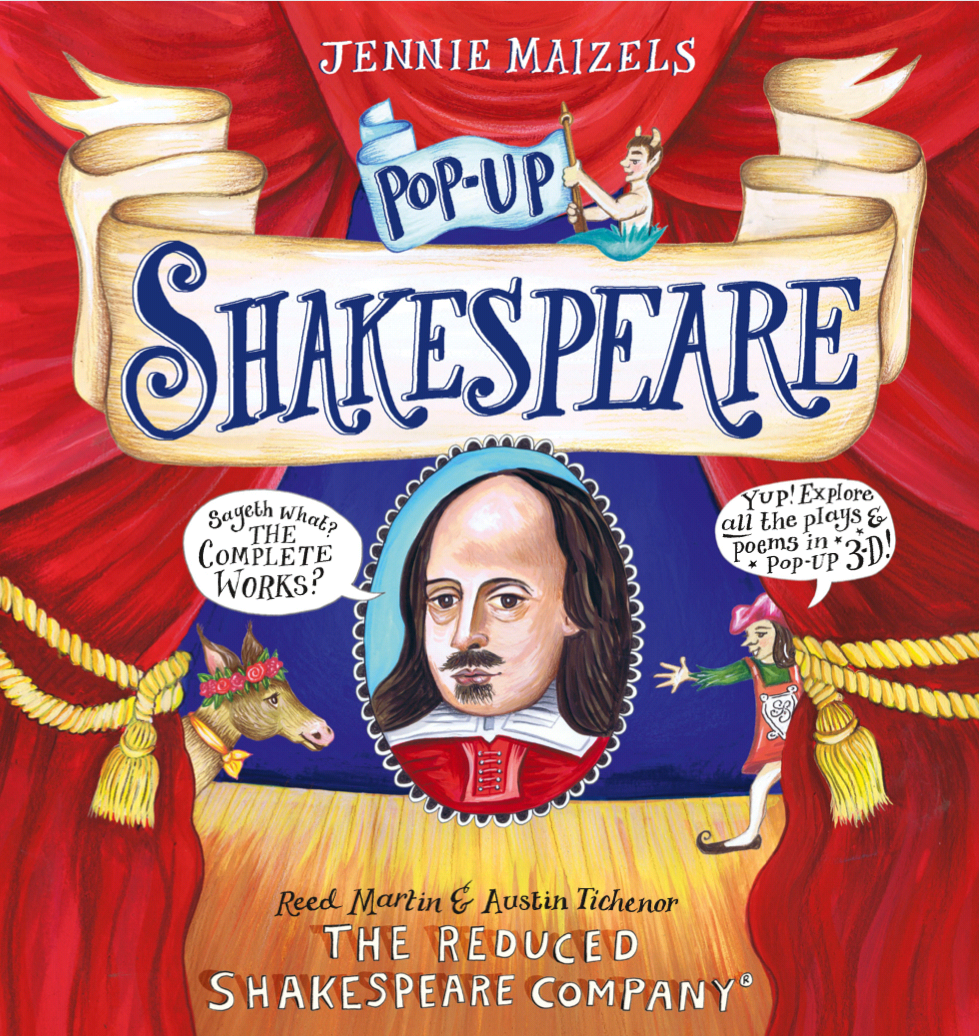
Pop-Up Shakespeare, by Reed Martin, Austin Tichenor, The Reduced Shakespeare Company, illustrated by Jennie Maizels, Candlewick Press, 2017.
According to my Pop-Up Shakespeare, “The real King John signed the Magna Carta…. But Shakespeare didn’t include this fun fact in his not-very-fun play. King John is interesting because only it and Richard II are the two Shakespeare plays written entirely in a type of verse called iambic pentameter.”
Check out Philip’s soliloquy above to identify its di-DA di-DA di-DA di-DA di-DA.
Image from Amazon.com.
Alder-liefest. Wiktionary says alderliefest comes from Middle English alderlevest, “dearest of all.” Alder is an “of all” superlative; levest deriving from Old English lēof and ultimately from Proto-Indo-European *lewbʰ– (“to admire, praise; to covet, desire; to love”) + -est (suffix forming the superlative of adjectives and adverbs).
In Shakespeare’s King Henry VI, Part II, Act I Scene 1, the Queen gushes all over about her hubby: “Great King of England and my gracious lord,/ The mutual conference that my mind hath had,/ By day, by night, waking and in my dreams,/ In courtly company or at my beads,/ With you, mine alder-liefest sovereign,/ Makes me the bolder to salute my king/ With ruder terms, such as my wit affords/ And over-joy of heart doth minister.”
Talk about gush. Pop-Up Shakespeare says, “The second part of Henry VI is (slightly) better than the first, but that’s not saying much.”

Image from Wikipedia.
Ames-Ace. The Britishism “ambs-ace” still stands for the lowest throw of dice, what we ‘Mericans call “snake eyes,” also meaning something worthless or unlucky. It derives from Middle English ambes as tracing back to Old French meaning “both aces.”
In Shakespeare’s day, the term was “ames-ace.” In All’s Well That Ends Well, Act II, Scene 3, complications of lowly born Helena loving Bertram while he lusts for an indifferent Diana has old Lord Lafew saying, “I’d rather be in this choice than throw ames-ace for my life.”

Image from Wikipedia.
Pop-Up Shakespeare says All’s Well That Ends Well along with Measure for Measure and Troilus and Cressida are considered Shakespeare’s “problem plays.” “The main problem,” Pop-Up says, “seems to be that as comedies, they’re not very funny.”
A Kicky-Wicky. My research, however, shows that All’s Well includes at least one more funny word: Later in that same Act II, Scene 3, one of Bertram’s pals says, “… To th’ wars, my boy, to th’ wars!/ He wears his honor in a box unseen/ That hugs his kicky-wicky here at home,/ Spending his manly marrow in her arms/ Which should sustain the bound and high curvet/ Of Mar’s fiery steed. To other regions!”
A “kicky-wicky”? It’s Elizabethan slang for a wife or mistress, both apparently numerous in those days.
And for Swifties. On a different note entirely, what’s not to like about Shakespeare showing up in a Taylor Swift song: At one point of Lover she sings, “All’s well that ends well to end up with you/ Swear to be overdramatic and true to my lover/ And you’ll save all your dirtiest jokes for me/ And at every table, I’ll save you a seat, lover.”
It’s not iambic pentameter, but I suspect Swifties are no less enamored. ds
© Dennis Simanaitis, SimanaitisSays.com, 2024
 Simanaitis Says
I thank reader Andrew G. for his kind words and sharp eyes: Even in my habitual 6:06 a.m. final editorial reading, I missed an errant “and” in “Measure for Measure” and corrected it now at midday.