
Simanaitis Says
On cars, old, new and future; science & technology; vintage airplanes, computer flight simulation of them; Sherlockiana; our English language; travel; and other stuff
A HOLIDAY TOUR 0F ROME
I’VE JUST ENJOYED TURNER CLASSIC MOVIES broadcast of Roman Holiday, the 1953 romantic comedy starring Gregory Peck, Audrey Hepburn, and Eddie Albert. And, indeed, it is a romance of the city of Rome as well as one of an American newspaper correspondent getting entangled there for 24 hours with a lovely but lonely princess visiting The Eternal City on royal business.
The movie is mentioned here at SimanaitisSays in “Fiat’s Mouse—the 500 Topolino;” Peck’s photographer pal Albert drives one.
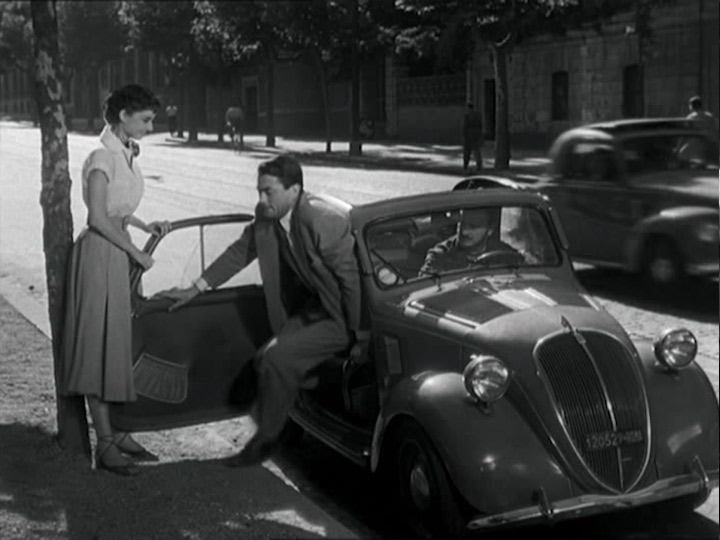
A Fiat 500 Topolino has a supporting role in Roman Holiday.
Also, there’s a wild scene of Hepburn piloting a Vespa scooter adding to already hectic traffic.

Ann and Joe careen through Rome on a Vespa scooter. See also “A Small Cycle Collection” and another Vespa citation.
I’m reminded of my street racing through Vatican City in one of my Roman adventures.
Here are other tidbits about Roman Holiday gleaned from a variety of sources, with personal comments interspersed here and there.
“Introducing” Audrey. It was her first American film, and Paramount emphasized this in the opening credits: “Introducing Audrey Hepburn.” In The New Biographical Dictionary of Film, David Thomson writes, “Of Irish-Dutch parents, Hepburn was brought up in Holland, worked in England from 1948-51, and then moved to Hollywood where she was a fairy queen for some fifteen years. She seemed English; she had a sense of manners and kindness that came close to grace; and she achieved a ‘look’—the knockout gamin who inspired a generation of thin, flat-chested, upper-class girls.”
Wikipedia notes that director William Wyler “wanted an ‘anti-Italian’ actress who was different from the curvy Italian stars of that era: ‘She was perfect … his new star had no arse, no tits, no tight-fitting clothes, no high heels. In short a Martian. She will be a sensation.’ ” This last quote from Shawn Levy in Dolce Vita Confidential, 2016.
Dalton’s Delayed Oscar. The Roman Holiday story and screenplay are by Dalton Trumbo, blacklisted at the time because of the “Red Scare Madness—The Fifties.” Wikipedia notes, “Trumbo’s name was reinstated when the film was released on DVD in 2003, and on December 19, 2011, full credit for Trumbo’s work was restored.”
Also, The Academy Award for Best Story was initially given to Ian McLellan Hunter, who fronted for Trumbo in the credits (and later got blacklisted himself). In 1993, Trumbo’s widow Cleo received her late husband’s Oscar.
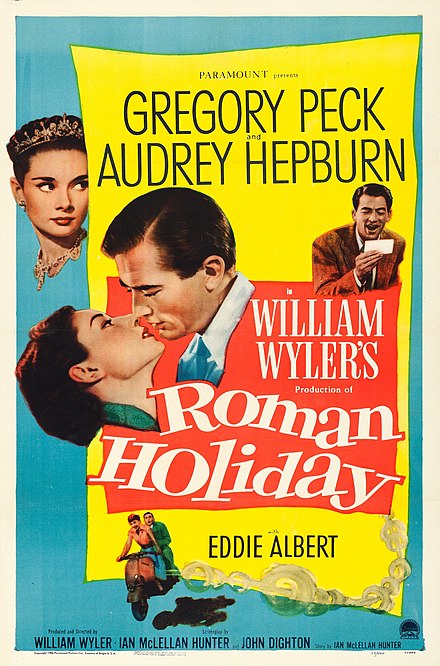
B/W for a Reason. Wikipedia notes that “The Italian Ministry of Tourism had originally refused permission for the movie to be filmed in Rome on the grounds that it would ‘degrade Italians.’”
Ha. The locals, principals as well as street crowds, come across as Italian in every positive sense, emotive and charming.
“Once the matter was resolved,” Wikipedia continues, “filming took place entirely in Rome and in the studios of Cinecittà. It was originally planned to be in color, but filming outside was so expensive that it had to be done in black and white.”
Wondrous Settings. The New York Times Book of Movies shares A.H Weiler’s review of Roman Holiday from The New York Times, August 28, 1953: “This is not a perfunctory trip. Mr. Wyler and his camera crew have distilled chuckles as well as a sightseeing junket in such stops as the princess getting a new coiffure; a perfectly wild motor-scooter ride through Roman streets, alleys, and markeplaces winding up with a session in a police station; and an uproarious dance on one of the barges on the Tiber that terminates with the princess and her swain battling and escaping from the sleuths sent to track her down.”
Weiler continued, “The cameras also have captured the raucous sounds and the varied sights of a bustling workaday Rome; of sidewalk cafes, of the Pantheon, the Forum, and such various landmarks as the Castel Sant’Angelo and the rococo, mirrored grandeur of the Colonna, Brancaccio, and Barberini Palazzi.”
Indeed, Wikipedia gives links to 14 of these locales. Having visited only a few times, I cannot say I know Rome well, though the movie brings back pleasant memories.

Ann and Joe meet on the Spanish Steps in the Piazza di Spagna. (Just to the left of the piazza is a shop where I bought a fine pair of string-back driving gloves.)
The New York Times Book of Movies summarizes the flick, “It is a short holiday in which they are involved but an entirely pleasurable one.” Yep, I’ve shared that experience. ds
© Dennis Simanaitis, SimanaitisSays.com, 2024
 Simanaitis Says