
Simanaitis Says
On cars, old, new and future; science & technology; vintage airplanes, computer flight simulation of them; Sherlockiana; our English language; travel; and other stuff
1955 FORD THUNDERBIRD—WHAT’LL SHE DO? PART 1
R&T WROTE IN MARCH 1955, “With all the interest in the new Thunderbird ‘personal car,’ the performance claims of overly enthusiastic salesmen can perhaps be excused. In a quick survey of 5 salesrooms we casually asked about the top speed of the T-Bird—and got replies varying from 125 to 150 mph!”
“Admittedly,” R&T continued, “it isn’t the easiest thing to get an accurate timed top speed run on a car—there have been times when we’ve had to skip this test evaluation.” (As a variation of this, see the estimated top speed of the supercharged Nash-Healey.) “But in this case,” R&T said, “our approach to the performance testing phase of the Thunderbird was to be as thorough and complete in our evaluation as was humanly possible”
Here in Parts 1 and 2 today and tomorrow we explore what was humanly possible at R&T.
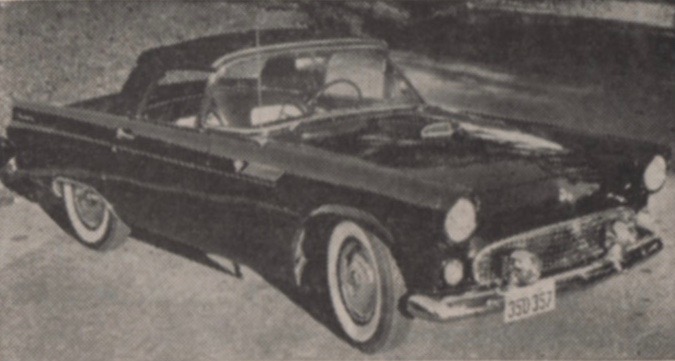
Indeed, the March 1955 road test was R&T’s first evaluation of the Thunderbird, with much of the text focused on testing methodology. In August 1956, the magazine would test another T-Bird, this one only slightly changed with its rear-mounted “continental” spare tire giving “a worthwhile increase in trunk volume.”

Above, the original T-Bird. Below, the 1956 model.

To my eye, the continental destroyed a clean rear three-quarter of the T-Bird. Little did I know at the time Ford’s plan for a four-place garishmobile removing any question of the T-Bird being anything other than a “personal car.”
Testing Methodology. Back to R&T’s 1955 evaluation: “The first step in any road test is to obtain a suitable car…. Quite by chance we found an enthusiastic R&T reader who not only had a T-Bird with 2500 miles on it, but also was ready and anxious to let us test the car.”
“The second step,” R&T said, “is to insure that the car to be tested is in top condition and capable of giving a typical performance, truly representative of the car in question. In this case the factory bent over backward and the car spent four hours in the famous Clay Smith shop from which come the Mexican race-winning Lincolns.”
“Having by now a well-tuned [but not overtuned] car, the next step was to obtain the services of a top driver. In this case we chose Jack McAfee, who did most of the driving during the performance checks.”
I wonder if McAfee’s role was to assuage the car’s owner that more than simply journalist hacks would be doing the heavy lifting.
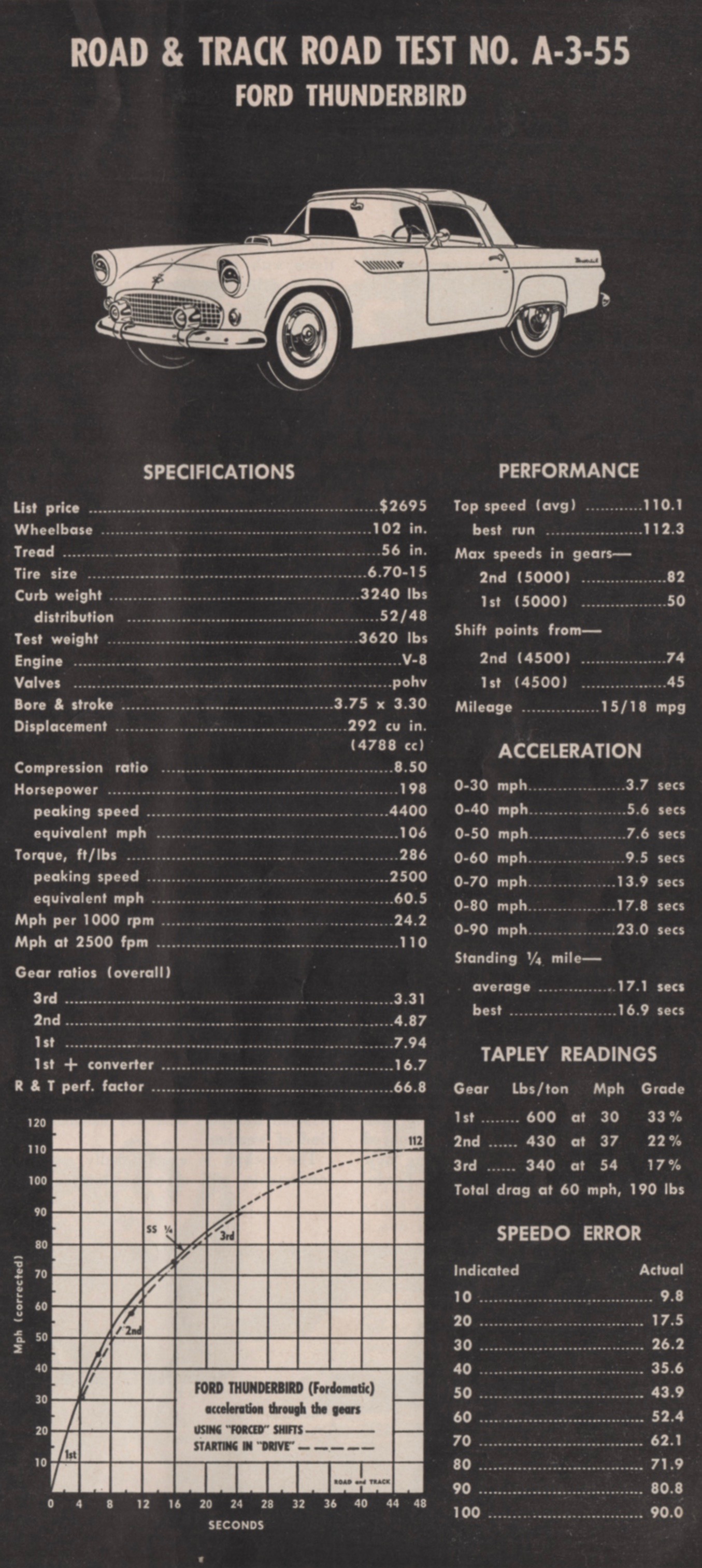
$2695 Base, Just Under $4000 As-tested. “The car itself,” R&T recounted, “was one of the early deliveries, fully equipped with Fordomatic transmission, heater, power steering, power brakes, power windows, and the folding soft top.”
A Secret Location? “The high speed runs began after a drive of 140 miles, with the outside temperature at 40º, altitude zero.” At the time R&T’s offices were at 540 W. Colorado Blvd. in Glendale, California. I found this location on Google Maps (it’s now Social Salon Suites, a five-star boutique) and inscribed a circle of 140-mile radius.

Hmm… One guess would be out near Indio (elevation -13 ft.), coolish this time of year at night. R&T’s March 1955 T-Bird test would have been performed earlier in the year before it got “hot beyond endurance,” as indeed Indio has been known to be, even before climate change.
What’ll She Do, Really? “There was a light breeze,” R&T reported, “and the two best timed runs in opposite directions recorded 107.9 and 112.3 mph respectively. The car would ‘peak out’ in about 1 1/2 miles and the respective tachometer readings were 4500 against and 4600 rpm with the wind.”
“During the best one-way run,” the magazine noted, “the speedometer needle indicated and held 125/126 mph for 1/2 mile before entering the surveyed time trap.” R&T’s analysis suggested “it appears quite unlikely that any other combination of gear ratio or transmission would produce more than 112 mph…. Reports of 128/130 mph in overdrive can therefore be relegated to the category of speedometer readings, downhill.”
Well, maybe. And we’ll begin Part 2 with “Another hmm….” and then get down to the art of acceleration. ds
© Dennis Simanaitis, SimanaitisSays.com, 2024
 Simanaitis Says
Thanks for this look at real world top speed, which applies to so many cars beloved by buffs; nonsense repeated in coffee table books and enthusiast magazines ’til, like Fox “News” punditry, it assumes a mantle of veracity.
We roll our eyes reading about “100 mph 1936 Buick Centuries (95.2 all out coaxed by a phalanx of Flint technicians at the GM Proving Grounds), and 1952-on Bentley Continentals able to “cruise at 120 mph,” when a razor-tuned example with highly inflated tires, back seat and spare tire removed, reached a level ground (perhaps slight tail wind?) 119 mph under the anxious eyes of Crewe engineers. Hardly a “cruising speed.” Most well fettled examples perhaps able to reach 110-112 all out?