
Simanaitis Says
On cars, old, new and future; science & technology; vintage airplanes, computer flight simulation of them; Sherlockiana; our English language; travel; and other stuff
YET MORE DRAGON LORE
YOU’D THINK THIS WEBSITE’S “Dragons be Here and There Parts 1 and 2,” July 7, 2022, would have satisfied my (and your) curiosity. However, 2024 is the Year of the Dragon and thus I recently consulted Brewer’s Dictionary of Phrase & Fable for more about these mythical beasts. Here are tidbits gleaned from Brewer’s together with my usual Internet sleuthing.

A Plethora of Dragons. Wikipedia notes that the dragon “is the fifth of the 12-year cycle of animals that appear in the Chinese zodiac related to the Chinese calendar. The ‘Year of the Dragon’ is associated with the Earthly Branch symbol 辰, pronounced chen.”
“During China’s Cultural Revolution,” Wikipedia recounts, “there was an attempt to replace the dragon with the giant panda; however, the movement was short lived.”
Do you think it was an effort to make all twelve “real” animals? Extra credit for naming the other eleven.

There is a succession of “elemental” signs for each symbol: Earth, Metal, Water, Wood, and Fire. This past Saturday, February 10, 2024, began the Year of the Wood Dragon. January 28, 2036, will begin the Year of the Fire Dragon.
Having Kids? Wikipedia notes, “There are typically marked spikes in the birth rates of countries that use the Chinese zodiac or places with substantial Chinese populations during the ‘Year of the Dragon,’ because these births are considered to be lucky and have desirable characteristics that supposedly lead to better life outcomes. The relatively recent phenomenon of planning a child’s birth in a ‘Year of the Dragon’ has led to hospital capacity issues and even an uptick in infant mortality rates toward the end of these years due to strained neonatal resources years.”
The Dragon’s Status, East and West. In China, according to depts.washington.edu, “the dragon represents good luck, strength, health and also the male element Yang.” By contrast, in Western culture dragons get a bad rap: Brewer’s notes, “In the Middle Ages the word was a symbol of sin in general and paganism in particular, the metaphor being derived from Revelation 12:9, where Satan is termed both ‘the great dragon’ and ‘that old serpent,’ and from Psalm 91:13, where it is said ‘the dragon shalt thou trample under feet.’ ”
Seeking Sainthood. Saint George got good coverage at “Dragons be Here and There Part 1.” Brewer’s expands considerably with other dragon slayers/Saints: Michael, Margaret, Samson, Clement, Romain, Philip, Martha, Floret, Cado, Maudet, Pol, and Keyne.
There’s good fun in following up with Brewer’s leads, for instance: “St. Martha. Sister of St. Lazarus and Saint Mary Magdalene. She is represented in art in homely costume, bearing at her girdle a bunch of keys, and holding a ladle or pot of water in her hand.”
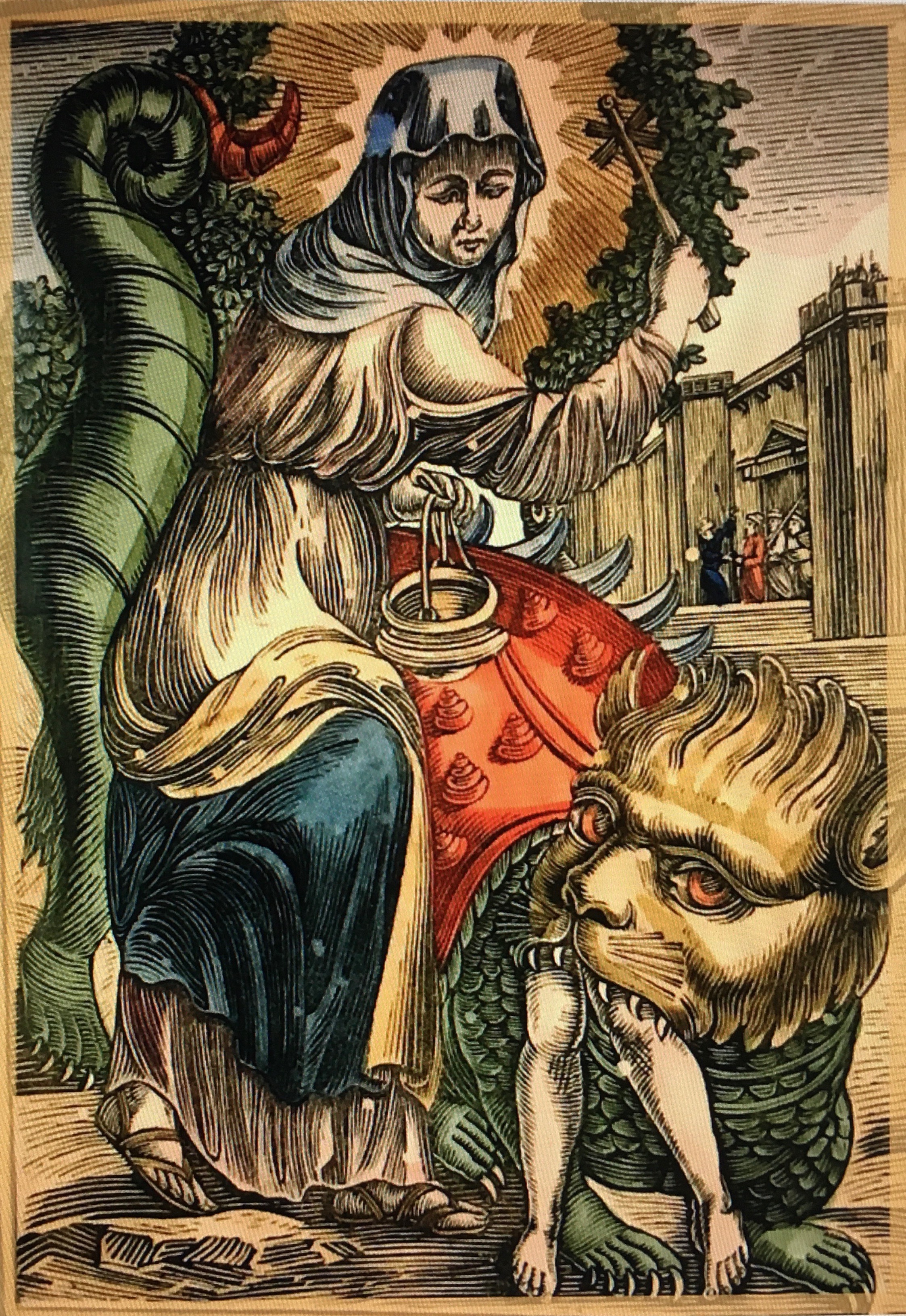
St. Martha and the dragon. Image from The Curious Rambler.
“Like St Margaret,” Brewer’s continues, “she is accompanied by a bound dragon, for she is said to have destroyed one that ravaged the neighborhood of Marseilles. She is commemorated on 29 July and is patron saint of Tarascon.”
Tarascon, eh? That’s where fictional characters Angela Victoria and Tartarin resided. To the best of my research, neither had anything to do with dragons; Tartarin chased lions, though I suspect with no harm done to the beasts.

And Then There’s the Dragoon. Brewer’s notes, “The name was originally that of a mounted infantryman, hence its inclusion in the present names of certain cavalry regiments, such as The Royal Scots Dragoon Guards. It is taken from the carbine called a ‘dragon,’ which breathed forth fire like the fabulous beast of this name.”
In marked contrast to Tartarin’s armament. ds
© Dennis Simanaitis, SimanaitisSays.com, 2024
 Simanaitis Says
Born in 1964 in the year of the wood dragon I enjoyed this very much, even if I don’t put much faith in zodiac predicitions. Half of my “traits” match well, 25% so-so, and 25% not at all. What does that mean? Who knows.
Hi, great article, my only criticism is, no mention of The Welsh Dragon, which is a red dragon emblazoned on a green and white background.
The national flag of Wales.
https://en.wikipedia.org/wiki/Flag_of_Wales
Sent from my iPhone
>
Yes, another proud dragon. My fault, not Brewer’s. It says “Red Dragon. See Red.” and there it says “Red Dragon. Anciently the badge of the Parthians, it was introduced in Britain by the Romans… The present Welsh flag consists of a red dragon passant on a ground of two horizontal stripes (white over green).”