
Simanaitis Says
On cars, old, new and future; science & technology; vintage airplanes, computer flight simulation of them; Sherlockiana; our English language; travel; and other stuff
WERE OUR ANCESTORS LIKE US?
I’VE BEEN ENJOYING SIMON BANKS’ OPERA: The Autobiography of the Western World. Like other chapters in the book, it examines fundamental questions of western civilization from the perspective of opera: “Were Our Ancestors Like Us?” focuses on Giussepe Verdi’s Aida and Philip Glass’s Akhnaten. Here are tidbits gleaned from Banks’ book, from Wikipedia, and from another of my favorite sources, this website. (Hem, hem.)
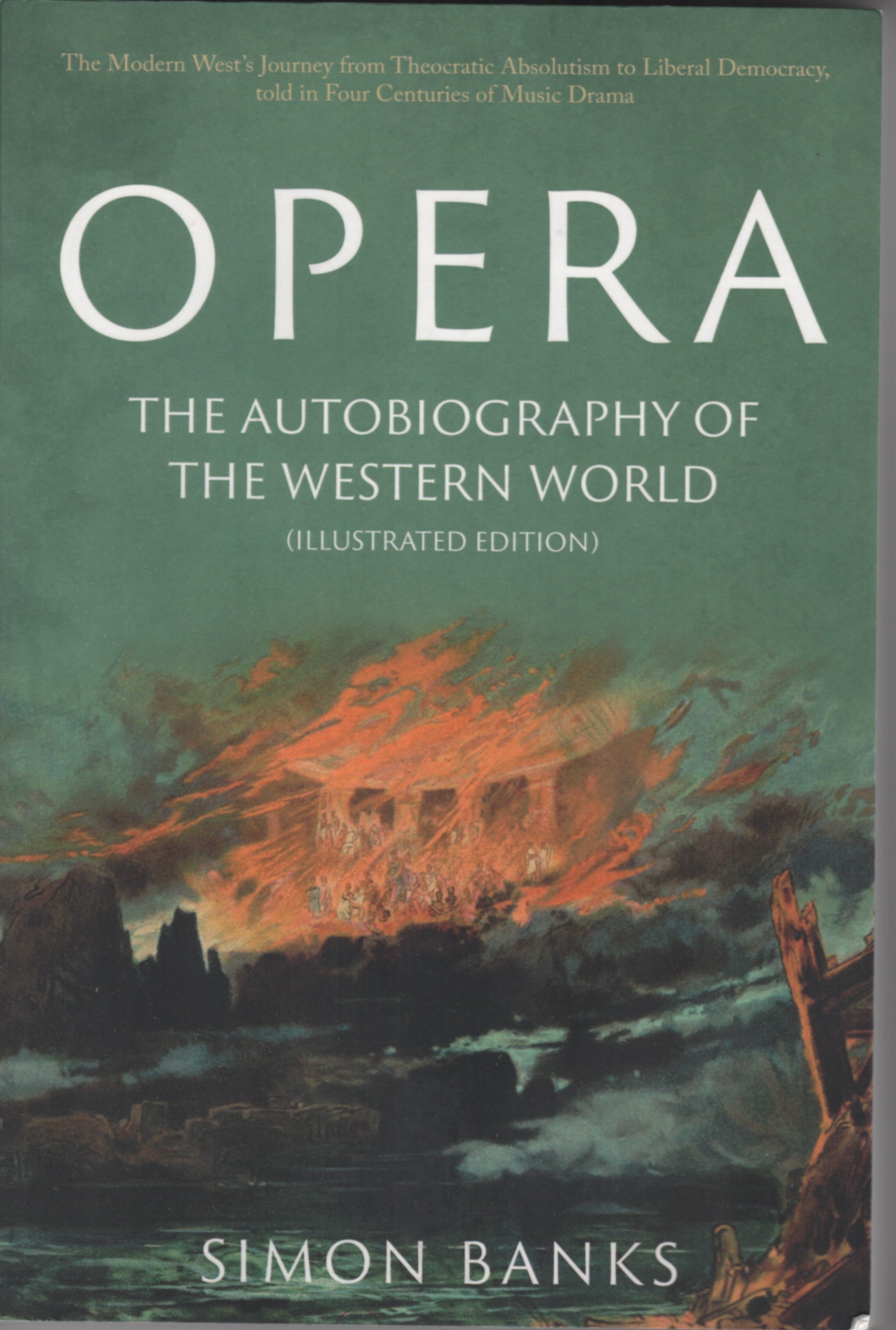
Opera: The Autobiography of the Western World, by Simon Banks, Troubador Publishing, 2022.
Banks’ ancestor thesis is an interesting one: “Verdi’s instinct was to create an ancient Egypt his 19th century audiences could easily recognize. Glass by contrast has the courage to relish the sheer strangeness and difference of life in 1350 BC: his opera is a meditation on the distances of time.”
Italian Versus Polyglot. Chosen languages of the operas corroborate Banks’ theme: Aida characters sing solely in Italian. Akhnaten is multilingual: Ancient Egyptian, Akkadian, Biblical Hebrew, and English (this last, in Akhnaten’s “Hymn to the Sun” as well as narration by Amenhotep III, Akhnaten’s father, doubling as a modern travel guide).
1871. Banks writes of “A Fictional Ancient Egypt That Seems Close and Familiar.” The opera “searingly depicts the human cost of the war between Egypt and Nubia.” Indeed, on a particularly personal level, there’s the love triangle of Radamès, Captain of the Egyptian Guard, secretly in love with Ethiopian princess Aida, and Amneris, daughter of the Pharaoh and in love with Radamès.

High Priests: the Church’s and the Pharaoh’s. Banks relates the tension of 1871: “Your priests are certainly priests, but they aren’t Christians,” wrote Verdi when the Catholic Church failed to protect protests about the massacre on the fall of the Paris Commune in 1871. The High Priest in Aida uses his claimed knowledge of the divine will to threaten people, but he discourages compassion and causes suffering.”
“While Verdi was composing Aida,” Banks recounts, “Pius shocked liberal Europe by declaring the Pope’s doctrinal infallibility.”

Verdi’s Perspective. Banks writes, “Aida is an emotional response to Europe in 1871…. The opera ends with a devoted couple who are loyal unto death. Verdi seems, in Aida’s emotionally transcendent final minutes, to be asserting the beauty of human attachments and the miraculous power of love in defiance of the inflexible dogma of the church and the biological determinism of science.”
Fast Forward to 1984. By contrast, Banks writes of Akhnaten being “An Authentic Ancient Egypt That Seems Distant and Strange.” He notes that, “Archaeology had been professionalised between 1871 and 1984. New, methodical analysis gave people extraordinarily accurate information about the past.”
Verdi never visited Egypt, but Philip Glass “builds his libretto from fragments of ancient Egyptian texts discovered by archaeologists in pyramids, in mummies, and around Akhnaten’s capital, Tell el-Amarna.”

Akhnaten ascends. This and following image of The Met production from Wikipedia.
The More We Look, the Stranger It Is. “Verdi shaped his material to make it seem familiar,” Banks says, “but Glass just gives us some rather odd hieroglyphics…. With the confidence of a mature civilisation, Akhnaten listens to the past without prejudice.”
Glass’s Minimalism. “In Akhnaten,” Banks writes, “repetitions of tiny musical fragments build up into extended arcs of sound, a trance-like aural world that invites listeners to discard their normal conscious thought processes, to suspend current time, and to journey through music into unfamiliar timeframes.”

To my ear, Akhnaten’s Ancient Egyptian, Akkadian, Biblical Hebrew, and then English also emphasize the 3500 years separating this pharaoh from us.
The Travel Guide’s Contribution. Banks notes the Act III’s transition to present-day Egypt and “some slightly crass quotations from a 20th century travel guide to Tell el-Amarna.” Wikipedia quotes him: “There is nothing left of this glorious city of temples and palaces.”
Akhnaten’s “dying cadences,” Banks writes, “leave the mysterious pharaoh and his family once again completely unknown to us, lost deep in the past.”
I’ve only begun delving into Opera: The Autobiography of the Western World. There will likely be other SimanaitisSays references; the book is a real keeper. ds
© Dennis Simanaitis, SimanaitisSays.com, 2024
 Simanaitis Says