
Simanaitis Says
On cars, old, new and future; science & technology; vintage airplanes, computer flight simulation of them; Sherlockiana; our English language; travel; and other stuff
PHYSICS OF A FORWARD PASS
I HAVE LONG ASSUMED GYROSCOPIC ACTION was responsible for the stability of a football’s spiral pass. Well, it turns out yes and no, as described by Regina G. Barber, Rachel Carlson, and Rebecca Ramirez in “After 20 Years, This Scientist Uncovered the Physics Behind the Spiral Pass,” NPR Short Wave, February 7, 2024.

Thank this trio of Regina, Rachel, and Rebecca for introducing us to experimental atomic physicist (and football fan) Tim Gay who, they recount, figured out this scientific quandary “after two decades of hobby research and more than a couple late night shouting matches with two other physicists over Zoom.” Here are tidbits about Gay and his analysis.
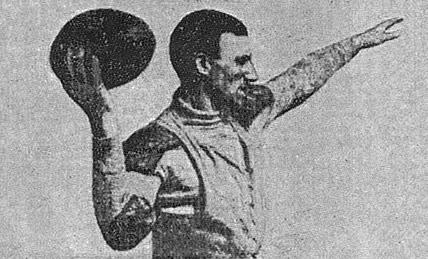
How a Football Travels. In a spiral pass, the front nose of the ball points up when it leaves the quarterback’s hand and then follows an arc until it ends up tilting down into the receiver’s hands. This, despite fundamental physics suggesting it should either rotate in the air or just stay mostly upright.
A Spinning Top? Our three R’s write, “Some researchers thought the football might act like a perfectly upright spinning top. In the case of the top, its axis along an invisible vertical line. The top will return to that vertical even if you tap the top so the axis momentarily moves.”
This might explain its stability, but not the part about that arc.
“Other papers tried to explain this inconsistency away with air resistance, or air drag,” say our reporters. “But, among other things, this theory relies on the football being asymmetrical like a weathervane, which it is not. So, Gay found that even air resistance couldn’t completely account for what was happening on the field.”
“As he continued searching for an answer,” they say, “Gay enlisted the help of two other physicists, Richard Price at MIT and William Moss at Lawrence Livermore National Laboratory.” This is when the three years of Zoom shouting ensued.
Torque of the Spin. “Until one day,” the three R’s write, “Gay started to wonder about another important concept: torque, or how much a force makes an object rotate.” There’s torque involved, of course, in getting the spin of the ball leaving the quarterback’s hand. But then the ball is on its own, with diminishing torque and air resistance playing roles in its behavior.
And Gyroscopic Precession. Gay and his colleagues sensed that gyroscopic precession was also involved. Our three R’s describe, “The concept describes the way the axis of something—like a spinning top or a football— makes a cone shape as it spirals. In the case of a spinning top, it circles around an invisible vertical line that runs through its point of support due to gravity.”
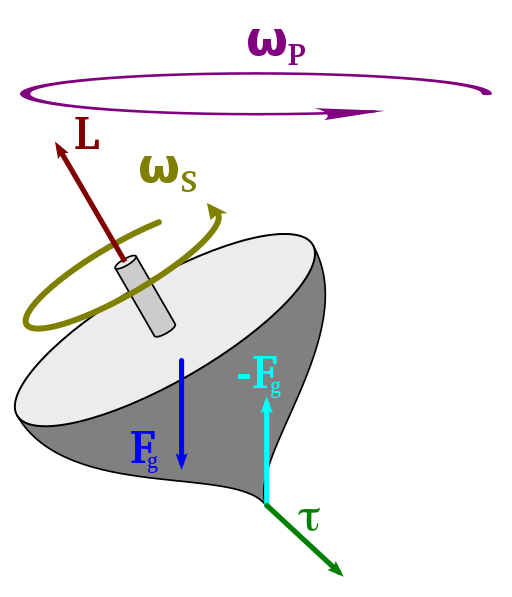
Indeed, this happens Big Time with the Earth’s precession of the equinoxes. Wikipedia notes, “Earth goes through one such complete precessional cycle in a period of approximately 26,000 years or 1° every 72 years, during which the positions of stars will slowly change in both equatorial coordinates and ecliptic longitude.”
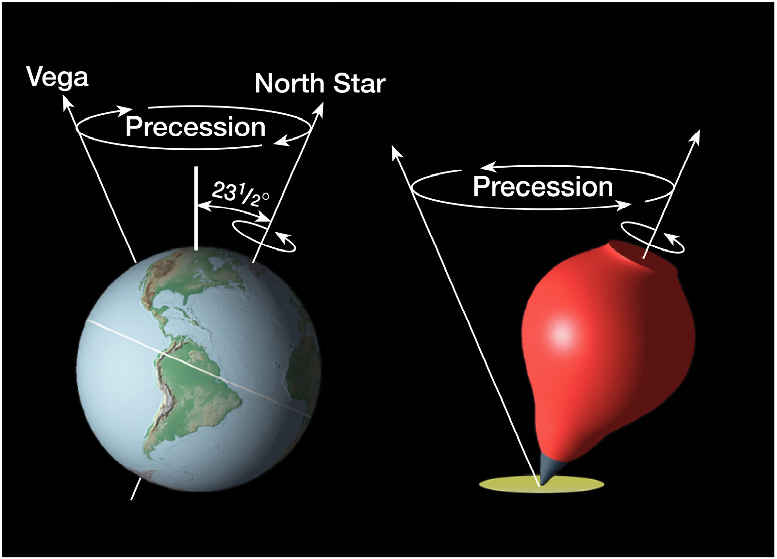
Image about the Earth “wobbling” from Socratic Q&A.
Gyroscopic precession happens decidedly more quickly with a spiraling football. In addition, for the football that line is defined by the air flow around the ball as it travels.
Testing the Theory. “Gay, Price, and Moss did theoretical calculations and computer simulations to put the theory to the test,” say the reporters. “It all clicked,” Gay says.
I’m sure you’ll keep all this in mind later today if you happen to watch Super Bowl LVIII. Thanks, Regina, Rachel, and Rebecca. ds
© Dennis Simanaitis, SimanaitisSays.com, 2024
 Simanaitis Says
Perfect!
>
Thank Tim Gay, his academe pals, and the three R’s.