
Simanaitis Says
On cars, old, new and future; science & technology; vintage airplanes, computer flight simulation of them; Sherlockiana; our English language; travel; and other stuff
ALLARD K3—GRENDEL’S SOPHISTICATED BROTHER?
TO GET A SENSE FOR THE K3’S RELATIONSHIP to Grendel, check out “Allard Palm Beach—Grendel’s Kid Sister,” appearing only three months before this particular R&T road test.
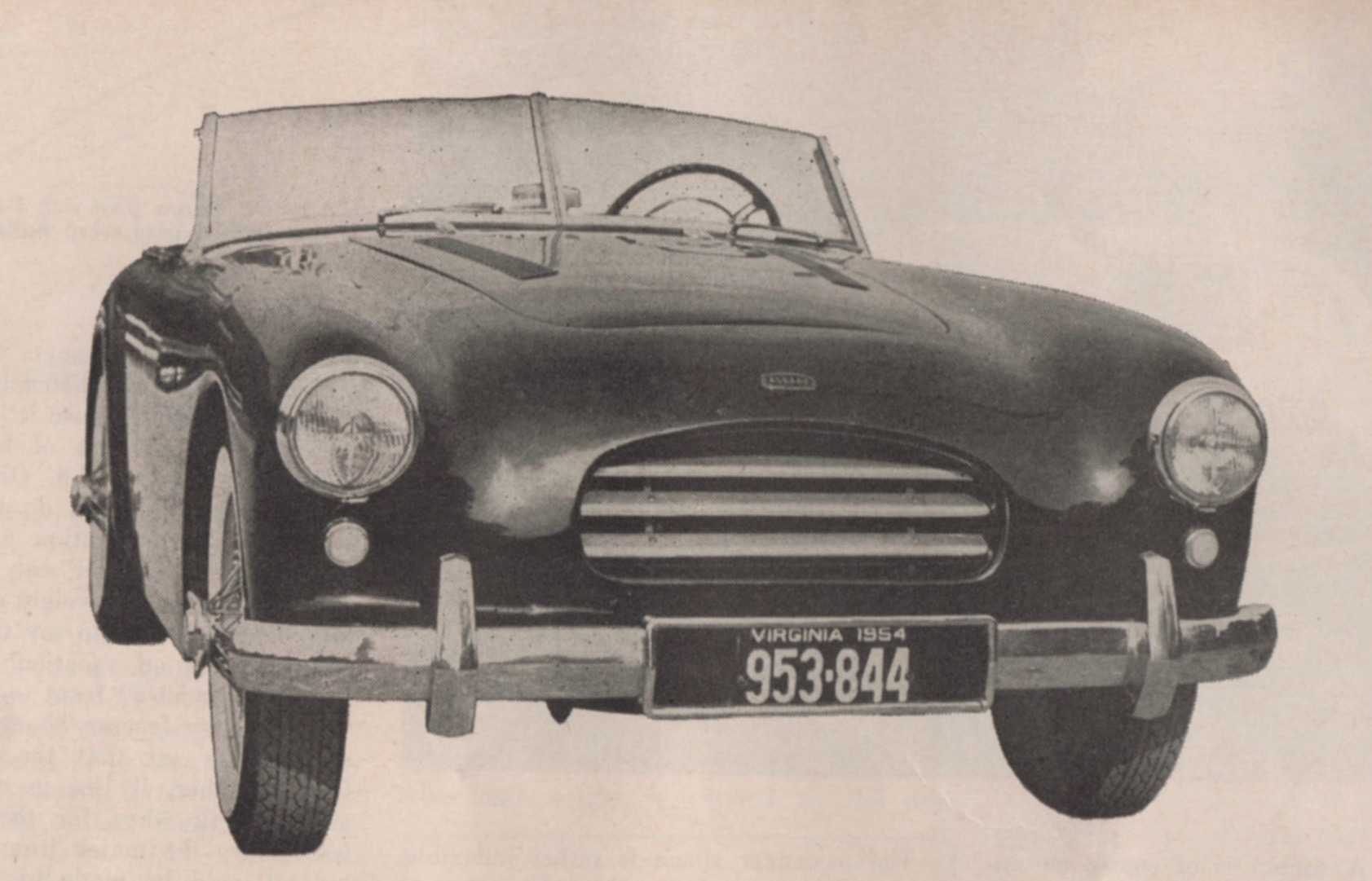
This and other images from R&T, October 1954.
“Allard,” R&T explained, “has always kept its competition and sports models separate; the J-2 (competition) and K-2 (sports) were contemporary, but they were homely looking cars, and more glamorous, eye-catching models were soon in preparation. The K-3 is the product of this evolution, and is undoubtably the handsomest car the company has yet built (considering that looks have never been their forte).
Ouch.
Unique Sports Car Features. “Like the Palm Beach,” R&T said, “this car holds a unique spot in the sports car field. It is probably the roomiest of all sports cars. It not only accommodates three comfortably on its single bench-type seat, but the floor, having been raised over the transmission and drive shaft, lies flat, giving the middle passenger clear foot space.”
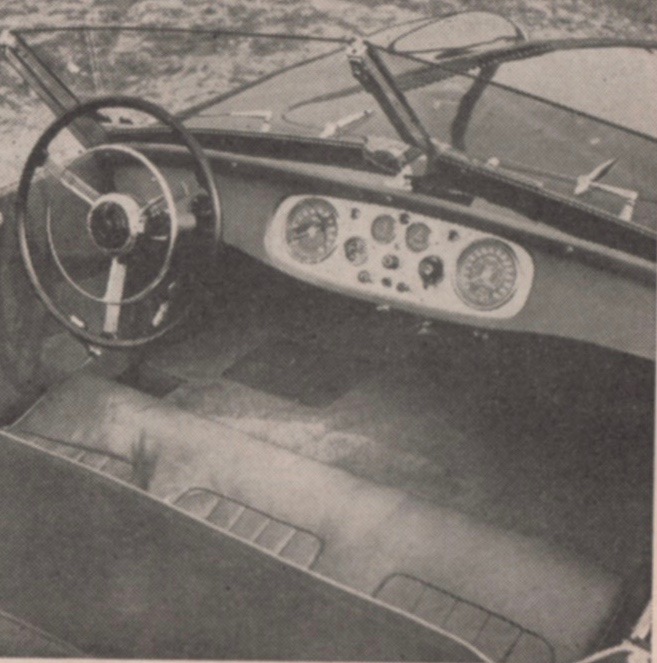
“The gearshift lever,” R&T noted, “has been moved to a notch between the driver’s seat and the door, even further uncluttering the spacious interior.”
Extra points for naming another marque with similar gear shift positioning.
Weatherproofing. Trunk Space. R&T continued listing unsports-car attributes: “Glass windup windows and small, snap-in rear quarter curtains seal against the canvas top for excellent weatherproofing. An unusually large trunk space, made possible by twin gas tanks in the rear fenders, is one more feature which points to the company’s aim of offering the public a practical touring car with sports car performance.”
Pick Your Own V-8 Burble. “As usual with Allard,” R&T said, “no engine is provided by the factory, but the car is set up to take any of the large-displacement U.S. V8s. Many of the car’s components are reworked Ford parts, and the frame is reinforced chrome-moly tubing. The 3-speed transmission and clutch on our test-car were also Ford, although other makes are sometimes used. The rear-end is de Dion, with coil springs all around and airplane-type shock absorbers.

“A true cosmopolite: English body, American engine, Italian tires, and French headlights.”
Hand-formed Aluminum. R&T observed, “The first impression of the Allard K-3 is one of smooth, powerful lines, a little boxlike, but broad and rugged. The hand-formed aluminum body is almost chrome-free, and the windshield posts and front grille panels are buffed aluminum. Even the dashboard is an aluminum panel with the tasteful, legible instruments grouped in a central cluster.”
Brute Power, Flat Cornering, Limited Maneuvering. “Driving the car,” R&T reported, “one is immediately struck with the quick response and brute-like power of the big, high-torque engine—in this case a Chrysler V-8.”
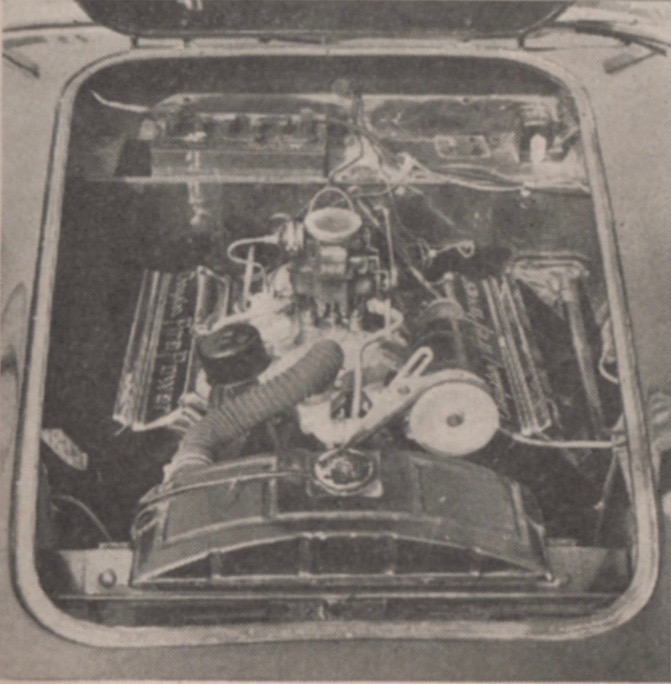
No dropped tools would find their way to the tarmac.
R&T noted, “Although the overall weight of the car if [sic] high for a sports car, the weight distribution fore and aft was exactly 50/50, and the car’s handling qualities are among the best…. Steering is surprisingly light and easy when the car is in motion and is quick enough (2.8 turns lock-to-lock) for all but the competition driver. Unfortunately the front wheels will not turn nearly far enough in either direction, and sharp-angled maneuvering in traffic or parking is virtually impossible. The car is not recommended for Gymkhana work!”
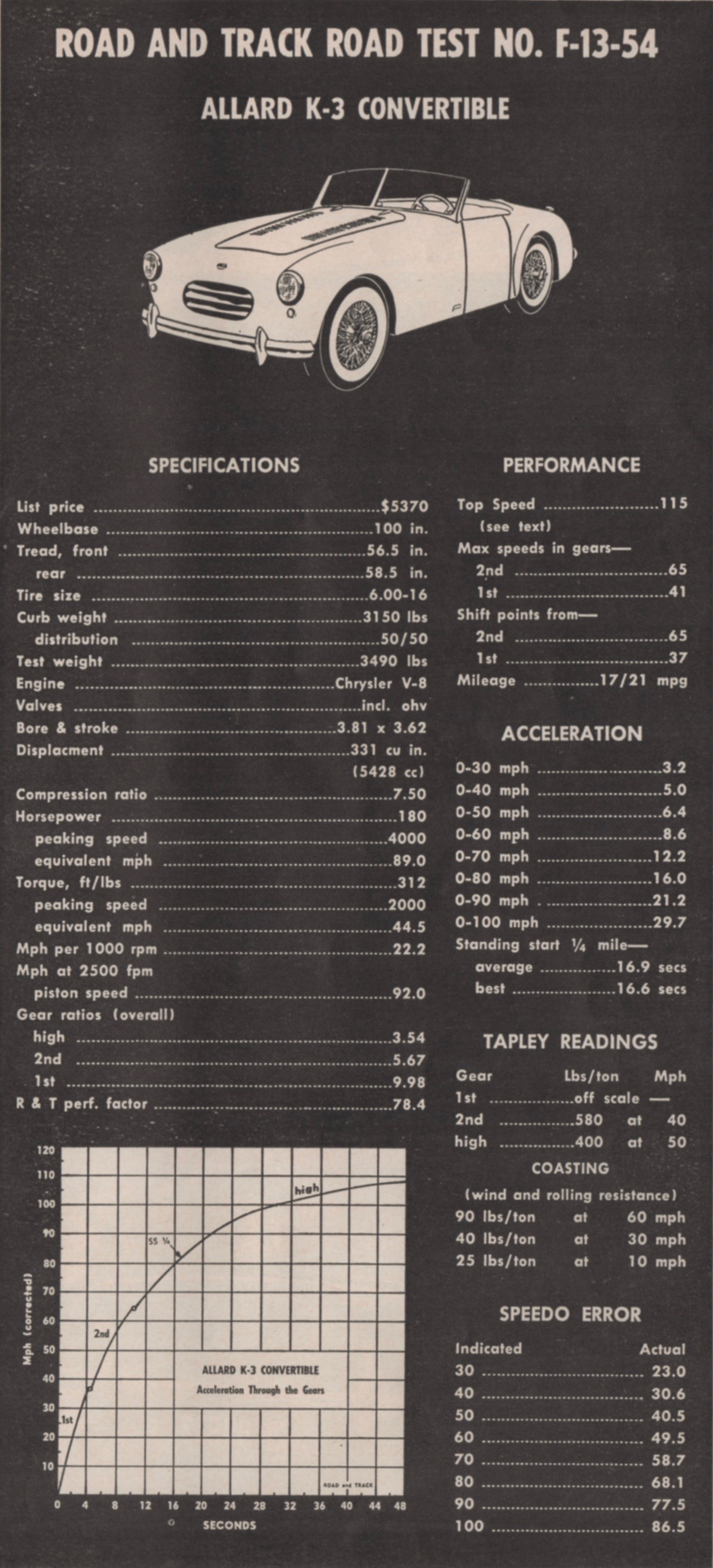
0-60 in 8.6! “The acceleration figures are healthy enough for any car and, in view of the weight involved, are outstanding for the K-3.” Remember, it’s 1954 and perfectly acceptable cars took twice the K-3’s 8.6 seconds to reach 60. But remember that odd shift lever location? “The linkage of the left-hand shift does not permit anything like swift gear changes, and slowed the 0-60 time by perhaps a second.”
Top Speed Antics. “An all-out high speed run,” the magazine recounted, “could not be made due to the fact that our usual desert testing strip was hot beyond endurance, and the cooler but more congested location had to be used.” (I’m guessing it was through the orange groves on two-lane Brookhurst Street inland of PCH.)
Allard Antics. Thus far, the road test reinforced that caption about “A true cosmopolite: English body [Allard], American engine [Chrysler], Italian tires [Pirellis], and French headlights [possibly Marchals].” But the last column of text detailed laments of what was, after all, an English cottage-industry automaker. Aluminum bodywork led to dents, ripples, and flaked paint from external fender pimples. That high floor caused reduced headroom and extreme wind buffeting. Top up/windows down proved impossible beyond 35 mph “due to the incredible flopping and shaking of the top.” Those two gas tanks held “just over six gallons each, limiting the cruising range annoyingly.”
“By no means the least exasperating fact,” R&T continued its kvetching, “is that no manual or written information of any kind is supplied to the owner…. With a car as complicated and costly as the K-3, this seems inexcusable. Add to these, no tonneau cover; inadequate windshield wipers; no provision for heating and defrosting; no room provided for an air cleaner; etc.; and one soon gains the impression that the cars were rushed out of the shop long before they were ready for the public.”
The K-3 is sounding more and more like Grendel. ds
© Dennis Simanaitis, SimanaitisSays.com, 2024
 Simanaitis Says
Many Bentleys had that shift lever position.
Meanwhile, the above another of those cars that had/has a lot going for it, but as with everything on wheels, with wings, or floating, trade offs, depending on audience.
Perhaps the K3 hewed as close to GT as sport car. Some in the enthusiast press of the day, inc. the respected R&T, question if the new XK-120 was a “real” sport car, citing weight.