
Simanaitis Says
On cars, old, new and future; science & technology; vintage airplanes, computer flight simulation of them; Sherlockiana; our English language; travel; and other stuff
EMAIL ELUCIDATION
THE INFORMATION HIGHWAY, ALAS, is sometimes a sewer. However I must say that, garbage deleted with a click, there are also gems of email elucidation, serendipitous bits of knowledge I wouldn’t have acquired otherwise. Here are tidbits about an example, one thing leading to another.
A Zany Marathon. History Facts recounts that “The marathon at the 1904 St. Louis Games is one of the most unusual events in Olympic history, in no small part because it was initially won by an athlete who rode in a car for most of the race.”

The website gives brief details, but even better its “rode in a car” link takes us to Karen Abbott’s article in Smithsonian Magazine, August 7, 2012.

A St. Louis Olympics. The St. Louis Olympics was only the third of modern IOC events, the first taking place in Athens in 1896, the second as part of the 1900 Paris Exposition. “In 1904,” Karen Abbott wrote, “St. Louis hosted the Olympic Games as part of the World’s Fair—and produced a spectacle that incorporated all the mischief of the midway.”
She continued, “Although there were moments of surprising and genuine triumph (gymnast George Eyser earned six medals, including three gold, despite his wooden leg), the games were largely overshadowed by the fair, which offered its own roster of sporting events, including the controversial Anthropology Days, in which a group of ‘savages’ recruited from the fair’s international villages competed in a variety of athletic feats—among them a greased-pole climb, ‘ethnic’ dancing, and mud slinging—for the amusement of Caucasian spectators.”

Entrants in the 1904 Olympics marathon. Image from History Facts.
Marathon Entries. Abbott noted, “A few of the runners were recognized marathoners who had either won or placed in the Boston Marathons, but the majority of the field was composed of middle-distance runners and assorted ‘oddities….’ Among the leading oddities were ten Greeks who had never run a marathon, two men of the Tsuana tribe of South Africa who were in St. Louis as part of the South African World’s Fair exhibit and who arrived at the starting line barefoot, and a Cuban national and former mailman named Félix Carbajal, who raised money to come to the States by demonstrating his running prowess throughout Cuba, once trekking the length of the island.”
Carbajal’s is quite a tale: “Upon his arrival in New Orleans,” Abbot recounted, “he lost all his money on a dice game and had to walk and hitchhike to St. Louis. At five feet tall, he presented a slight but striking figure at the starting line, attired in a white, long-sleeved shirt, long, dark pants, a beret and a pair of street shoes. One fellow Olympian took pity, found a pair of scissors and cut Carbajal’s trousers at the knee.”

Cuban marathoner (and former mailman) Félix Carbajal. Image from Britannica via Smithsonian Magazine.
The St. Louis Course. Abbott described, “Heat and humidity soared into the 90s, and the 24.85-mile course…. wound across roads inches deep in dust. There were seven hills, varying from 100-to-300 feet high, some with brutally long ascents. In many places cracked stone was strewn across the roadway, creating perilous footing, and the men had to constantly dodge cross-town traffic, delivery wagons, railroad trains, trolley cars and people walking their dogs.”
The Event. Indeed, Abbott noted that one of the South African participants was chased a mile off course by wild dogs. And “Félix Carbajal trotted along in his cumbersome shoes and billowing shirt, making good time even though he paused to chat with spectators in broken English. On one occasion he stopped at a car, saw that its occupants were eating peaches, and asked for one. Being refused, he playfully snatched two and ate them as he ran. A bit further along the course, he stopped at an orchard and snacked on some apples, which turned out to be rotten. Suffering from stomach cramps, he lay down and took a nap.”
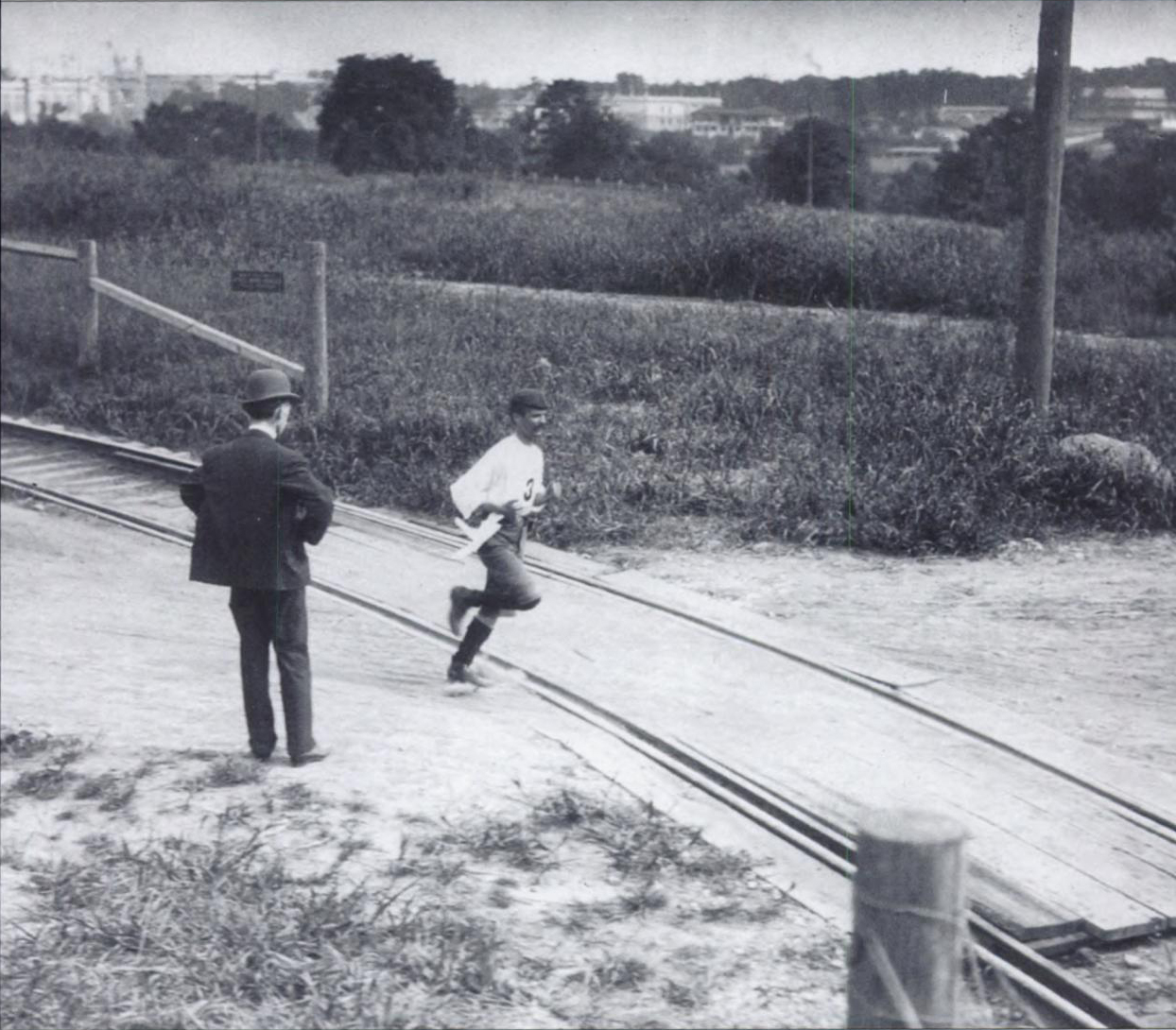
Fred Lorz’s Ride, Thomas Hicks’ Doping. “At the nine-mile mark,” Abbott wrote, “cramps also plagued Lorz, who decided to hitch a ride in one of the accompanying automobiles, waving at spectators and fellow runners as he passed.”
Abbott continued, “Hicks, one of the early American favorites, came under the care of a two-man support crew at the 10-mile mark…. Seven miles from the finish, his handlers fed him a concoction of strychnine and egg whites—the first recorded instance of drug use in the modern Olympics. Strychnine, in small doses, was commonly used a stimulant, and at the time there were no rules about performance-enhancing drugs. Hicks’ team also carried a flask of French brandy but decided to withhold it until they could gauge the runner’s condition.”
Lorz Across the Line First! Recovered from his cramps (and no doubt refreshed by his hitchhiking), Lorz took to running again and crossed the finish line first with a time just under three hours.
Abbott recounted, “The crowd roared and began chanting, ‘An American won!’ Alice Roosevelt, the 20-year-old daughter of President Theodore Roosevelt, placed a wreath upon Lorz’s head and was just about to lower the gold medal around his neck when, one witness reported, ‘someone called an indignant halt to the proceedings with the charge that Lorz was an impostor.’ The cheers turned to boos. Lorz smiled and claimed that he had never intended to accept the honor; he finished only for the sake of a ‘joke.’ ”
Meanwhile, High on the Course…. “Hicks, the strychnine coursing through his blood,” Abbott wrote, “had grown ashen and limp. When he heard that Lorz had been disqualified he perked up and forced his legs into a trot…. He began hallucinating, believing that the finish line was still 20 miles away…. His trainers carried him over the line, holding him aloft while his feet moved back and forth, and he was declared the winner.”

Marathon winner Hicks and his handlers. Image from Smithsonian Magazine.
What’s More…. Abbott concluded the saga by noting, “Hicks and Lorz would meet again at the Boston Marathon the following year, which Lorz won without the aid of anything but his legs.”
Quite the tale all around, and I would have never known of it were it not for History Facts leading me to Smithsonian Magazine and Karen Abbott’s fascinating article (which, by the way, she footnoted with 14 books and articles). ds
© Dennis Simanaitis, SimanaitisSays.com, 2024
 Simanaitis Says