
Simanaitis Says
On cars, old, new and future; science & technology; vintage airplanes, computer flight simulation of them; Sherlockiana; our English language; travel; and other stuff
OPERA TIDBITS FROM SIR DENIS (AND DENNIS) PART 2
YESTERDAY A DIFFERENT APPROACH was offered for operatic review: Combine Daughter Suz and my Met HD Live Carmen experiences with the irreverent—and occasionally non-PC—analyses of Sir Denis Forman’s A Night at the Opera.

Act III, Scene 1. Here in Part 2, we pick up with Don José showing a poor career fit with Carmen’s smuggler pals, whether they’re at the side of their overturned semi (in Carrie Cracknell’s low-life border-town mountain-pass setting) or simply “A rocky mountain pass,” where, as Forman notes, “The gang of smugs stagger on stage pretty well fagged out.”
Forman: “At least my mother still loves me says Don José. Then push off back to her says Carmen. You bitch says Don José.”
To my eye, the star of this act is Michaela, Don José’s home-girl who’s been following him around since Act I. “The general situation up here is very scary she says and also I am scared of Carmen.” Forman calls her aria “A free-moving, sometimes affecting, piece with no great melodic strength.”
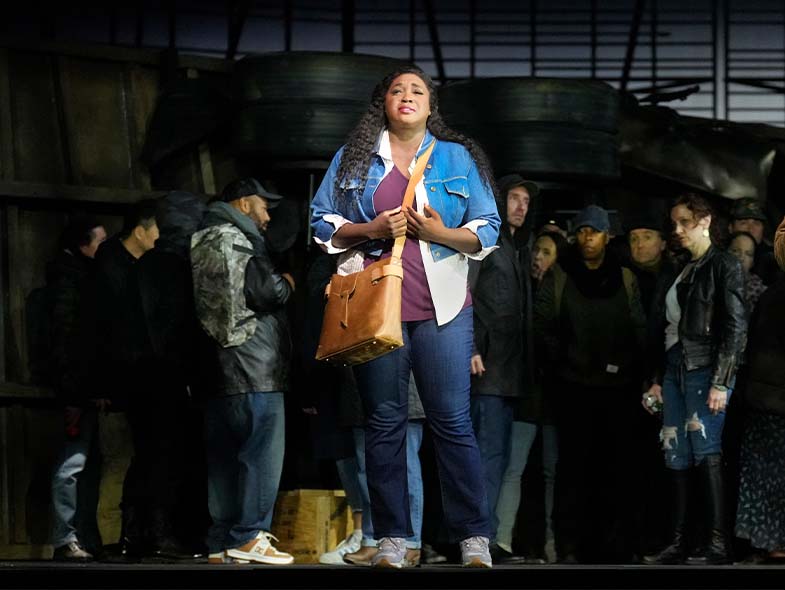
Maybe so, but Met soprano Angel Blue knocked it out of the park… er, the low-life border-town mountain pass.
Don José is guarding the camp and who shows up but Escamillo, who says, “I am seeking a relationship with Carmen I believe she was potty about some boring soldier but now she has gone off him….”
A fight ensues.

Don José, portrayed by tenor Piotr Beczała, dukes it out with rodeo star Escamillo, bass-baritone Kyle Ketelsen.
Forman continues with Don José, “… if you think you’ve seen the last of me Carmen think again…. (Escamillo—cheerful chappie—is heard offstage toreadoring his way down the mountain path.”
All this works just fine with Cracknell’s overturned semi.
Act III, Scene 2. Tradition sets this “Outside a bullring: the day of a bullfight.” No, wait, the Met’s version has a rodeo ring but no big deal.
Forman: “Fans arrive for the big fight. There is intense commercial activity. Oranges wine water cigarettes fans programmes etc. all on sale.” In traditional productions, this is where animal trainers do their stuff and everyone knows when the cymbals crash to tempo.
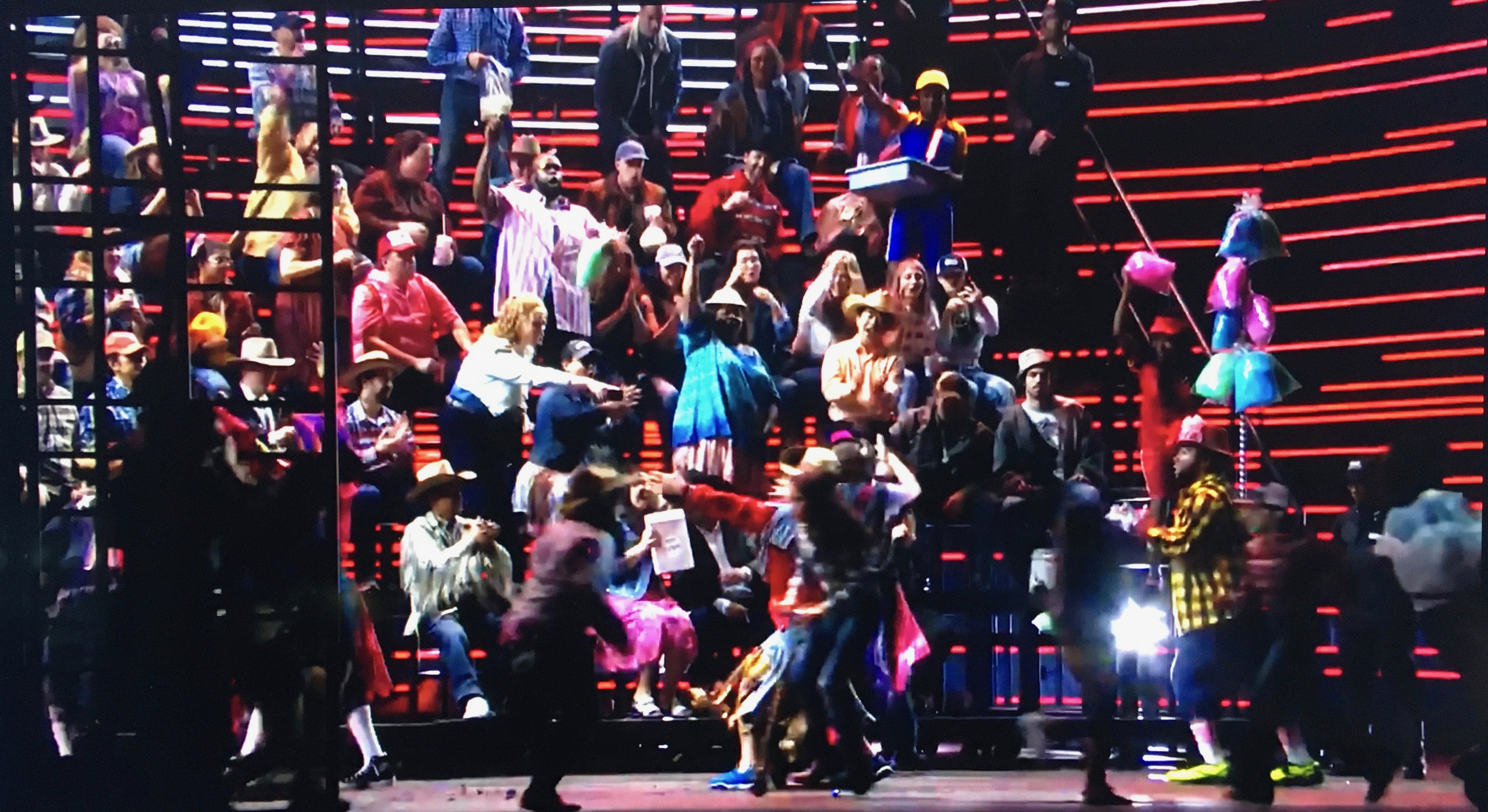
This and following images from The Met Trailer.
In the new Met production, tumblers work their way back and forth across the stage. “Carmen arrives on Escamillo’s arm, surrounded by his rodeo entourage.”
It’s lively enough, mind. But I do miss the horses.

I love Escamillo’s outfit. Below, the two meet an adoring rodeo crowd.

Forman: “Watch out Carmen! says Frasquita; Don José has been sighted in the crowd. Who’s afraid of the big bad wolf? says Carmen I will go and talk to him.”
The Met describes, “José appears and begs Carmen to forget the past and start a new life with him. She calmly tells him that their affair is over: She was born free and will live free until she dies. The crowd is heard cheering Escamillo. José persists in trying to win Carmen back.”
Forman’s version: “So it’s you says Carmen. It’s me says Don José. You don’t scare me says she. Come away with me Carmen says Don José. No. Absolutely no says Carmen our relationship is through finished ended kaput…. Here’s your lousy ring back: she chucks it at him.”
The Met setting makes use of a revolving portion of the stage. Their fight begins to the right of the rodeo crowd but moves directly before it. All are suitably horrified by the conclusion.

This is not going to end happily.
Sound Better Than Visual. Forman observes, “The final scene, with what in film terms would be cross-cutting between the inside and the outside of the bullring, is even better in sound that it would be in pictures.”
He continues, “Carmen’s impact is directly to the solar plexus, no doubt through the brain, but without requiring too much assistance from that quarter. It is clear, uncomplicated and, as Nietzsche said [Who he? Ed.], is the perfect antidote to the paranoia of Wagner…. Carmen is as near bullet-proof as any opera can be. It flourished in a recent splendid film, was transformed in an earlier film, Carmen Jones, and some would say enhanced, by Peter Brook, it even survived being set in a used-car lot by English National Opera.”
And even in a low-life border-town by The Met. ds
© Dennis Simanaitis, SimanaitisSays.com, 2024
 Simanaitis Says