
Simanaitis Says
On cars, old, new and future; science & technology; vintage airplanes, computer flight simulation of them; Sherlockiana; our English language; travel; and other stuff
OPERA TIDBITS FROM SIR DENIS (AND DENNIS) PART 1
SIR DENIS FORMAN’S A NIGHT AT THE OPERA is subtitled “An Irreverent Guide to the Plots, the Singers, the Composers, the Recordings.” Daughter Suz and I, indeed, have just seen what might well be termed an irreverent Carmen. Here, in Parts 1 and 2 today and tomorrow, are tidbits about this Bizet opera quoted from Forman’s wonderful book, together with my review of the Met’s new version.

A Night at the Opera, by Sir Denis Forman, Random House, 1994.
Briefly…. Forman says, “Carmen is unforgettable, but for opera amnesiacs it is the one with the tor-ee-a-dor song the gypsy Carmen and the simple soldier who stabs her to death.”
Well, sorta. The Metropolitan Opera, writes, “Acclaimed English director Carrie Cracknell makes her Met debut, reinvigorating the classic story with a staging that moves the action to the modern day and finds at the heart of the drama issues that could not be more relevant today: gendered violence, abusive labor structures, and the desire to break through societal boundaries.”
And Carmen’s not stabbed in this one.

Trailer from The Met via YouTube.
From Forman, Act I. Forman describes the traditional opera, with his own touch of irreverence: “We are in Seville in the early 1800s outside W.D. and H.O. Wills wholly-owned Spanish subsidiary with guardroom opposite…. Hey corporal says the new officer Zuniga is that a tobacco factory? with female labour? Sure is says Don José: the girls are a menace. They scare the bajesus out of me”
By the way, W.D. & H.O. Wills, Wikipedia notes, “was the first British company to mass-produce cigarettes, and one of the founding companies of Imperial Tobacco along with John Player & Sons.” It flourished from 1786 to 1901.
Act 1, The Met. The Carrie Cracknell production begins in a modern American border town. The factory isn’t producing cigs, it’s an arms manufacturer employing women.
From the Met’s synopsis: “The factory bell rings, and the men gather to watch the female workers—especially their favorite, Carmen. She tells the men that love is free and obeys no rules. Only one man ignores her: Don José. Carmen throws a flower at him….”

This and other images from The Met Trailer.
From Forman: “Carmen gives a habanera lecture on the nature of love. It’s volatile she says. She spots Don José and fancies him. She chucks him a carnation. Cheeky pig says he but bajesus is she sexy.”
The Met’s Carmen is mezzo-soprano Aigul Akhmetshina in skimpy top, cutoff jeans, and boots. And I agree with Don José’s assessment.

Image by Ken Howard/Met Opera.
Act II. Forman describes the action at Lilas Pastia’s, “known as the HQ for smuggling crack.” Director Carrie Cracknell (name a coincidence only) replaces Pastia’s with partying taking place in a long-haul truck carrying smuggled arms.
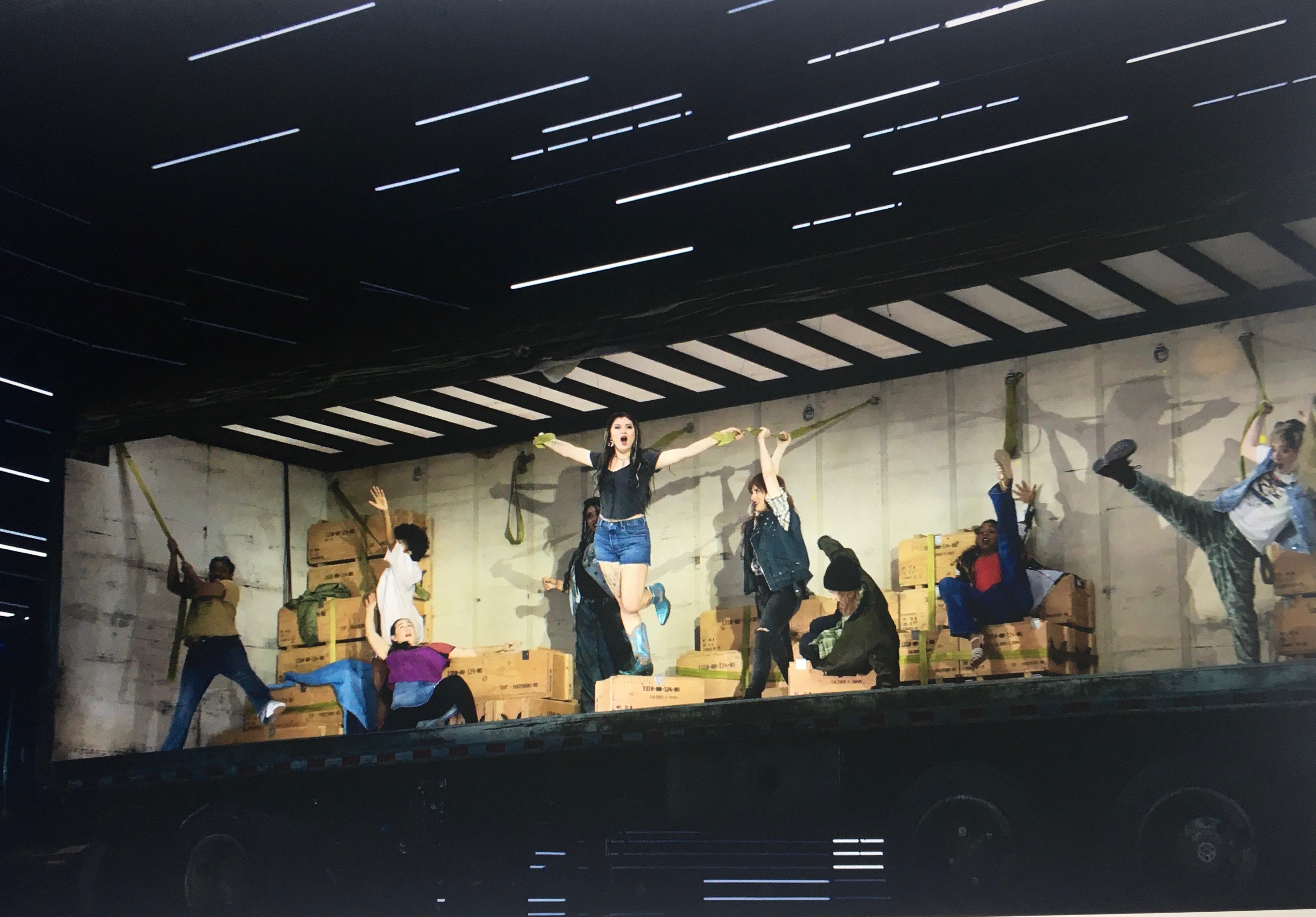
The Met’s setting worked tremendously well for me, evoking memories of Tokyo’s Yoyogi Park where well-healed rock groups would rent semi trailers with drop-down sides and built-in sound systems.
Forman: “Escamillo sings pop song No. 1 in the Sevillian charts concerning the irresistible sexual power of men who kill bulls (e.g. himself).”

The Met: Escamillo, rodeo star, drives next to the semi in a red sports car.
Forman’s Don José shows up at Pastia’s: “Where you bin asks Carmen. In jankers says Don José released forty-five minutes ago and I adore you.”
What with one thing and another (including a fight with Zuniga), Don José gets coerced into joining Carmen and the arms smugglers.
Forman: “Everyone sings in praise of gippo culture mountains freedom liberty etc. (No mention of wind rain and snow nor of persecution by the law being moved on by Rural District Councils and other gippo whinges.)”
In enjoying Forman, it helps to adopt a Brit frame of mind. In enjoying the Met’s production, I delight in its low-life girls reminding me of junior high school.

Tomorrow in Part 2, we’ll continue these Forman/Met analyses of Carmen. ds
© Dennis Simanaitis, SimanaitisSays.com, 2024
 Simanaitis Says