
Simanaitis Says
On cars, old, new and future; science & technology; vintage airplanes, computer flight simulation of them; Sherlockiana; our English language; travel; and other stuff
KUDOS ALL AROUND!!
HIGH PRAISE TO NASA AND ITS OVERACHIEVEMENT! On April 19, 2021, NASA’s helicopter Ingenuity made history in completing its first powered, controlled flight on Mars. As noted by NASA, “Designed to be a technology demonstration that would make no more than five test flights in 30 days, the helicopter eventually completed 72 flights in just under 3 years, soaring higher and faster than previously imagined.” Talk about working beyond expectations!
Hurrah, Ingenuity! Hurrah, NASA! Hurrah, Jet Propulsion Lab!
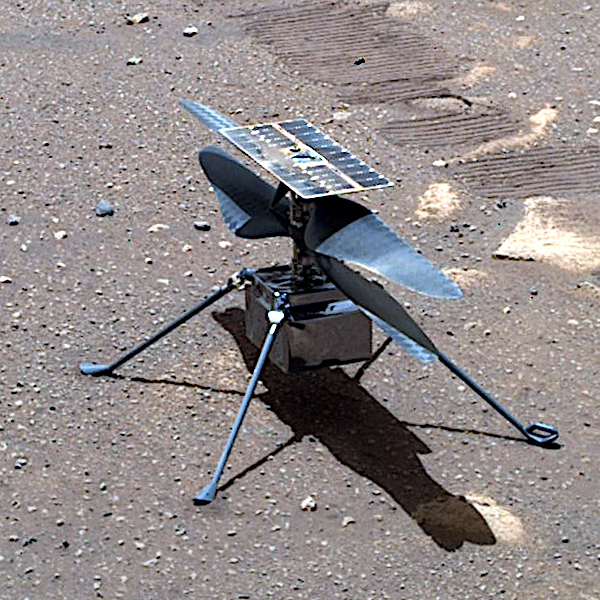
Let’s celebrate this with tidbits gleaned from its “After Three Years on Mars, NASA’s Ingenuity Helicopter Mission Ends,” from accompanying links, and from my usual Internet sleuthing. Also, see “New Copter Repelled by Mars Too!,” here at SimanaitisSays celebrating Ingenuity‘s first three flights.
The Wright Stuff. The Wright Brothers’ achievement on December 17, 1903, was significant in several ways: Their craft was heavier than air (not just a balloon), powered (not just a glider), controlled (not just a catapulted ditching), and, of course, transported a human being.
A Swatch of the Wright Flyer I. NASA honored the Wrights achievement by including a swatch from the lower left wing of the Wright Flyer I attached to the underside of the Ingenuity solar panel.
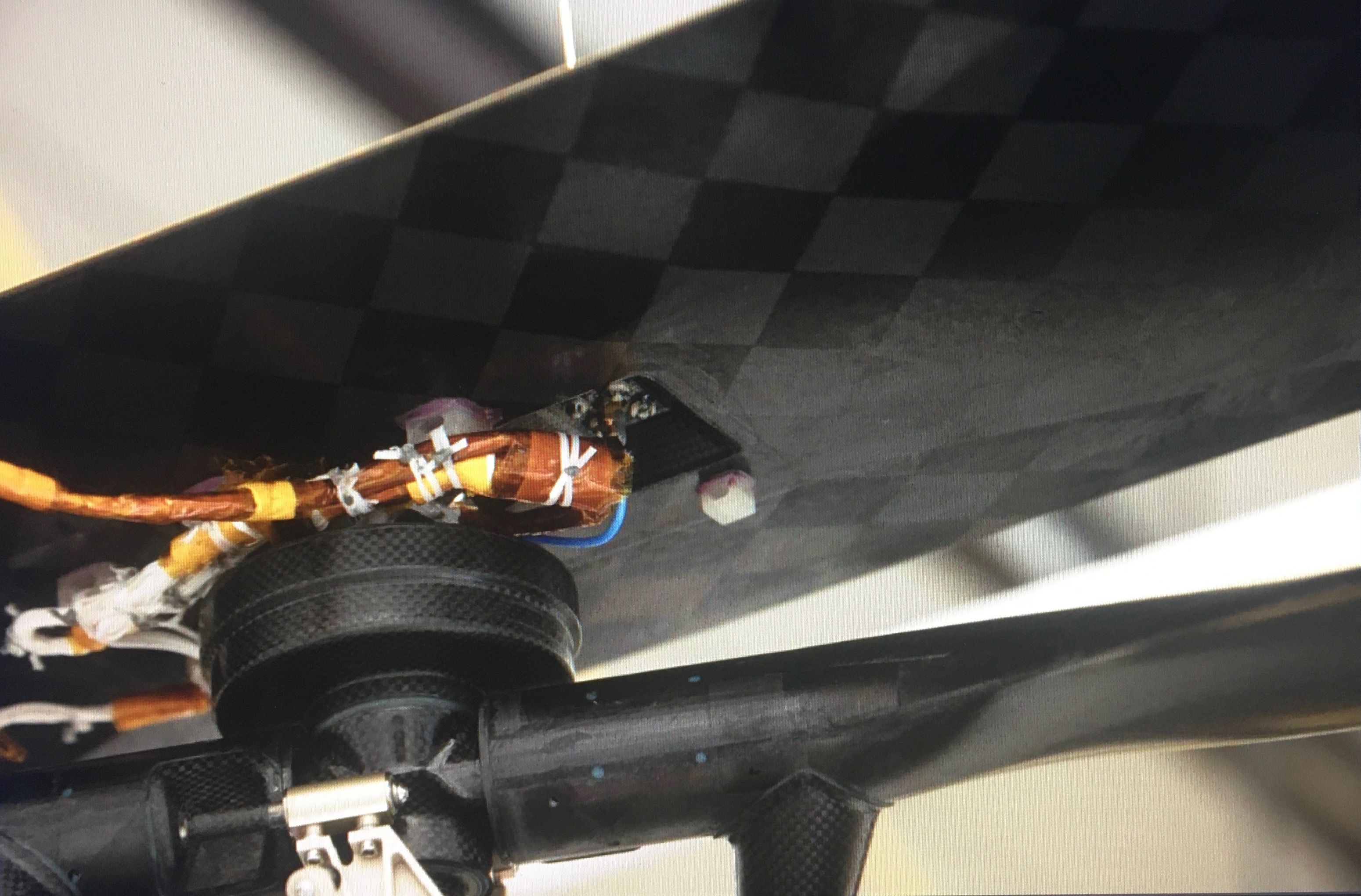
“Located on the underside of the helicopter’s solar panel (the dark rectangle),” NASA explains, “the swatch is attached with dark orange polymide tape to a cable extending from the panel, and then further secured in place with white polyester cord used to bind cables together. A gray dot of epoxy at the intersection of the three wraps of cord prevents the lacing from loosening as the rotor blades (upper pair seen at bottom) rotate at up to 2,400 rpm.”
NASA continues, “The swatch of material from the Wright brothers’ first airplane was obtained from the Carillon Historical Park, in Dayton, Ohio—home to the Wright Brothers National Museum.”
Ingenuity’s Design. As described in Wikipedia, “Ingenuity consists of a rectangular fuselage measuring 136 mm × 195 mm × 163 mm (5.4 in × 7.7 in × 6.4 in) suspended below a pair of coaxial counter-rotating rotors measuring 1.21 m (4 ft) in diameter. This assembly is supported by four landing legs of 384 mm (15.1 in) each. It also carries a solar array mounted above the rotors to recharge its batteries. The entire vehicle is 0.49 m (1 ft 7 in) tall.”
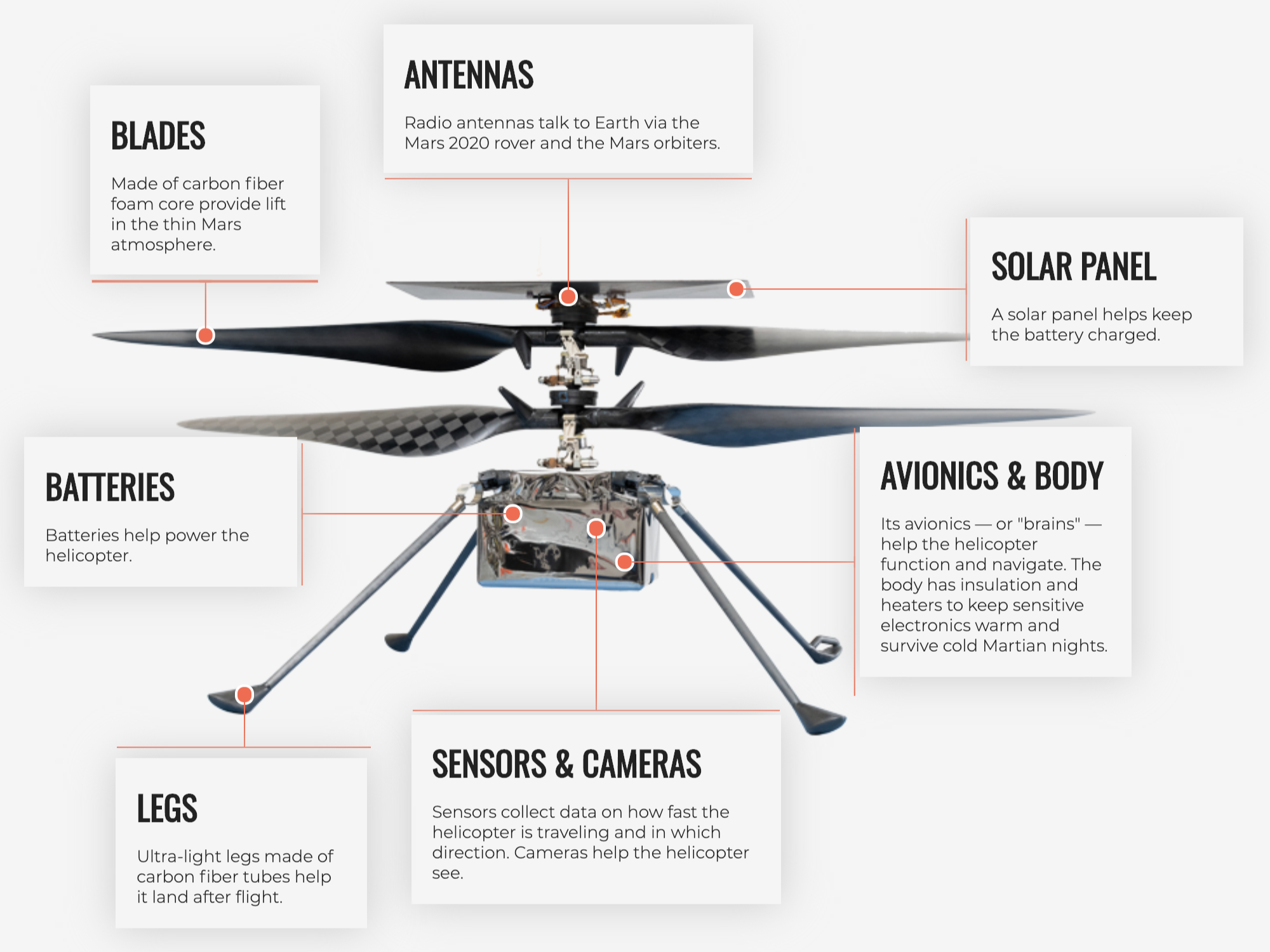
This and the following image from Wikipedia.
Helicopter Tidbits: Twin counter-rotation balances the torque of helicopter blades (otherwise balanced by a tail rotor, albeit with complications of powering these aft blades).
Also, to control pitch, roll, and yaw, the blades of any helicopter don’t simply rotate: Swashplates continually adjust each blade’s angle of attack appropriately.

Ingenuity’s upper swashplate assembly. A: rotor blade; B: pitch link; C: servo; D: swashplate.
“To keep Ingenuity aloft,” Wikipedia writes, “its specially shaped blades of enlarged size must rotate between 2400 and 2900 rpm, or about 10 times faster than what is needed on Earth. Each of the helicopter’s contra-rotating coaxial rotors is controlled by a separate swashplate that can affect both collective and cyclic pitch.”
Simulating the Martian Environment. Wikipedia recounts, “ For flight testing, a large vacuum chamber was used to simulate the very low pressure of the atmosphere of Mars – filled with carbon dioxide to approximately 0.60% (about 1⁄160) of standard atmospheric pressure at sea level on Earth—which is roughly equivalent to a helicopter flying at 34,000 m (112,000 ft) altitude in the atmosphere of Earth.”

A prototype Mars helicopter, which flew in a simulated Martian environment, May 31, 2016. Image from NASA/JPL-Caltech.
Wikipedia continues, “In order to simulate the much-reduced gravity field of Mars (38% of Earth’s), 62% of Earth’s gravity was offset by a line pulling upwards during flight tests. A ‘wind-wall’ consisting of almost 900 computer fans was used to provide wind in the chamber.”

Ingenuity is dislodged from the Perseverance rover in preparation for its Martian adventure.
Saving the Best for Last Here. NASA’s “The Legacy of Ingenuity” sums up the achievement beautifully.
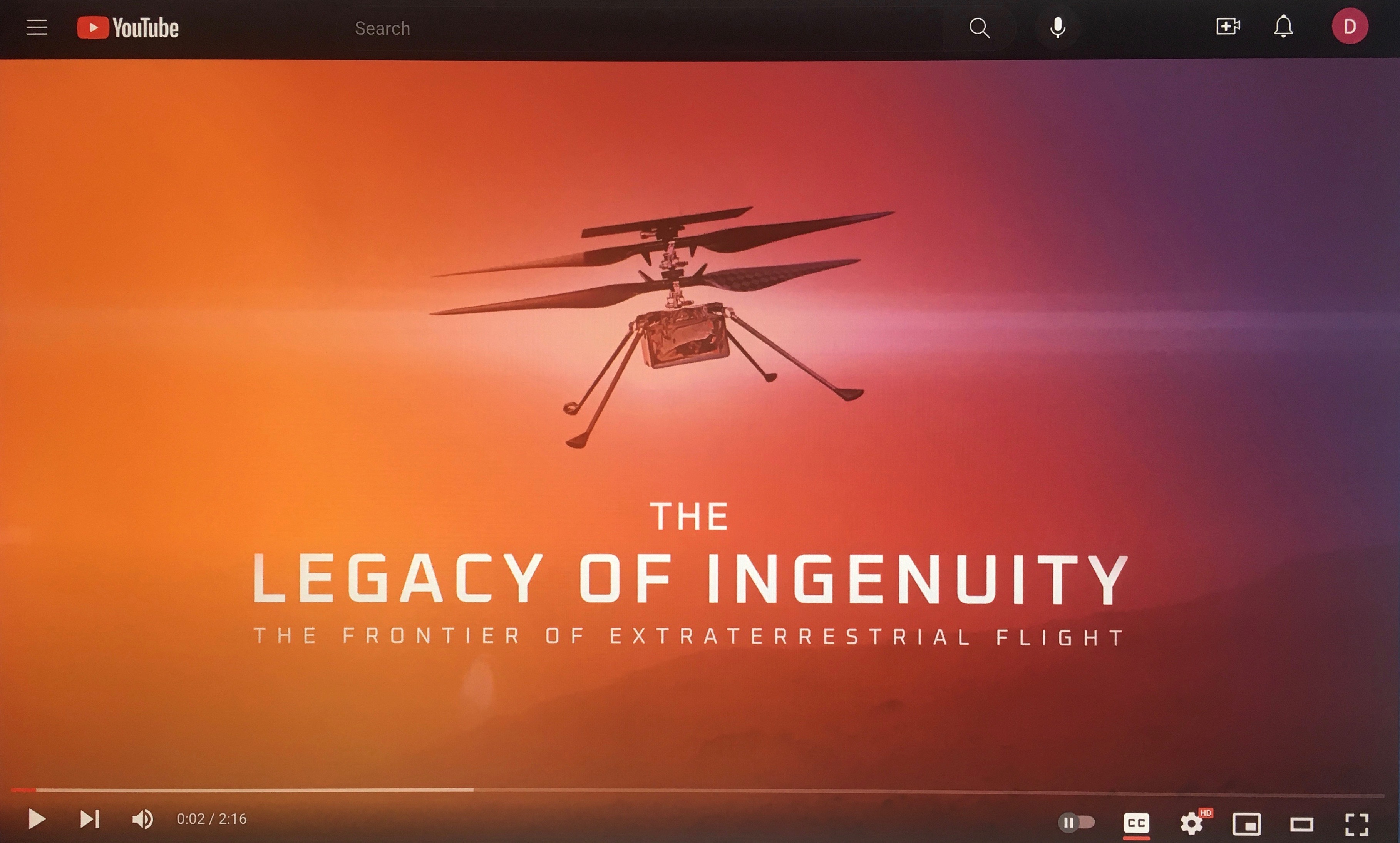
What a splendid achievement! ds
© Dennis Simanaitis, SimanaitisSays.com, 2024
 Simanaitis Says