
Simanaitis Says
On cars, old, new and future; science & technology; vintage airplanes, computer flight simulation of them; Sherlockiana; our English language; travel; and other stuff
THE FIRST BROADWAY SMASH HIT!
WAS BROADWAY’S FIRST SMASH HIT THE GERSHWINS’ LADY, BE GOOD, 1924? Or maybe Vincent Youman’s No, No, Nanette, 1925? Or Jerome Kern’s Show Boat, 1927?
No. If we’re talking “smash hit,” it’s Charles Barras’s The Black Crook, 1866. This extravaganza had songs and dances, plenty of special effects, scantily-clad dancers—and it set a record 474 performances on Broadway, got revived twice in 1870-1871 and 1871-1872, with other revivals to come.
Musical? Revue? Extravaganza? Notes the book Musicals: The Definitive Illustrated Story, The Black Crook “is regarded by some as the first modern musical.” Wikipedia expands a bit saying, “Many theatre writers have cautiously identified The Black Crook as the first popular piece that conforms to the modern notion of a musical…. The story is a Faustian melodramatic romantic comedy, but the production became famous for its spectacular special effects and skimpy costumes.”

Poster from the New York Public Library collection.
Paul Mroczka recounts the full story in his “Broadway Theatre History: The Black Crook, the Play that Was Not the First Musical,” All Tickets, June 15, 2023.
Here are tidbits gleaned from these and other sources, with some of the best lines coming from Mroczka’s analyses.
The Play’s Genesis. American actor and playwright Charles M. Barras, 1826–1873, wrote The Black Crook in 1866 as a mishmash of the Germanic Faust legend based on the real Johann Georg Faust (c. 1480–1540), who, so the legend goes, chose worldly learning over divine knowledge.
Barras’s title character is Hertzog, a crook-backed master of black magic who can live forever provided he delivers a fresh soul to the devil every New Year’s Eve.

A typical scene from The Black Crook. This and a following image from “Broadway’s First Musicial: The Black Crook.
Mroczka observes, “The script was poorly written and the acting wasn’t much better. But then something oddly magical happened.”
A Theater Fire, Unemployed Dancers, and a Fired-up Play. Mroczka continues, “There was a theatre fire at the Academy of Music in New York. A French ballet troupe was booked into the venue to present La Biche au Bois. But when the theatre burned down the 100-woman dance company had nowhere to perform.”
The Black Crook’s producer William Wheatley needed to liven the play, so he cut a deal with the Academy of Music’s Henry C. Jarrett and Henry Palmer to incorporate the dancers—scantily attired—into the play.
Originally Barras objected, but his reward was a $1500 bonus; think around $30,000 in today’s currency. What’s more, Wikipedia notes, “The spectacular success of The Black Crook earned Barras a fortune of some $250,000 (about $5,000,000 today).”
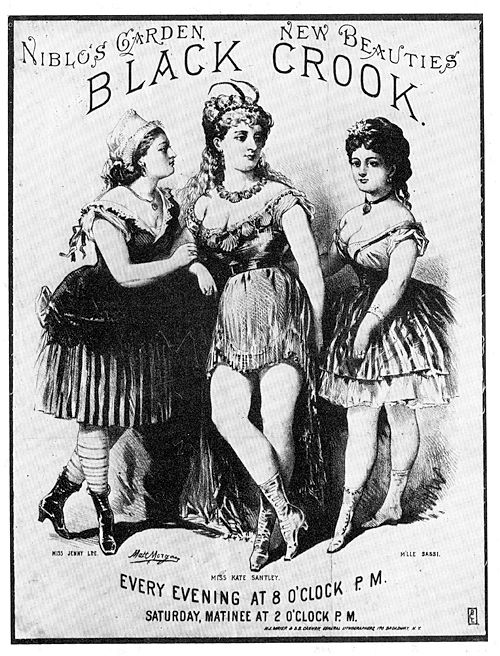
Image from pinterest.com.
Opinions in 1866. Wikipedia cites no less than Mark Twain saying, “”Beautiful bare-legged girls … nothing but a wilderness of girls—stacked up, pile on pile, away aloft to the dome of the theatre, diminishing in size and clothing….” By contrast, Charles Dickens said, “[It is] the most preposterous peg to hang ballets on that was ever seen. The people who act in it have not the slightest idea of what it is about.”
Modern Reviewers’ Analyses: Wikipedia recounts, “The production included state-of-the-art special effects, including a pantomime-style transformation scene that converted a rocky grotto into a fairyland throne room in full view of the audience…. The poster announced with great emphasis the presence of a French ‘Ballet Troupe of Seventy Ladies’ choreographed by David Costa. This scantily-clad female dancing chorus in skin-colored tights was a big draw.”
You betcha.

Paul Mroczka says, “The Black Crook featured some spectacular dance numbers and special effects. This included an aerial ballet where the dancers were flown on wires and a descent into hell unlike any other. Although the show ran for more than five hours opening night, the amazing scenography, 100 dancers and 200 shapely legs made it a smash hit.”
“What was The Black Crook?” Mroczka asks rhetorically. “I’d say it was closer to an extravaganza than a musical. The extravaganza was a literary, musical, or theatre piece with music that included spectacular scenes, various types and styles of entertainment, such as burlesque, vaudeville, pantomime, etc., and a loose structure. The different elements in an extravaganza are not unified stylistically, thematically or in terms of plot…. The Black Crook—New York’s first smash hit show. But not a musical.”
Musical or not, to Charles Barras in 1866 it was $1250-$1786 per shapely leg, depending upon whether it’s Mroczka’s or Wikipedia’s gam count. ds
© Dennis Simanaitis, SimanaitisSays.com, 2024
 Simanaitis Says